Lexar NM790 2TB Review — a DRAM-less PCIe 4.0 Value Pick (2026)
Quick answer
Buy the Lexar NM790 2TB if the goal is a 2 TB game library or a PS5 upgrade that reads like a flagship spec sheet — it is that rare DRAM-less drive whose rated specs would have topped enthusiast charts two generations ago.
Read: 7400 MB/s Write: 6500 MB/s Endurance: 1500 TBW Warranty: 5 years Interface: M.2 4.0 x 4
The Lexar NM790 2TB pushes 7,400 MB/s reads on PCIe 4.0 without DRAM, and it remains one of the sharpest value plays in its class.
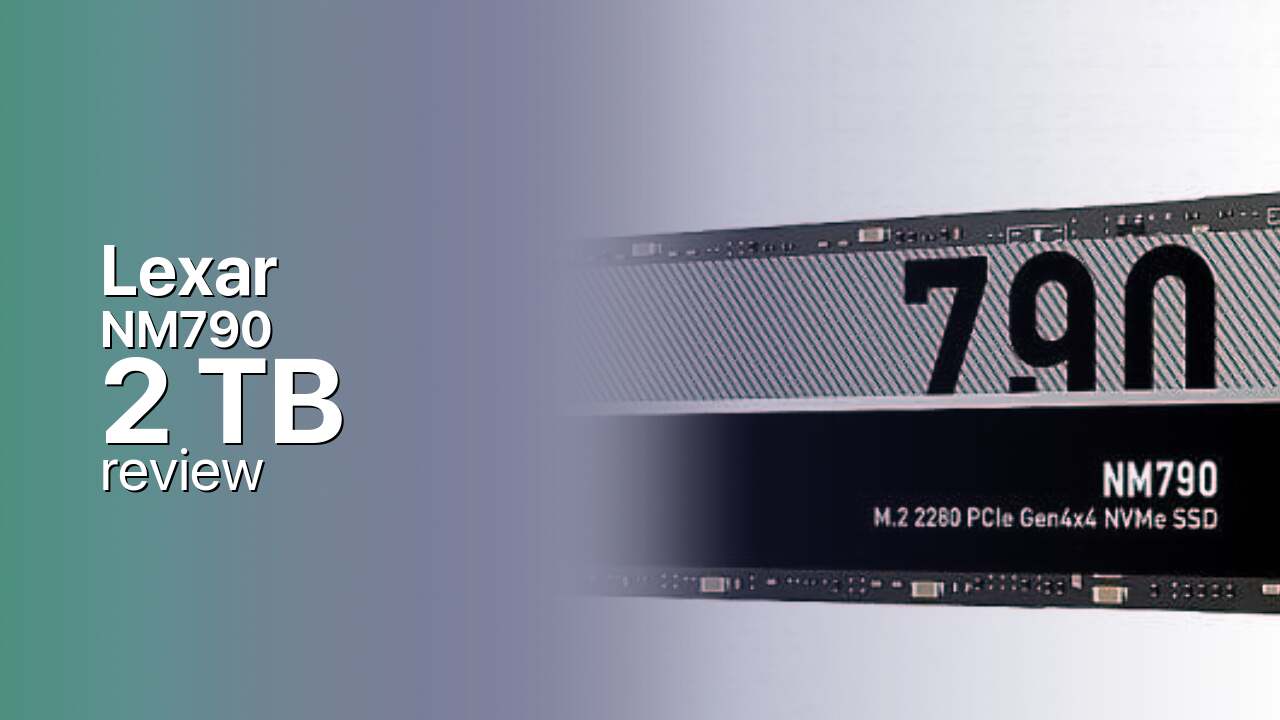
Controller & Memory
Inside its single-sided 80 mm PCB, the Lexar NM790 2TB pairs Maxio's 12nm MAP1602 controller — quad-channel, DRAM-less — with two modules of YMTC 232-layer TLC NAND and Host Memory Buffer 3.0, which borrows a slice of system RAM for the mapping tables a physical DRAM chip would normally hold. Lexar rounds the firmware out with a dynamic SLC cache, AES-256 hardware encryption, and TCG Opal 2.0 support, a combination rarely seen at this tier. The whole assembly is 2.45 mm thick and weighs 6 grams, so it slides into thin laptops and console bays without a fight.
Within the NM790 lineup, the 2TB model sits at the sweet spot of the range. It carries the full 7,400/6,500 MB/s rating and 1,500 TBW endurance, where the 8 TB sibling derates to 7,000/6,200 MB/s; the 4 TB steps up to 3,000 TBW and NVMe 2.0, while the 2 TB sticks with NVMe 1.4. Lexar sells a separate NM790 with Heatsink bundle for PS5 owners who want a pre-cooled stick, and lists the drive as compatible with laptops, desktops, and Sony's console alike. Just plan for cooling on a desktop board that ships without a motherboard heatsink, because flash running at these speeds will heat up during long transfers.
Against its natural rivals, the case is simple. The WD Black SN770 — the closest DRAM-less competitor in spirit and positioning — tops out at 5,150 MB/s reads and 1,200 TBW endurance, both of which the NM790 clearly beats on paper. The Crucial T500 fights back with a DRAM-less Phison E25 platform tuned for sustained writes, and the Samsung 990 Pro remains the performance ceiling for PCIe 4.0 when budget is no object. For a 2 TB boot-plus-library drive, though, the Lexar NM790 2TB lands a better balance of rated speed and endurance than anything else in its bracket.
Storage Comparisons:
NM790 Performance & Benchmarks
Lexar rates the 2TB NM790 at 7,400 MB/s sequential reads and 6,500 MB/s writes over PCIe 4.0 x4, with up to 1,000K random-read and 900K random-write IOPS. Those are manufacturer figures, but independent testing backs the shape of them: NikKTech's 2TB review awarded the drive a Golden Award and found it running at the front of the DRAM-less PCIe 4.0 field in peak workloads. In day-to-day use the numbers mean near-instant level loads in DirectStorage titles, PS5 games loading well past Sony's 5,500 MB/s recommendation, and multi-gigabyte file imports that finish in seconds rather than minutes.
Lexar NM790 2 TB vs M.2 4.0 x 4 peers
Switch between sequential throughput and random IOPS to see how this drive stacks up against other M.2 4.0 x 4 SSDs in our database. The highlighted bar is the drive on this page — click any other bar to open that drive.
- Patriot Viper PV593 1 TB: 14,500 MB/s read, 14,000 MB/s write
- Patriot Viper PV593 2 TB: 14,500 MB/s read, 14,000 MB/s write
- Patriot Viper PV593 4 TB: 14,500 MB/s read, 14,000 MB/s write
- Patriot Viper PV573 2 TB: 14,000 MB/s read, 12,000 MB/s write
- Lexar NM790 2 TB (this drive): 7,400 MB/s read, 6,500 MB/s write
Two caveats define the sustained picture. First, the NM790 is an SLC-cached design: writes run at rated speed until the dynamic cache fills, then throughput falls back to native TLC rates for the remainder of a very large copy — irrelevant for a boot drive or game installs, but noticeable when hundreds of gigabytes move in one sitting. Second, NikKTech's 12-hour SNIA stress test documented thermal throttling once the drive got hot, so a motherboard heatsink or the bundled-heatsink variant is worth having for heavy, sustained workloads. Outside those edge cases, reviewers consistently found the 2TB NM790 indistinguishable from pricier DRAM-equipped Gen4 drives.
Lexar NM790 vs Competitors
See how the NM790 stacks up against other M.2 4.0 x 4 drives in our database:
Compare with rival drives:
Endurance, TBW & Warranty
Lexar backs the NM790 2TB with a 5-year limited warranty rated to 1,500 TBW, whichever arrives first. Spread across a heavy home workload of 40 GB written per day, that endurance budget stretches past a century, so the TBW ceiling is effectively unreachable for personal use. The rated MTBF is 1.5 million hours — a fleet-level reliability statistic, not a promise about any individual stick. Underneath the numbers, the hardware adds sudden power-loss protection, wear leveling, bad-block management, and hardware AES-256 encryption. The same 5-year terms apply across the range, with the 1 TB model rated to 1,000 TBW and the 4 TB to 3,000 TBW. Warranty claims go through Lexar directly in most regions; checking the retailer's return window first is still the sensible order of operations.
Lexar NM790 2 TB Specifications
| Category | Value |
|---|---|
| Capacity [?] | 2 TB |
| Interface [?] | M.2 4.0 x 4 |
| Controller [?] | Maxiotech MAP1602A |
| Memory type [?] | YMTC 232-L TLC |
| DRAM [?] | No |
| Read speed (MB/s) [?] | 7400 |
| Write speed (MB/s) [?] | 6500 |
| Read IOPS [?] | 1000000 |
| Write IOPS [?] | 900000 |
| Endurance (TBW) [?] | 1500 |
| MTBF (million hours) [?] | 1500000 |
| Warranty (years) [?] | 5 |
Verdict: Is the NM790 Worth It in 2026?
Buy the Lexar NM790 2TB if the goal is a 2 TB game library or a PS5 upgrade that reads like a flagship spec sheet — it is that rare DRAM-less drive whose rated specs would have topped enthusiast charts two generations ago. Skip it for sustained, multi-hundred-gigabyte write workloads such as video-editing scratch disks; a DRAM-equipped alternative like the Crucial T500 or WD Black SN850X holds composure better once the SLC cache empties. The WD Black SN770 is the nearest match on character, but it concedes rated speed (5,150 MB/s) and endurance headroom (1,200 TBW) to this Lexar. As a straight PCIe 4.0 value pick in 2026, the NM790 2TB earns one of the first slots on our shortlist.
+ Pros
- 7,400 MB/s reads and 6,500 MB/s writes
- 1,500 TBW endurance with a 5-year warranty
- Single-sided PCB fits PS5 and thin laptops
- HMB 3.0 keeps power draw below DRAM drives
- AES-256 encryption with TCG Opal 2.0
- Rated up to 1,000K random-read IOPS
- Cons
- No DRAM cache on the PCB
- Throttles under sustained SNIA stress testing
- No heatsink included on the base model
- SLC cache exhaustion slows very large transfers
Buy this or similar SSD Storage:



Video Review
NEW BEST BUDGET SSD? | Lexar NM790 SSD review