MSI Spatium M370 1TB Review: A Mid-2021 Gen3 Value Play (2026)
Quick answer
Buy the MSI Spatium M370 1TB when the price sits clearly below faster-rated Gen3 rivals and a five-year warranty matters more than headline speed — it is a safe, TLC-based system drive for older Gen3 desktops and laptops.
Read: 2400 MB/s Write: 1750 MB/s Endurance: 800 TBW Warranty: 5 years Interface: M.2 3.0 x 4
Launched in mid-2021, the MSI Spatium M370 1TB remains a plain-spoken Gen3 drive — 2,400 MB/s reads, 800 TBW endurance and a five-year warranty.
Controller & Memory
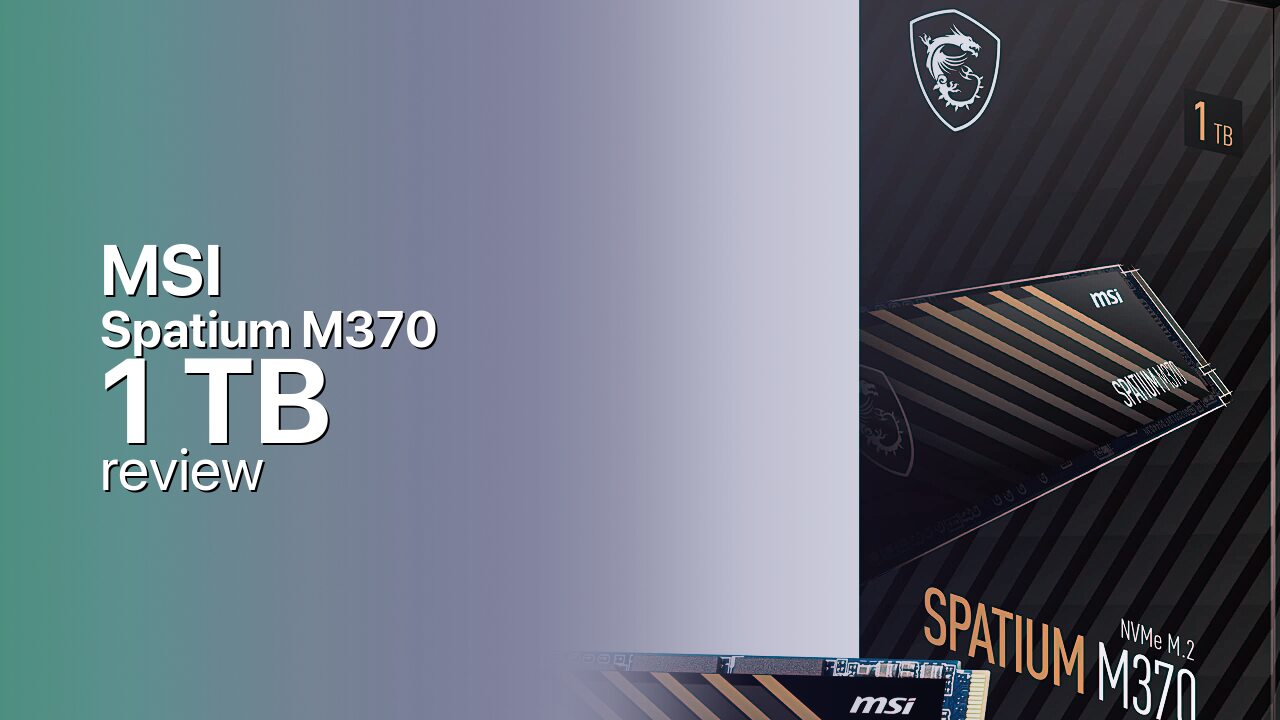
The MSI Spatium M370 1TB arrived in July 2021 as MSI's value play in the Gen3 market, and its platform tells the story: Phison's E13T controller — identified in TechPowerUp's teardown as the PS5015-E15-35 — running DRAM-less with a 64MB Host Memory Buffer, behind Kioxia BiCS4 96-layer TLC NAND on PCIe 3.0 x4 and NVMe 1.3. MSI rates this capacity at 2,400 MB/s sequential reads and 1,750 MB/s writes; TechPowerUp's database lists the write rating at 1,850 MB/s, an earlier datasheet revision, so treat the difference as paperwork rather than silicon. At 2.15 mm thick, it fits any laptop slot or desktop board.
The family ladder runs 128GB through 2TB with endurance at 75, 200, 400, 800 and 1,600 TBW, all under a five-year limited warranty. The 1TB row is the mainstream pick: enough room for Windows, a real game collection and a working project folder, with the endurance budget to match. The honest context is that 2021 set a high bar for DRAM-less Gen3 — the Samsung 980 rated 3,500/3,000 MB/s, the WD Blue SN570 3,500/2,300 — and the M370 rates below all of them on paper.
What it offers instead is a known-quantity package: TLC rather than the QLC in Crucial's P3, a five-year warranty rather than the three years many budget brands give, and strong random-write ratings of 330K IOPS. Console duty is off the table — PCIe 3.0 fails Sony's PS5 criteria outright. For an older Gen3 desktop or a laptop upgrade where price leads and speed ratings follow, it occupies a defensible slot; for anything newer, Gen4 value drives have overtaken it.
Storage Comparisons:
Spatium M370 Performance & Benchmarks
MSI rates the 1TB Spatium M370 at 2,400 MB/s sequential reads and 1,750 MB/s writes on PCIe 3.0 x4, with 215K random-read and 330K random-write IOPS. TechPowerUp's testing of this exact capacity sized the dynamic pseudo-SLC cache at roughly 23 GB — modest even for the class — after which writes settle near 500 MB/s. That post-cache floor is the platform's defining weakness: a 100 GB game install or a large video export crosses the cache boundary quickly, and the second half of the transfer runs at a fraction of the rated speed.
MSI Spatium M370 1 TB vs M.2 3.0 x 4 peers
Switch between sequential throughput and random IOPS to see how this drive stacks up against other M.2 3.0 x 4 SSDs in our database. The highlighted bar is the drive on this page — click any other bar to open that drive.
- ADATA SX 8800 Pro 512 GB: 3,500 MB/s read, 2,700 MB/s write
- ADATA SX 8800 Pro 1 TB: 3,500 MB/s read, 2,700 MB/s write
- ADATA XPG Spectrix S40G RGB 256 GB: 3,500 MB/s read, 3,000 MB/s write
- ADATA XPG Spectrix S40G RGB 512 GB: 3,500 MB/s read, 3,000 MB/s write
- MSI Spatium M370 1 TB (this drive): 2,400 MB/s read, 1,750 MB/s write
Below the cache, behavior is more forgiving. Queue-depth-1 random reads and latency — what boot times and app launches actually feel — stay competitive for a DRAM-less design thanks to Host Memory Buffer, and the 330K random-write rating keeps mixed desktop workloads responsive. Game loading differs from Gen4 drives by a second or two at most, since titles lean on small reads rather than sequential bursts. The M370 makes sense as a daily-use system drive where bursts stay small; where large sustained writes are routine, its 2021-era cache design shows its age against the WD Blue SN570 or Samsung 980.
MSI Spatium M370 vs Competitors
See how the Spatium M370 stacks up against other M.2 3.0 x 4 drives in our database:
Compare with rival drives:
Endurance, TBW & Warranty
MSI covers the Spatium M370 1TB for five years or 800 TBW, whichever arrives first — a 0.4 drive-writes-per-day class that TechPowerUp notes is comparatively generous for a value drive. In daily terms, a steady 20 GB of writes per day would take more than a century to exhaust the budget, so the warranty term is the practical limit for virtually any desktop workload. The ladder puts this capacity at four times the 256GB model's endurance and half the 2TB's. MTBF is rated up to 1.5 million hours, a fleet statistic rather than a per-unit prediction. LDPC error correction, end-to-end data path protection and TCG Pyrite encryption run underneath, and claims go through MSI's standard support channels with proof of purchase.
MSI Spatium M370 1 TB Specifications
| Category | Value |
|---|---|
| Capacity [?] | 1 TB |
| Interface [?] | M.2 3.0 x 4 |
| Controller [?] | Phison E13T 4 Channel |
| Memory type [?] | Kioxia 96-L3D TLC |
| DRAM [?] | No |
| Read speed (MB/s) [?] | 2400 |
| Write speed (MB/s) [?] | 1750 |
| Read IOPS [?] | 215000 |
| Write IOPS [?] | 330000 |
| Endurance (TBW) [?] | 800 |
| MTBF (million hours) [?] | 1500000 |
| Warranty (years) [?] | 5 |
Verdict: Is the Spatium M370 Worth It in 2026?
Buy the MSI Spatium M370 1TB when the price sits clearly below faster-rated Gen3 rivals and a five-year warranty matters more than headline speed — it is a safe, TLC-based system drive for older Gen3 desktops and laptops. Skip it on any Gen4 or Gen5 board, where value drives like the WD Blue SN570 or Samsung 980 out-rate it at similar money, and rule it out for PS5 storage entirely. The Crucial P3 undercuts it with QLC and weaker sustained writes; the SN570 is the stronger all-rounder. Judged as a 2021 design still sold into the budget tier, the M370 1TB is coherent but never quick. At this capacity it is also the most practical pick in the family.
+ Pros
- Rated 2,400 MB/s reads on PCIe 3.0 x4
- 800 TBW endurance with 5-year warranty
- Kioxia BiCS4 96-layer TLC, not QLC
- 330K random-write IOPS rating
- TCG Pyrite encryption support
- 2.15 mm height fits thin laptops
- Cons
- Trails 2021 Gen3 rivals' 3,000 MB/s write ratings
- 23 GB cache empties fast, writes fall to ~500 MB/s
- DRAM-less, Host Memory Buffer only
- No PS5 compatibility on PCIe 3.0
- Rated slower than the Crucial P3's 3,500 MB/s reads
Buy this or similar SSD Storage:



Video Review
Просто NVMe SSD MSI Spatium M370 1TB S78-440L570-P83