MSI Spatium M370 2TB Review: Gen3 Bulk Storage, Long Warranty (2026)
Quick answer
Buy the MSI Spatium M370 2TB as TLC bulk storage with an unusually long warranty for the tier — game libraries, media archives and backup staging on a Gen3-era board are exactly its job, and 1,600 TBW of endurance backs the duty.
Read: 2400 MB/s Write: 1850 MB/s Endurance: 1600 TBW Warranty: 5 years Interface: M.2 3.0 x 4
The MSI Spatium M370 2TB stretches a modest Gen3 platform across 2TB with 1,600 TBW of endurance and the family's fastest write rating at 1,850 MB/s.
Controller & Memory
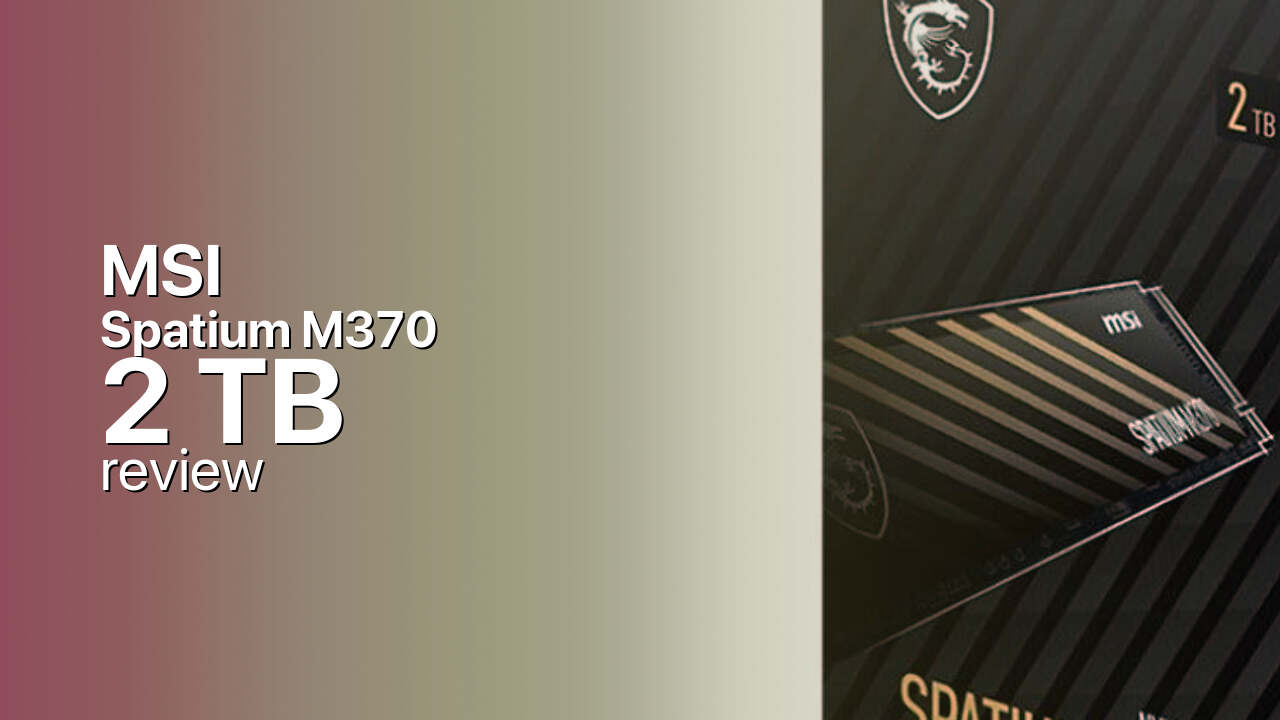
The MSI Spatium M370 2TB is the top rung of MSI's entry NVMe line, and it carries the family's best numbers by a small margin: 2,400 MB/s sequential reads, 1,850 MB/s writes, 220K random-read and 330K random-write IOPS. The platform is unchanged from its siblings — Phison's E13T controller running DRAM-less with a 64MB Host Memory Buffer, Kioxia BiCS4 96-layer TLC NAND, PCIe 3.0 x4 and NVMe 1.3 — so the gains come from NAND parallelism, not a faster controller. At 2.15 mm thick in a standard 2280 frame, it fits any laptop slot or desktop board, including Gen4 and Gen5 systems running it at Gen3 speeds.
The capacity ladder below runs 128GB, 256GB, 512GB and 1TB with endurance at 75, 200, 400 and 800 TBW; the 2TB doubles the 1TB's budget to 1,600 TBW under the same five-year limited warranty. That endurance figure is the quiet argument for this drive: TLC flash with a 0.4 drive-writes-per-day class, rather than the QLC that most 2TB Gen3 value drives in this bracket use.
The realistic competition for 2TB bulk storage is the Crucial P3 2TB, which is cheaper per gigabyte but QLC-based with a steep post-cache penalty, and the Gen4 WD Blue SN580 2TB, which rates far higher for not much more. The M370 2TB makes sense when price sits well under those and the job is archival — game libraries, media hoards, backup staging on an older Gen3 board. Console duty remains out of reach: PCIe 3.0 fails Sony's PS5 requirements regardless of capacity.
Storage Comparisons:
Spatium M370 Performance & Benchmarks
MSI rates the 2TB Spatium M370 at 2,400 MB/s sequential reads and 1,850 MB/s writes — the family's fastest write rating — with 220K random-read and 330K random-write IOPS. TechPowerUp's entry for this exact capacity confirms both figures. The platform's sustained-write character carries over from TechPowerUp's 1TB testing, which measured a dynamic pseudo-SLC cache of roughly 23 GB before writes settled near 500 MB/s; the 2TB model's cache is larger and unpublished, but the same pattern applies — quick bursts, then a several-hundred-MB/s floor on long transfers.
MSI Spatium M370 2 TB vs M.2 3.0 x 4 peers
Switch between sequential throughput and random IOPS to see how this drive stacks up against other M.2 3.0 x 4 SSDs in our database. The highlighted bar is the drive on this page — click any other bar to open that drive.
- ADATA SX 8800 Pro 512 GB: 3,500 MB/s read, 2,700 MB/s write
- ADATA SX 8800 Pro 1 TB: 3,500 MB/s read, 2,700 MB/s write
- ADATA XPG Spectrix S40G RGB 256 GB: 3,500 MB/s read, 3,000 MB/s write
- ADATA XPG Spectrix S40G RGB 512 GB: 3,500 MB/s read, 3,000 MB/s write
- MSI Spatium M370 2 TB (this drive): 2,400 MB/s read, 1,850 MB/s write
For bulk-storage duty, that trade is acceptable but worth understanding. Filling the drive with a game library happens mostly across the cache in hundreds of smaller writes, and 1,850 MB/s moves a 100 GB title in about a minute while it lasts. Sustained multi-hundred-gigabyte transfers — full backups, video archives — drop to the post-cache floor for their second half. Reads are unaffected: 2,400 MB/s loads games within a second of Gen4 drives, and 220K random-read IOPS keeps a packed library browsing smoothly. As a secondary drive on a Gen3 system, the numbers line up with the job; as a scratch disk, look elsewhere.
MSI Spatium M370 vs Competitors
See how the Spatium M370 stacks up against other M.2 3.0 x 4 drives in our database:
Compare with rival drives:
Endurance, TBW & Warranty
MSI covers the Spatium M370 2TB for five years or 1,600 TBW, whichever arrives first — the largest endurance budget in the family and a 0.44 drive-writes-per-day class across the term. In everyday terms, a steady 20 GB of daily writes would take more than two centuries to exhaust the budget, so the warranty term is the practical limit even for a drive filling and rewriting large media collections. The ladder gives the 1TB half this budget at 800 TBW and the 256GB an eighth at 200 TBW. MTBF is rated up to 1.5 million hours, a fleet statistic rather than a single-drive promise. LDPC error correction, end-to-end data path protection and TCG Pyrite encryption run underneath, and claims go through MSI's standard support channels with proof of purchase.
MSI Spatium M370 2 TB Specifications
| Category | Value |
|---|---|
| Capacity [?] | 2 TB |
| Interface [?] | M.2 3.0 x 4 |
| Controller [?] | Phison E13T 4 Channel |
| Memory type [?] | Kioxia 96-L3D TLC |
| DRAM [?] | No |
| Read speed (MB/s) [?] | 2400 |
| Write speed (MB/s) [?] | 1850 |
| Read IOPS [?] | 220000 |
| Write IOPS [?] | 330000 |
| Endurance (TBW) [?] | 1600 |
| MTBF (million hours) [?] | 1500000 |
| Warranty (years) [?] | 5 |
Verdict: Is the Spatium M370 Worth It in 2026?
Buy the MSI Spatium M370 2TB as TLC bulk storage with an unusually long warranty for the tier — game libraries, media archives and backup staging on a Gen3-era board are exactly its job, and 1,600 TBW of endurance backs the duty. Skip it when speed per dollar matters: the Gen4 WD Blue SN580 2TB outrates it substantially for similar money on modern boards, and no amount of capacity fixes its PS5 incompatibility on PCIe 3.0. The Crucial P3 2TB is the cheaper QLC alternative, with weaker post-cache writes as the trade. Within the M370 line, this is the capacity where the platform's endurance and write ratings peak. Endurance per terabyte is the strongest argument it makes.
+ Pros
- 1,600 TBW endurance with 5-year warranty
- Rated 2,400/1,850 MB/s on PCIe 3.0
- Fastest write rating in the M370 family
- Kioxia BiCS4 TLC, not QLC
- 220K random-read IOPS rating
- 2.15 mm height for thin slots
- Cons
- Trails Gen4 value drives' 5,000 MB/s reads
- No PS5 compatibility on PCIe 3.0
- DRAM-less, Host Memory Buffer only
- Post-cache writes settle near 500 MB/s
- Rated slower than the Crucial P3's 3,500 MB/s reads
Buy this or similar SSD Storage:



Video Review
Просто NVMe SSD MSI Spatium M370 1TB S78-440L570-P83