MyDigitalSSD BPX 960GB Review — Phison E12 Power, 1,665 TBW (2026)
Quick answer
Buy the MyDigitalSSD BPX 960GB if you are feeding a Gen3-era system that needs a large, fast TLC drive and one crosses your path at clearance pricing — its 1,665 TBW endurance and full DRAM cache age better than most of its contemporaries.
Read: 3400 MB/s Write: 3100 MB/s Endurance: 1665 TBW Warranty: 5 years Interface: M.2 3.0 x 4
The MyDigitalSSD BPX 960GB is the Phison E12 era of the BPX line — 3,400/3,100 MB/s ratings, Toshiba TLC and a 1,665 TBW endurance budget.
Controller & Memory
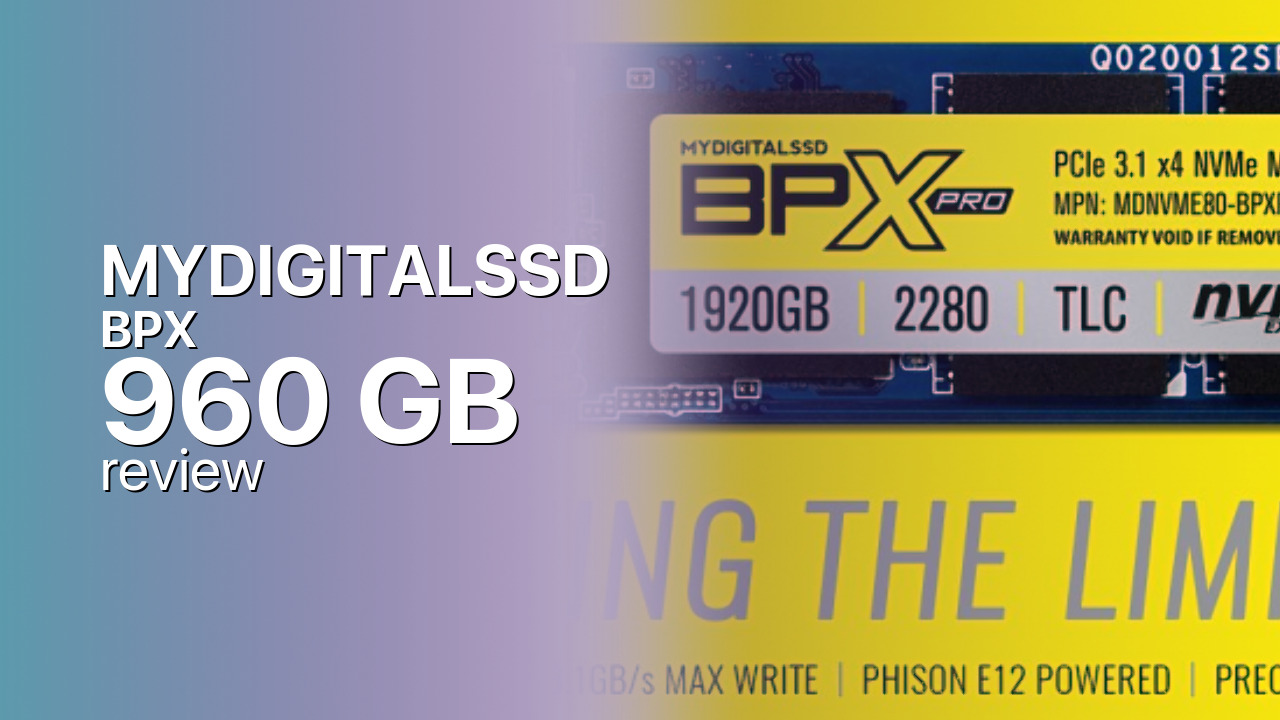
The MyDigitalSSD BPX 960GB represents the second act of the BPX name. The original BPX was an early Phison E7 design running MLC NAND at 2,600 MB/s-class reads; the BPX Pro generation — which is what this 960 GB model belongs to — moved to the eight-channel Phison PS5012-E12 controller with Toshiba BiCS3 64-layer 3D TLC NAND and a DDR4 DRAM cache, lifting ratings to 3,400 MB/s reads and 3,100 MB/s writes over PCIe 3.1 x4 with NVMe 1.3. TweakTown's review of this exact capacity posed the obvious question — as good as the original? — and the spec answer is that the Pro trades MLC's pedigree for TLC speed and far deeper endurance.
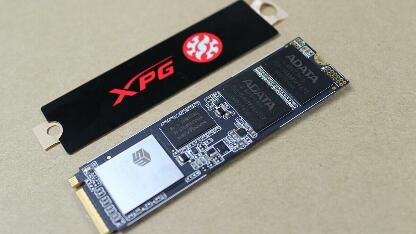
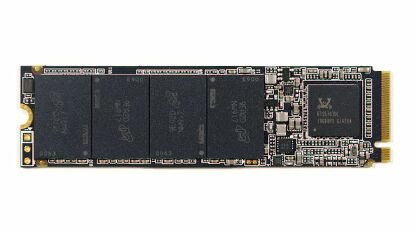
The 960 GB sits near the top of a four-step range: 240 GB (rated 3,400/1,100 MB/s, 380 TBW), 480 GB (2,100 MB/s writes, 800 TBW), this 960 GB (3,100 MB/s writes, 1,665 TBW) and a 2 TB at 3,115 TBW. At 960 GB the board goes double-sided, packing a full terabyte-class complement of NAND plus NANYA DDR4 DRAM chips, and the platform carries AES-256 encryption with TCG Opal and Pyrite support — rare completeness for a value-oriented brand.
Tom's Hardware tested this capacity and liked the platform's direction, noting the E12 runs much cooler than the E7 it replaced, while dinging a small SLC write cache. The buyer in 2019 was a prosumer who wanted Samsung-adjacent numbers without the price; in legacy terms the drive now serves Gen3-era systems that need fast, large TLC storage. Its contemporaries — the Samsung 970 EVO Plus, WD Black SN750 and ADATA XPG SX8200 — remain the names to weigh it against.
Storage Comparisons:
BPX Performance & Benchmarks
MyDigitalSSD rates the 960 GB BPX Pro at 3,400 MB/s sequential reads and 3,100 MB/s writes — the full E12 platform figure, unlocked by the double-sided layout and paired DRAM. The company published no per-capacity random IOPS rating, so the finer performance character comes from the reviews: Tom's Hardware, which tested the 960 GB among three capacities, described application performance below the chart-toppers while concluding the platform earned its recommendation on value, and its listed con — a small SLC cache — defines the drive's one sustained-write caveat.
MYDIGITALSSD BPX 960 GB vs M.2 3.0 x 4 peers
Switch between sequential throughput and random IOPS to see how this drive stacks up against other M.2 3.0 x 4 SSDs in our database. The highlighted bar is the drive on this page — click any other bar to open that drive.
- ADATA SX 8800 Pro 512 GB: 3,500 MB/s read, 2,700 MB/s write
- ADATA SX 8800 Pro 1 TB: 3,500 MB/s read, 2,700 MB/s write
- ADATA XPG Spectrix S40G RGB 256 GB: 3,500 MB/s read, 3,000 MB/s write
- ADATA XPG Spectrix S40G RGB 512 GB: 3,500 MB/s read, 3,000 MB/s write
- MYDIGITALSSD BPX 960 GB (this drive): 3,400 MB/s read, 3,100 MB/s write
That cache behavior matters for specific workloads. Burst writes — game installs, file moves, project saves — land at full speed, and the DRAM-backed mapping keeps random access consistent under load, a genuine advantage over the DRAM-less drives that would later dominate the budget tier. Push hundreds of gigabytes continuously and the modest SLC cache fills, after which throughput settles to native TLC rates for as long as the cache takes to recover. For boot duty, gaming and mixed professional work the 3,400/3,100 ratings deliver Gen3's practical ceiling — around triple a SATA drive — and the E12's thermal throttling safeguards keep the double-sided board within bounds even without a heatsink. Against the Samsung 970 EVO Plus the difference showed in sustained application scores, not in the spec-sheet peaks.
MYDIGITALSSD BPX vs Competitors
See how the BPX stacks up against other M.2 3.0 x 4 drives in our database:
Compare with rival drives:
Endurance, TBW & Warranty
MyDigitalSSD backed the BPX Pro series with a 5-year limited warranty, and the 960 GB carries a 1,665 TBW endurance rating — the deepest write budget of any 960 GB-class consumer drive of its generation. Tom's Hardware's endurance comparison made the gap plain: rivals like the ADATA XPG SX8200 960 GB were rated 640 TBW and the Samsung 970 EVO 600 TBW, well under half this drive's allowance. One point six six five petabytes works out to roughly 900 GB of writes per day across the warranty term, so at a typical 20-50 GB daily workload the NAND budget outlives any realistic ownership by decades. The rating is covered by the standard 5-year terms, with claims handled through MyDigitalSSD's support channels and the usual proof of purchase.
MYDIGITALSSD BPX 960 GB Specifications
| Category | Value |
|---|---|
| Capacity [?] | 960 GB |
| Interface [?] | M.2 3.0 x 4 |
| Controller [?] | Phison PS5012-E12 8 Channel |
| Memory type [?] | Toshiba 3D TLC |
| DRAM [?] | Yes |
| Read speed (MB/s) [?] | 3400 |
| Write speed (MB/s) [?] | 3100 |
| Read IOPS [?] | n/a |
| Write IOPS [?] | n/a |
| Endurance (TBW) [?] | 1665 |
| MTBF (million hours) [?] | 1500000 |
| Warranty (years) [?] | 5 |
Verdict: Is the BPX Worth It in 2026?
Buy the MyDigitalSSD BPX 960GB if you are feeding a Gen3-era system that needs a large, fast TLC drive and one crosses your path at clearance pricing — its 1,665 TBW endurance and full DRAM cache age better than most of its contemporaries. Skip it for a fresh build, where PCIe 4.0 drives now occupy the same bracket with faster links, and skip it for a PS5, which requires Gen4 speeds the BPX Pro cannot deliver. The Samsung 970 EVO Plus and WD Black SN750 remain the stronger all-around Gen3 picks if sustained application performance leads your list. As the value endurance play of the E12 generation, this 960 GB earned its recommendation back then — and its reputation holds.
+ Pros
- 3,400 MB/s reads and 3,100 MB/s writes
- 1,665 TBW endurance with 5-year warranty
- Full DDR4 DRAM cache on board
- AES-256 encryption with TCG Opal and Pyrite
- E12 platform runs cooler than the original E7 BPX
- Cons
- Small SLC cache per Tom's Hardware
- Double-sided PCB complicates thin-laptop fits
- No PS5 compatibility (Gen3 platform)
- No per-capacity IOPS rating published
- Legacy Gen3 platform, long out of production
Buy this or similar SSD Storage:



Video Review
NVMe vs Sata iii - How much faster is it? - MyDigitalSSD BPX Review