Patriot Viper VP4100 500GB Review — Early Gen4, Long Warranty (2026)
Quick answer
Buy the Patriot Viper VP4100 500GB when the goal is a cheap, honest Gen4 boot drive whose warranty outlives the rest of the build: 850 TBW, five years of coverage, and real E16 silicon at entry-level money is a package newer budget drives rarely match.
Read: 5000 MB/s Write: 4400 MB/s Endurance: 850 TBW Warranty: 5 years Interface: M.2 4.0 x 4
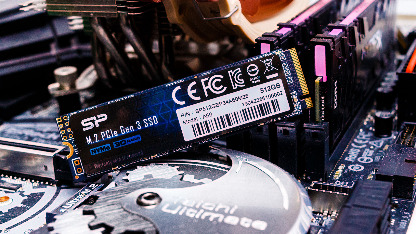
The Patriot Viper VP4100 500GB brings Phison's early-Gen4 E16 platform and an unusually generous 850 TBW endurance rating to the starter-drive tier.
Controller & Memory
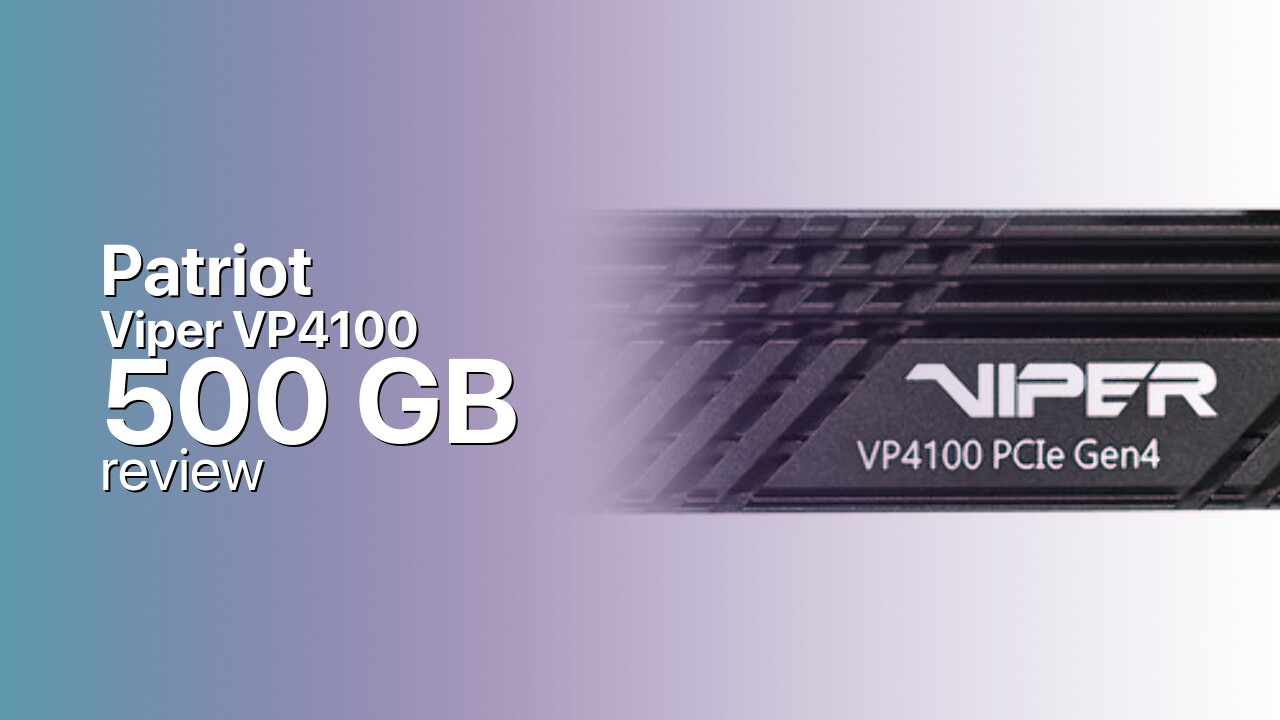
The Patriot Viper VP4100 500GB is a piece of PCIe 4.0 history that still makes sense: Patriot's first Gen4 Viper drive, built on Phison's PS5016-E16 controller — the same silicon that powered the first wave of Gen4 flagships — paired with 3D TLC NAND. Rated at 5,000 MB/s reads and 4,400 MB/s writes over PCIe 4.0 x4, it was a speed demon at launch and remains comfortably ahead of anything SATA-based today. The 500 GB capacity is the range's entry point, with the usual entry-tier caveat that peak speeds dip slightly below the 1 TB and 2 TB models.
What the VP4100 500GB offers instead of cutting-edge silicon is an endurance deal that still turns heads: 850 TBW under a 5-year warranty — TechPowerUp called that rating a good value for the class, and it exceeds what many newer budget drives promise at this capacity. The DRAM-less E16 design leans on Host Memory Buffer, keeping the bill of materials lean, and the Viper branding brings Patriot's gaming-market support behind it. Within the range, the 1 TB model doubles endurance to 1,800 TBW and lifts peak speeds; within the bracket, the Kingston NV3 and WD Blue SN580 are the natural comparisons, both newer designs with their own trade-offs.
The audience is the budget builder who wants genuine Gen4 speed and a warranty that outlasts the GPU upgrade cycle: a boot drive for a first gaming PC, an office uplift, or a small game library. It is not a PS5 pick at 500 GB, and sustained write-heavy workloads belong on DRAM-equipped drives — but as a cheap, warrantied entry into NVMe Gen4, it holds its lane.
Storage Comparisons:
Viper VP4100 Performance & Benchmarks
The VP4100 line is rated at 5,000 MB/s sequential reads and 4,400 MB/s writes over PCIe 4.0 x4, and the 500 GB model sits just under those headline figures — entry E16 capacities give up a little peak bandwidth to their larger siblings. In the real world that still means boot times and application launches far ahead of any SATA drive, game loads with no perceptible penalty against newer Gen4 drives, and DirectStorage titles benefiting from the full PCIe 4.0 link.
Patriot Viper VP4100 500 GB vs M.2 4.0 x 4 peers
Switch between sequential throughput and random IOPS to see how this drive stacks up against other M.2 4.0 x 4 SSDs in our database. The highlighted bar is the drive on this page — click any other bar to open that drive.
- Patriot Viper PV593 1 TB: 14,500 MB/s read, 14,000 MB/s write
- Patriot Viper PV593 2 TB: 14,500 MB/s read, 14,000 MB/s write
- Patriot Viper PV593 4 TB: 14,500 MB/s read, 14,000 MB/s write
- Patriot Viper PV573 2 TB: 14,000 MB/s read, 12,000 MB/s write
- Patriot Viper VP4100 500 GB (this drive): 5,000 MB/s read, 4,400 MB/s write
The DRAM-less E16 design defines the edges. A pseudo-SLC cache absorbs burst writes, and once a transfer large enough to exhaust it arrives, throughput settles to native TLC rates for the remainder — visible in sustained multi-hundred-gigabyte copies, irrelevant for boot-and-games duty. Random performance is ordinary for the class rather than exceptional, which is the E16's known character. Thermals are modest given the generation's power envelope, and the bare 2280 stick fits laptop slots and motherboard heatsinks alike. Reviewers of the line, including Legit Reviews, consistently praised the endurance rating and warranty more than raw benchmark leads — and for a starter drive, that is exactly the right priority.
Patriot Viper VP4100 vs Competitors
See how the Viper VP4100 stacks up against other M.2 4.0 x 4 drives in our database:
Compare with rival drives:
Endurance, TBW & Warranty
Patriot rates the VP4100 500GB at 850 TBW under a 5-year limited warranty, whichever arrives first — an unusually strong endurance figure for a 500 GB drive, one TechPowerUp highlighted as a good value when the line launched. At a light 20 GB of writes per day, that budget stretches to more than a century, so the warranty term is the practical limit for a boot drive's workload. The rating also dwarfs what most newer budget drives promise at half the capacity. The 1 TB model scales to 1,800 TBW on the same 5-year terms. Patriot handles claims through its standard support channels; keeping the retailer's proof of purchase keeps the process simple.
Patriot Viper VP4100 500 GB Specifications
| Category | Value |
|---|---|
| Capacity [?] | 500 GB |
| Interface [?] | M.2 4.0 x 4 |
| Controller [?] | Phison PS5016-E16 |
| Memory type [?] | Micron 176-L TLC |
| DRAM [?] | No |
| Read speed (MB/s) [?] | 5000 |
| Write speed (MB/s) [?] | 4400 |
| Read IOPS [?] | |
| Write IOPS [?] | |
| Endurance (TBW) [?] | 850 |
| MTBF (million hours) [?] | 2000000 |
| Warranty (years) [?] | 5 |
Verdict: Is the Viper VP4100 Worth It in 2026?
Buy the Patriot Viper VP4100 500GB when the goal is a cheap, honest Gen4 boot drive whose warranty outlives the rest of the build: 850 TBW, five years of coverage, and real E16 silicon at entry-level money is a package newer budget drives rarely match. Skip it for game libraries (500 GB fills in a handful of installs), PS5 duty (capacity, not speed, disqualifies it), and sustained write workloads, where the DRAM-less E16 shows its age. The Kingston NV3 offers a newer platform at similar money with less endurance, the WD Blue SN580 trades blows as an OEM-leaning alternative, and Patriot's own 1 TB model doubles everything that matters. As a starter drive with an endurance guarantee, it is a smart, if aging, pick.
+ Pros
- 850 TBW endurance — generous for 500 GB
- 5-year limited warranty
- Phison E16 Gen4 platform
- Rated up to 5,000 MB/s reads
- Gaming-brand support from Patriot
- Cons
- No DRAM cache on the PCB
- 500 GB fills after a few modern installs
- Entry-capacity speeds trail the 1 TB/2 TB models
- Aging E16 platform trails newer budget drives
Buy this or similar SSD Storage:
Video Review
SSD Patriot Viper VP4100 500GB PCIe 4x4 VP4100-500GM28H