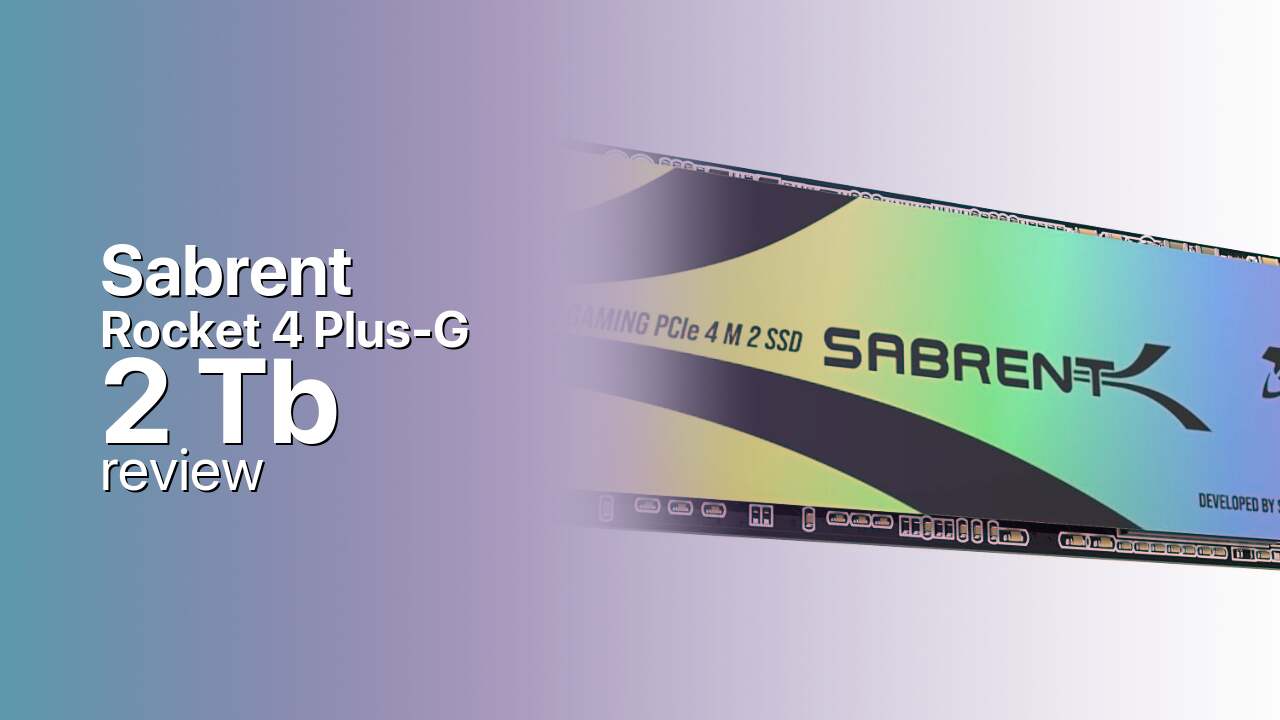
Sabrent Rocket 4 Plus-G 2TB — PCIe 4.0 NVMe SSD Review (2026)
Quick answer
The Rocket 4 Plus-G 2 TB is a Phison E18 drive with an endurance rating that belongs in a different conversation.
Read: 7400 MB/s Write: 7000 MB/s Endurance: 5100 TBW Warranty: 5 years Interface: M.2 4.0 x 4
The Sabrent Rocket 4 Plus-G 2 TB is a high-endurance Phison E18 PCIe 4.0 drive that pairs the proven Gen4 controller platform with an unusually generous TBW rating, positioning it for buyers who write more than the typical consumer.
Controller & Memory
The Rocket 4 Plus-G is built on the Phison PS5018-E18, the eight-channel PCIe 4.0 x4 controller that powers most high-end Gen4 consumer SSDs. Sabrent pairs it with Micron 96-layer 3D TLC NAND and DDR4 DRAM — a configuration shared with the standard Rocket 4 Plus and most competing E18 drives. The G designation appears to denote a specific SKU variant, possibly with graphene-enhanced thermals or a different warranty tier, though Sabrent's product documentation is sparse on the differentiation from the standard Rocket 4 Plus.
The 2 TB capacity populates all eight E18 channels and delivers the full 7,400 MB/s read and 7,000 MB/s write performance that defines the platform's ceiling, with 1,000,000 IOPS on both random read and write. The standout spec is the endurance rating: 5,100 TBW for the 2 TB model, which translates to 2,550 TBW per terabyte — nearly double the 700–800 TBW/TB typical of most E18 consumer drives and approaching enterprise U.2 territory. If accurate, this places the Rocket 4 Plus-G in a distinct niche as a consumer drive with workstation-grade write endurance, suitable for content creators who write hundreds of gigabytes per day and want a single-drive solution without stepping up to an enterprise SSD form factor.
In the PCIe 4.0 market, the Rocket 4 Plus-G competes against every other Phison E18 drive — the Corsair MP600 Pro, Kingston KC3000, and Sabrent's own standard Rocket 4 Plus — from which it is differentiated solely by the endurance uplift. Performance is identical across the E18 family, so the buying decision for the Plus-G hinges entirely on whether the higher TBW rating justifies any price premium over the standard Rocket 4 Plus. For the vast majority of consumers who write 20–30 GB/day, the standard 1,400 TBW on the regular Rocket 4 Plus is already a multi-century endurance budget, making the Plus-G's 5,100 TBW a spec-sheet differentiator rather than a practical necessity.
Storage Comparisons:
Rocket 4 Plus-G Performance & Benchmarks
Sabrent rates the 2 TB Rocket 4 Plus-G at 7,400 MB/s sequential reads and 7,000 MB/s sequential writes with 1,000,000 IOPS random read and write — numbers that place it at the PCIe 4.0 x4 interface ceiling and are shared across all high-end E18 implementations. The Phison E18's performance is well-characterised by now: peak throughput arrives within 1–2% of rated figures in independent benchmarks, and the large pseudo-SLC cache on a 2 TB drive absorbs roughly 200–300 GB of burst writes before transitioning to native TLC speeds around 1,200–1,400 MB/s.
Sabrent Rocket 4 Plus-G 2 TB vs M.2 4.0 x 4 peers
Switch between sequential throughput and random IOPS to see how this drive stacks up against other M.2 4.0 x 4 SSDs in our database. The highlighted bar is the drive on this page — click any other bar to open that drive.
- Patriot Viper PV593 1 TB: 14,500 MB/s read, 14,000 MB/s write
- Patriot Viper PV593 2 TB: 14,500 MB/s read, 14,000 MB/s write
- Patriot Viper PV593 4 TB: 14,500 MB/s read, 14,000 MB/s write
- Patriot Viper PV573 2 TB: 14,000 MB/s read, 12,000 MB/s write
- Sabrent Rocket 4 Plus-G 2 TB (this drive): 7,400 MB/s read, 7,000 MB/s write
For gaming and general desktop use, the Rocket 4 Plus-G is indistinguishable from any other E18 drive — and, for that matter, from any PCIe 4.0 flagship. The real-world scenarios that differentiate the Plus-G are sustained write-heavy workloads: 8K video ingest, large database rebuilds, multi-terabyte file transfers, and any workflow where the drive spends significant time writing at full speed. In these scenarios, the Plus-G's endurance headroom means the drive can sustain high write throughput for years longer than a standard E18 drive before approaching its TBW ceiling. For video editors and data analysts who wear out consumer SSDs within their warranty period, the Plus-G's endurance premium may translate to real cost savings over time.
Sabrent Rocket 4 Plus-G vs Competitors
See how the Rocket 4 Plus-G stacks up against other M.2 4.0 x 4 drives in our database:
Compare with rival drives:
Endurance, TBW & Warranty
Sabrent covers the Rocket 4 Plus-G 2 TB with a five-year warranty (registration required for full coverage), bounded by an extraordinary 5,100 TBW endurance rating. At 100 GB/day — a heavy content-creation workload — this endurance budget lasts roughly 140 years. For context, the standard Rocket 4 Plus 2 TB carries 1,400 TBW, meaning the Plus-G offers roughly 3.6 times the write endurance on the same controller and NAND platform. The TBW figure is high enough that buyers should verify it against Sabrent's official product page at time of purchase, as endurance ratings at this level are unusual for consumer SSDs and may reflect a specific production batch or warranty program. Sabrent's RMA process is handled through their support portal with shipping labels provided in supported regions.
Sabrent Rocket 4 Plus-G 2 TB Specifications
| Category | Value |
|---|---|
| Capacity [?] | 2 TB |
| Interface [?] | M.2 4.0 x 4 |
| Controller [?] | Phison PS5018-E18 |
| Memory type [?] | Micron TLC |
| DRAM [?] | DDR4 |
| Read speed (MB/s) [?] | 7400 |
| Write speed (MB/s) [?] | 7000 |
| Read IOPS [?] | 1000000 |
| Write IOPS [?] | 1000000 |
| Endurance (TBW) [?] | 5100 |
| MTBF (million hours) [?] | 2000000 |
| Warranty (years) [?] | 5 |
Verdict: Is the Rocket 4 Plus-G Worth It in 2026?
The Rocket 4 Plus-G 2 TB is a Phison E18 drive with an endurance rating that belongs in a different conversation. Its storage performance is identical to every other E18 flagship, but the 5,100 TBW figure — if accurate — puts it in a class of one among consumer PCIe 4.0 drives. For content creators, data scientists, and anyone whose SSD writes are measured in hundreds of gigabytes per day, the Plus-G's endurance premium is a genuine differentiator that may justify its price. For everyone else — gamers, office users, general-purpose desktop builders — the standard Rocket 4 Plus or any competing E18 drive will deliver identical daily performance with an endurance budget that is already functionally unlimited at consumer write rates.
+ Pros
- 7,400 MB/s reads — saturating the PCIe 4.0 x4 interface
- 5,100 TBW endurance — roughly 3.6x the standard E18 2 TB rating
- Phison E18 with Micron TLC — mature, proven, high-performance platform
- DDR4 DRAM cache — full FTL in dedicated memory, no HMB compromises
- 5-year warranty with product registration from Sabrent
- Cons
- Performance identical to cheaper E18 alternatives — premium is purely endurance
- Sabrent RMA infrastructure is smaller than Samsung or WD equivalents
- Drive runs warm under sustained load — heatsink recommended for desktop use
- Double-sided PCB on 2 TB — may not fit all thin laptops
Buy this or similar SSD Storage:



Video Review
Sabrent Rocket 4 Plus 2TB Review - An Ultra QUICK PCIe 4.0 SSD!