Seagate FireCuda X1070 1TB Review — Entry-Level Gen4, Flagship Support (2026)
Quick answer
Buy the Seagate FireCuda X1070 1TB when the mechanical fit decides: a handheld or thin-laptop build that needs a single-sided, cool-running 2280 module, plus a warranty and recovery plan no other entry-level drive matches.
Read: 7200 MB/s Write: 6000 MB/s Endurance: 600 TBW Warranty: 5 years Interface: M.2 4.0 x 4
The Seagate FireCuda X1070 1TB pairs entry-level Gen4 hardware — 7,200 MB/s reads on Micron 232-layer QLC — with a 5-year warranty and Rescue data recovery usually reserved for premium drives.
Controller & Memory
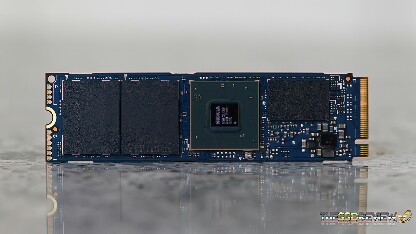
The Seagate FireCuda X1070 1TB, released in March 2026, is built to a deliberately cost-focused recipe: Seagate positions the line for handhelds, laptops and value-conscious desktops, and the hardware matches the brief. A TenaFE TC2201 controller — a new, little-known 12 nm design — runs DRAM-less with a 64 MB Host Memory Buffer, while Micron N58R FortisFlash 232-layer QLC provides the storage. Everything sits on a single-sided M.2 2280 PCB connected over PCIe 4.0 x4 with NVMe 1.4, rated at 7,200 MB/s sequential reads and 6,000 MB/s writes. Tom's Hardware summed up the product as entry-level hardware meets premium support, because the warranty package is far above what this component tier usually receives.
The family runs from 1 TB to 4 TB, and the 1 TB is the only variant that gives up performance: its 6,000 MB/s write rating and 850K/900K random IOPS sit below the 6,500 MB/s and 900K/1,000K figures of the 2 TB and 4 TB models, while endurance scales from 600 TBW here to 1,200 TBW and 2,400 TBW. Single-sided construction holds at every capacity, so the drive suits thin laptop slots and handheld consoles that accept an M.2 2280 module — devices using shorter 2230 or 2242 modules are out of luck. No heatsink is included, so desktop builders should plan on a separate one, and TechPowerUp lists the drive as PS5-compatible on the bare hardware.
Competition comes from the WD Blue SN580, which swaps QLC for TLC in the same DRAM-less bracket, and the Crucial P3 Plus, the closest QLC rival, with Kingston's NV3 undercutting both on the specification sheet. Seagate's own FireCuda 530R covers buyers who want DRAM and TLC at 7,400 MB/s. The SSD Review was openly skeptical about the unproven controller choice, and TweakTown's 4 TB review conceded that the family trails premium Gen4 entries in gaming performance — the X1070's case rests on its support package rather than its hardware.
Storage Comparisons:
X1070 Performance & Benchmarks
Seagate rates the 1 TB X1070 at 7,200 MB/s sequential reads, 6,000 MB/s sequential writes, and 850K/900K random read/write IOPS — all manufacturer figures, and the write and IOPS numbers are the lower ratings reserved for this smallest capacity. In practice the read rating matters most: operating systems, game installs and level loading run with no perceptible penalty against 7,400 MB/s-class drives, because real workloads rarely approach the interface ceiling. The rated IOPS are best-case numbers, but they signal a controller comfortable with everyday multitasking rather than one tuned for a single burst metric.
Seagate X1070 1 TB vs M.2 4.0 x 4 peers
Switch between sequential throughput and random IOPS to see how this drive stacks up against other M.2 4.0 x 4 SSDs in our database. The highlighted bar is the drive on this page — click any other bar to open that drive.
- Patriot Viper PV593 1 TB: 14,500 MB/s read, 14,000 MB/s write
- Patriot Viper PV593 2 TB: 14,500 MB/s read, 14,000 MB/s write
- Patriot Viper PV593 4 TB: 14,500 MB/s read, 14,000 MB/s write
- Patriot Viper PV573 2 TB: 14,000 MB/s read, 12,000 MB/s write
- Seagate X1070 1 TB (this drive): 7,200 MB/s read, 6,000 MB/s write
Sustained behavior is where the QLC and DRAM-less design show. A pseudo-SLC cache absorbs everyday bursts, and TechPowerUp's testing puts writes after the cache at roughly 1,300 MB/s on this capacity — a figure that only registers on very large transfers, since a boot-and-games workload rarely writes enough in one sitting to exhaust the cache. Tom's Hardware found the drive runs cool enough that a heatsink is optional in ventilated slots, and TweakTown's 4 TB review reached a similar thermal conclusion while noting the drive trails premium Gen4 entries in gaming tests. The Host Memory Buffer design keeps random performance steady for operating system duty, which is the workload this drive will actually see.
Seagate X1070 vs Competitors
See how the X1070 stacks up against other M.2 4.0 x 4 drives in our database:
Compare with rival drives:
Endurance, TBW & Warranty
Endurance is rated at 600 TBW on the 1 TB model — 0.3 drive writes per day across the term — with scaling to 1,200 TBW at 2 TB and 2,400 TBW at 4 TB. At a modest 20 GB of writes per day, that 600 TBW budget stretches beyond 80 years, so the warranty clock is the practical limit, not the flash. The 5-year limited warranty is the headline, but the attached 3-year Rescue Data Recovery Services plan is the differentiator: Seagate will attempt in-lab recovery of data lost to drive failure, a service tier this component class almost never includes. The rated 1.8 million hours MTBF is a population statistic across many drives rather than a promise for any single unit, but it sits at the level Seagate publishes for its mainstream lines. Claims run through Seagate's standard support channels with proof of purchase.
Seagate X1070 1 TB Specifications
| Category | Value |
|---|---|
| Capacity [?] | 1 TB |
| Interface [?] | M.2 4.0 x 4 |
| Controller [?] | TenaFE TC2201 |
| Memory type [?] | Micron 232-layer QLC |
| DRAM [?] | No |
| Read speed (MB/s) [?] | 7200 |
| Write speed (MB/s) [?] | 6000 |
| Read IOPS [?] | 850000 |
| Write IOPS [?] | 900000 |
| Endurance (TBW) [?] | 600 |
| MTBF (million hours) [?] | 1800000 |
| Warranty (years) [?] | 5 |
Verdict: Is the X1070 Worth It in 2026?
Buy the Seagate FireCuda X1070 1TB when the mechanical fit decides: a handheld or thin-laptop build that needs a single-sided, cool-running 2280 module, plus a warranty and recovery plan no other entry-level drive matches. Skip it when sustained write throughput or steady-state performance matters — video work and large-transfer duties belong on TLC — or when maximum Gen4 speed is the goal. The WD Blue SN580 offers TLC flash in the same DRAM-less bracket, and Seagate's own FireCuda 530R supplies DRAM-backed 7,400 MB/s performance a step up the range. As an entry-level QLC drive wrapped in flagship support, the X1070 1TB is coherent once its price reflects its hardware. TechPowerUp's PS5-compatible listing gives the 1 TB model a console fallback role its spec sheet alone would not suggest.
+ Pros
- 7,200 MB/s rated sequential reads
- Single-sided M.2 2280 at every capacity
- 5-year warranty with 3-year Rescue recovery
- 600 TBW endurance rating
- Cool-running, low-power build suits handhelds
- Cons
- DRAM-less design relies on Host Memory Buffer
- QLC writes settle near 1,300 MB/s after the cache
- 1TB variant rated 6,000 MB/s writes, below 2TB/4TB
- No heatsink included
- Unproven TenaFE TC2201 controller
Buy this or similar SSD Storage:
Video Review
Seagate Firecuda Gaming SSD - Disassembly/Extracting NVMe Drive