Team Group MP44Q 4TB Review — QLC Density, Gen4 Speed (2026)
Quick answer
The Team Group MP44Q 4TB is for the archive builder: a game vault, media library or PS5 expansion that wants 7,000 MB/s reads and 2,048 TBW of endurance at QLC pricing, with five years of coverage.
Read: 7000 MB/s Write: 5900 MB/s Endurance: 2048 TBW Warranty: 5 years Interface: M.2 4.0 x 4
The Team Group MP44Q 4TB sells QLC density the honest way — 7,000 MB/s Gen4 reads, 2,048 TBW of endurance and serious headroom for game libraries.
Controller & Memory
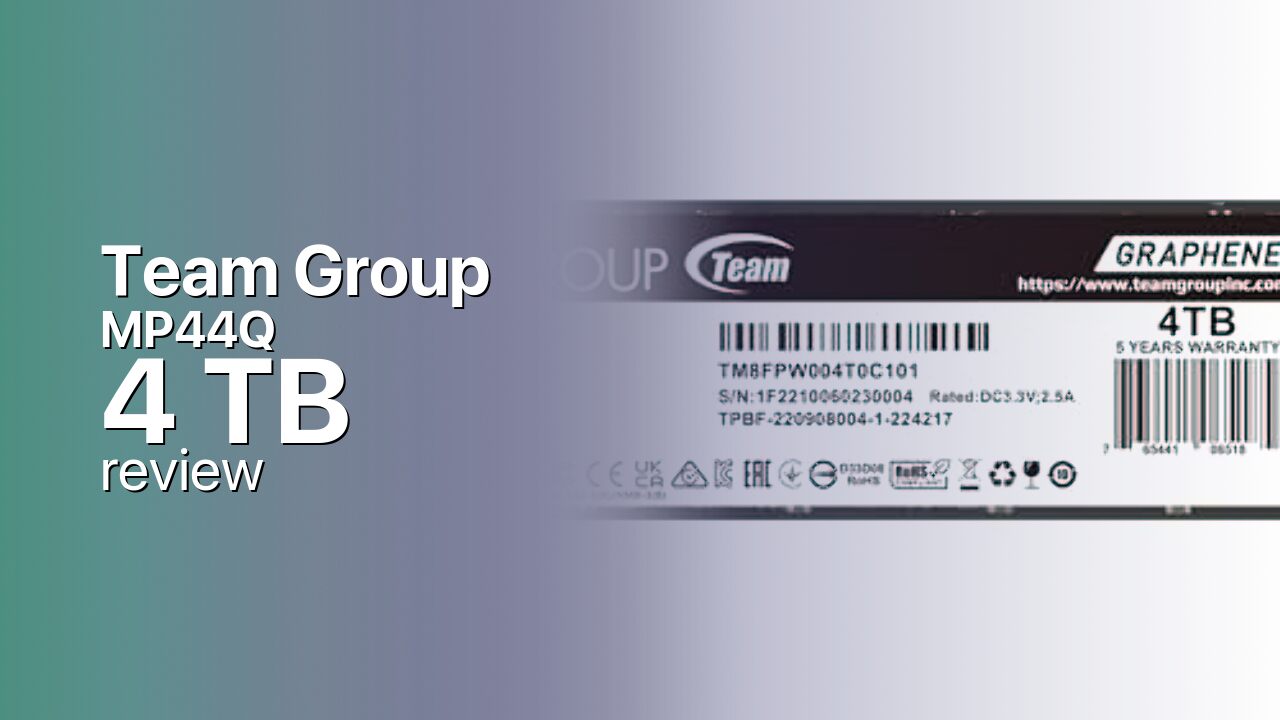
The Team Group MP44Q 4TB is the QLC density play in TeamGroup's Gen4 value line: a DRAM-less M.2 2280 board on the Maxio MAP1602 controller with Host Memory Buffer, carrying YMTC's 232-layer 3D QLC NAND beneath a graphene heat-dissipation label. TeamGroup rates it at 7,000 MB/s sequential reads and 5,900 MB/s writes over PCIe 4.0 x4, and the rating is uniform across the whole 1 TB to 8 TB range — the 4 TB model gains endurance and capacity headroom, not speed, over its siblings. TechPowerUp's database documents this exact capacity on the same platform as the HP FX700, with the Acer FA200 and Patriot Viper VP4300 Lite as family relatives.
Endurance is where the 4 TB step pays off: 2,048 TBW of rated writes under the 5-year limited warranty, double the 2 TB model's 1,024 TBW (TeamGroup's product page rounds these to 2,000 and 1,000 TBW). That is flagship-drive endurance territory on a budget QLC platform. The competition at 4 TB is thinner than at smaller sizes: Crucial's P3 Plus 4TB and P310 4TB are the direct QLC rivals on Micron flash, while TLC alternatives like the WD Black SN770 stop at 2 TB — though Kingston's NV3 4TB plays the same variable-hardware game. Tom's Hardware's review of the 2 TB family member warns that TLC drives become compelling at 4 TB pricing, so the shelf comparison deserves a look before buying.
The buyer profile is specific: a game vault, media archive or PS5 library expansion where terabytes matter more than sustained write speed. The graphene label keeps total height under 4 mm, meeting Sony's PS5 size rules without extra hardware, and YMTC's QLC tested as notably power-efficient in Tom's Hardware's review of the platform.
Storage Comparisons:
MP44Q Performance & Benchmarks
TeamGroup rates the MP44Q 4TB at 7,000 MB/s sequential reads and 5,900 MB/s writes — the same figures as every capacity in the range, and a rating that clears Sony's 5,500 MB/s PS5 guidance with room to spare. No random IOPS figure is published. In daily use, reads at this level mean game loads and file access with no perceptible penalty against costlier TLC drives; Tom's Hardware's testing of the 2 TB sibling found the platform outscoring TLC rivals including the Kingston NV3, TeamGroup's own MP44 and the WD Black SN770 in 3DMark and PCMark storage benchmarks.
Team Group MP44Q 4 TB vs M.2 4.0 x 4 peers
Switch between sequential throughput and random IOPS to see how this drive stacks up against other M.2 4.0 x 4 SSDs in our database. The highlighted bar is the drive on this page — click any other bar to open that drive.
- Patriot Viper PV593 1 TB: 14,500 MB/s read, 14,000 MB/s write
- Patriot Viper PV593 2 TB: 14,500 MB/s read, 14,000 MB/s write
- Patriot Viper PV593 4 TB: 14,500 MB/s read, 14,000 MB/s write
- Patriot Viper PV573 2 TB: 14,000 MB/s read, 12,000 MB/s write
- Team Group MP44Q 4 TB (this drive): 7,000 MB/s read, 5,900 MB/s write
The QLC trade-off matters more at 4 TB only because buyers here move bigger files. The dynamic pseudo-SLC cache absorbs bursts — roughly a quarter of the 2 TB model's capacity per Tom's Hardware's measurements, with writes of 5.75 GB/s sustained for 86 seconds before a drop to around 103 MB/s. A 4 TB drive scales that cache up, so the wall arrives later but the post-cache pace is similar. Media archivists and game-library builders rarely hit it; editors shuffling terabytes of footage daily should buy TLC. Where the platform shines for this capacity's audience is efficiency and thermals: low power draw, a 56-degree Celsius peak in write testing, and a graphene label that adds under a millimeter of height.
Team Group MP44Q vs Competitors
See how the MP44Q stacks up against other M.2 4.0 x 4 drives in our database:
Compare with rival drives:
Endurance, TBW & Warranty
Team Group backs the MP44Q 4TB with a 5-year limited warranty rated at 2,048 TBW of writes — the product page rounds the figure to 2,000 TBW — whichever limit arrives first. That is endurance usually reserved for flagship TLC drives, and it translates to roughly 280 years at a steady 20 GB of daily writes, so the warranty term is the practical ceiling. The 1 TB and 2 TB models carry 512 TBW and 1,024 TBW on identical terms, and an 8 TB flagship tops the range at 4,000 TBW. The rated MTBF of 1.6 million hours is a fleet-wide population statistic, not a per-drive promise, but it ranks near the top of the consumer tier. Claims run through TeamGroup's regional service network with proof-of-purchase.
Team Group MP44Q 4 TB Specifications
| Category | Value |
|---|---|
| Capacity [?] | 4 TB |
| Interface [?] | M.2 4.0 x 4 |
| Controller [?] | Maxio MAP1602 |
| Memory type [?] | 232-layer 3D QLC |
| DRAM [?] | No |
| Read speed (MB/s) [?] | 7000 |
| Write speed (MB/s) [?] | 5900 |
| Read IOPS [?] | n/a |
| Write IOPS [?] | n/a |
| Endurance (TBW) [?] | 2048 |
| MTBF (million hours) [?] | 1600000 |
| Warranty (years) [?] | 5 |
Verdict: Is the MP44Q Worth It in 2026?
The Team Group MP44Q 4TB is for the archive builder: a game vault, media library or PS5 expansion that wants 7,000 MB/s reads and 2,048 TBW of endurance at QLC pricing, with five years of coverage. Skip it for constant heavy writing — post-cache QLC throughput falls to hard-drive pace — and note Tom's Hardware's caution that TLC drives get compelling at 4 TB prices; the Crucial P310 4TB or a TLC sale might serve heavy users better. The Crucial P3 Plus 4TB is the closest QLC rival at a lower rated speed. As budget bulk storage with flagship-class endurance numbers, the 4 TB MP44Q makes a coherent and confident case.
+ Pros
- Rated 7,000 MB/s reads and 5,900 MB/s writes
- 2,048 TBW endurance — flagship-drive territory
- 5-year warranty at a QLC price point
- Low power draw confirmed in Tom's Hardware testing
- Single-sided 3.7 mm PCB with graphene label
- Cons
- Post-cache writes drop to roughly 100 MB/s
- No DRAM on the PCB — Host Memory Buffer only
- TLC alternatives get compelling at 4 TB pricing
- Random IOPS figures not published
Buy this or similar SSD Storage:



Video Review
TEAMGROUP MP44Q Review 2026 - Don't Waste your Money...