TeamGroup T-Force G50 2TB Review — Endurance-Rich Game Library (2026)
Quick answer
The TeamGroup T-Force G50 2TB is the capacity for people filling a library: 1,300 TBW of endurance, a 4,500 MB/s write rating and TechPowerUp's full-review verdict that the pricing makes the performance easy to forgive.
Read: 5000 MB/s Write: 4500 MB/s Endurance: 1300 TBW Warranty: 5 years Interface: M.2 4.0 x 4
The TeamGroup T-Force G50 2TB trades a slice of write speed for double the endurance of the 1TB model — 4,500 MB/s writes, 1,300 TBW and the same 5,000 MB/s reads.
Controller & Memory
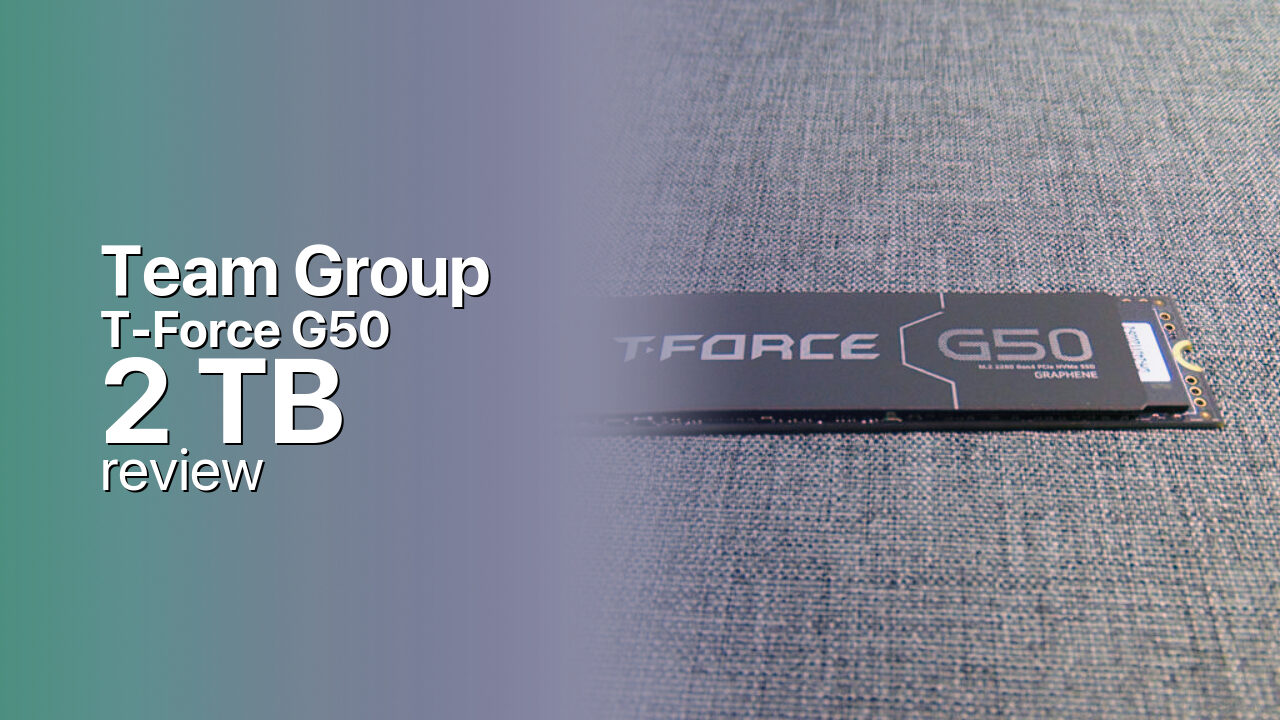
The TeamGroup T-Force G50 2TB shares its platform with the rest of the range: an InnoGrit IG5220 (RainierQX) controller running DRAM-less with Host Memory Buffer, and YMTC 128-layer 3D TLC NAND — The FPS Review's teardown of this exact capacity read the flash packages directly and confirmed the YMTC silicon. It is a single-sided M.2 2280 drive with TeamGroup's patented ultra-thin graphene heat spreader pre-fitted, 7 g and 3.7 mm thick, small enough for thin laptops, ITX builds and the PS5 slot.
At 2 TB the G50 makes an interesting trade. Reads stay at the family-standard 5,000 MB/s and endurance doubles to 1,300 TBW, but the write rating steps down from the 1TB's 4,800 MB/s to 4,500 MB/s. For a game library or archive duty that is the right trade — capacity and durability matter more than a six percent write delta. This is also the capacity TechPowerUp chose for its full review, measuring sequential reads near 4.5 GB/s and writes around 4.1 GB/s and concluding that the pricing made the performance easy to forgive; PCWorld reached a similar verdict, and The FPS Review scored value a perfect ten while naming thermals the weak point. The 4TB extends the endurance table to 2,600 TBW if the library grows again.
The buyer profile is a gamer filling a second slot with a library, or a budget creator archiving projects. Rivals include the WD Blue SN580 2TB and Crucial's QLC-based P3 Plus 2TB, which trades endurance for price, while TeamGroup's own MP44 plays a much faster tier above. TeamGroup sells the G50 in 512GB, 1TB, 2TB and 4TB, with part number TM8FFE002T0C129 marking this capacity.
Storage Comparisons:
T-Force G50 Performance & Benchmarks
TeamGroup rates the G50 2TB at 5,000 MB/s sequential reads and 4,500 MB/s sequential writes over PCIe 4.0 x4, backed by 1,300 TBW of endurance. This is the one G50 capacity with a full independent review trail: TechPowerUp's testing measured sequential reads up to roughly 4.5 GB/s and writes around 4.1 GB/s, with more than 2.5 GB/s sustained at realistic queue depths, while The FPS Review reported good game load times but noted the drive gets toasty during long sustained writes and recommended fitting a motherboard heatsink.
Team Group T-Force G50 2 TB vs M.2 4.0 x 4 peers
Switch between sequential throughput and random IOPS to see how this drive stacks up against other M.2 4.0 x 4 SSDs in our database. The highlighted bar is the drive on this page — click any other bar to open that drive.
- Patriot Viper PV593 1 TB: 14,500 MB/s read, 14,000 MB/s write
- Patriot Viper PV593 2 TB: 14,500 MB/s read, 14,000 MB/s write
- Patriot Viper PV593 4 TB: 14,500 MB/s read, 14,000 MB/s write
- Patriot Viper PV573 2 TB: 14,000 MB/s read, 12,000 MB/s write
- Team Group T-Force G50 2 TB (this drive): 5,000 MB/s read, 4,500 MB/s write
The 2TB capacity helps where it counts. The pseudo-SLC cache scales with the NAND complement, so bursts last longer than on the 512GB model before throughput settles to native TLC rates, and the doubled endurance budget tolerates heavier writing. Game loading — the workload most buyers actually feel — is read-dominated and queue-depth-light, exactly where the DRAM-less design costs nothing; The FPS Review's numbers showed load times comfortably competitive for the class. Multitasking with hundreds of parallel small writes is where the missing DRAM shows, and workstation users should look at the DRAM-cached G50 Pro instead. For installs, library shuffles and everyday copying, the 2TB behaves like the ratings suggest: strong bursts, honest sustained numbers, no surprises.
Team Group T-Force G50 vs Competitors
See how the T-Force G50 stacks up against other M.2 4.0 x 4 drives in our database:
Compare with rival drives:
Endurance, TBW & Warranty
TeamGroup backs the G50 2TB with a 5-year limited warranty rated to 1,300 TBW, whichever limit arrives first — double the 650 TBW of the 1TB and four times the 512GB's 325 TBW. At a typical 20 GB of daily writes, 1,300 TBW represents about 178 years of use, so endurance is effectively a non-issue under desktop workloads and the calendar term is the real limit. The spec sheet rates MTBF at 3,000,000 hours, a population-level statistic that speaks to manufacturing quality rather than the lifespan of any individual unit. TeamGroup's warranty support runs through its service channels with proof of purchase, and the graphene heat spreader ships pre-fitted — The FPS Review still suggests a motherboard heatsink for sustained write-heavy sessions, which also keeps the drive within its 0-70°C operating range.
Team Group T-Force G50 2 TB Specifications
| Category | Value |
|---|---|
| Capacity [?] | 2 TB |
| Interface [?] | M.2 4.0 x 4 |
| Controller [?] | InnoGrit IG5220 |
| Memory type [?] | YMTC 128-layer 3D TLC |
| DRAM [?] | No |
| Read speed (MB/s) [?] | 5000 |
| Write speed (MB/s) [?] | 4500 |
| Read IOPS [?] | 520000 |
| Write IOPS [?] | 480000 |
| Endurance (TBW) [?] | 1300 |
| MTBF (million hours) [?] | 3000000 |
| Warranty (years) [?] | 5 |
Verdict: Is the T-Force G50 Worth It in 2026?
The TeamGroup T-Force G50 2TB is the capacity for people filling a library: 1,300 TBW of endurance, a 4,500 MB/s write rating and TechPowerUp's full-review verdict that the pricing makes the performance easy to forgive. Skip it for sustained professional write loads or heavy multitasking — the DRAM-less platform is the constraint, and the DRAM-cached G50 Pro or a WD Black-class drive fits that job better. Against the Crucial P3 Plus 2TB, this drive trades some price for TLC endurance; against the WD Blue SN580 2TB, it trades rated write speed for a pre-fitted heat spreader. For a boot-plus-library Gen4 build on a budget, we think this is the G50 to buy.
+ Pros
- 1,300 TBW endurance with 5-year warranty
- 5,000/4,500 MB/s rated reads and writes
- TLC NAND, not QLC, at 2 TB
- Graphene heat spreader pre-fitted
- Independently reviewed by TechPowerUp and The FPS Review
- Double the endurance of the 1TB model
- Cons
- Write rating trails the 1TB model
- No DRAM cache — Host Memory Buffer only
- Runs warm during sustained writes
- Reads trail 7,000 MB/s Gen4 drives
Buy this or similar SSD Storage:



Video Review
TEAMGROUP T-FORCE G50 1TB - Up For Some Speed Benchmarks!