TeamGroup T-Force G50 512GB Review — Budget Gen4 With a Catch (2026)
Quick answer
The TeamGroup T-Force G50 512GB is the right pick when a spare Gen4 slot needs filling for boot or light secondary duty and the budget is genuinely tight: reads match the rest of the lineup, the graphene heat spreader is included, and the 5-year warranty carries over intact.
Read: 5000 MB/s Write: 2500 MB/s Endurance: 325 TBW Warranty: 5 years Interface: M.2 4.0 x 4
The TeamGroup T-Force G50 512GB pairs 5,000 MB/s reads with 325 TBW of endurance, but its 2,500 MB/s write rating makes it the budget runt of the G50 lineup.
Controller & Memory
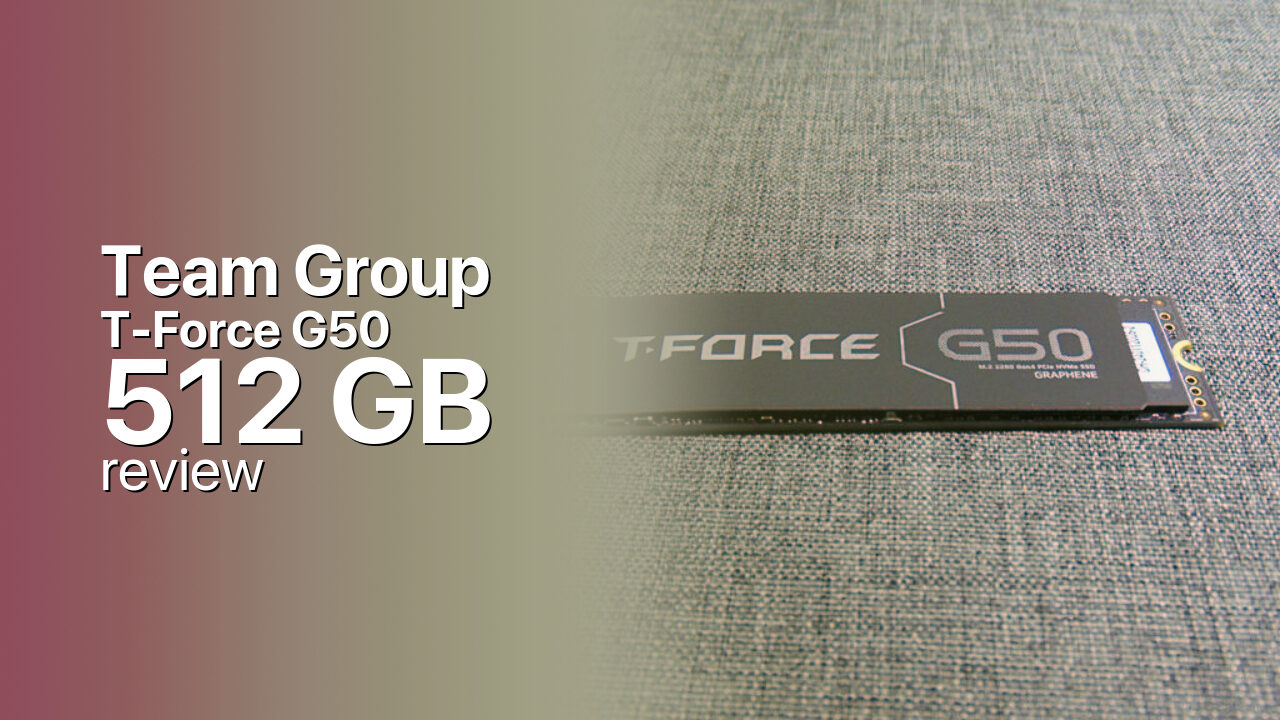
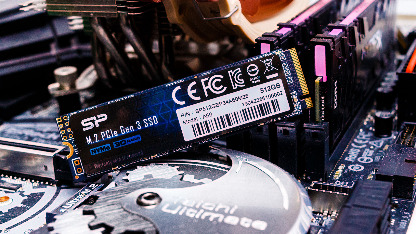
Inside, the TeamGroup T-Force G50 512GB is a deliberately lean PCIe 4.0 build: an InnoGrit IG5220 (RainierQX) controller without a DRAM package, relying on Host Memory Buffer instead, and YMTC 128-layer 3D TLC NAND — a combination The FPS Review confirmed on the bench by reading the flash part numbers directly. The M.2 2280 PCB is single-sided and carries TeamGroup's patented ultra-thin graphene heat spreader, so the whole assembly weighs 7 g and fits thin laptops, small-form-factor builds and the PS5 expansion slot without fouling anything.
Position within the G50 family is where the 512GB capacity shows its stripes. Every G50 reads at the same rated 5,000 MB/s, but writes drop to 2,500 MB/s here — the 1TB holds 4,800 MB/s and the 2TB and 4TB hold 4,500 MB/s — and endurance is rated at 325 TBW against 650 TBW and 1,300 TBW for its larger siblings. The DRAM-cached G50 Pro adds a memory package and tops out at 2 TB, so anyone wanting a cached version of this platform has to step into that variant.
For buyers, this is a boot-drive-and-basics capacity: the operating system, an application set and light game duty on a spare slot. It competes in the value Gen4 bracket against the Kingston NV3 and Crucial P3 Plus, while the WD Blue SN580 plays the same DRAM-less TLC game with faster rated writes. Reviews of the G50 family from TechPowerUp, PCWorld and The FPS Review land on a consistent verdict — middling hardware, honest ratings, pricing that makes the compromise easy to forgive — and that logic applies least of all to this smallest capacity.
Storage Comparisons:
T-Force G50 Performance & Benchmarks
TeamGroup rates the G50 512GB at 5,000 MB/s sequential reads and 2,500 MB/s sequential writes over PCIe 4.0 x4 — the read figure matches the whole lineup, while the write rating is a little over half of what the 1TB model carries. Random performance is not officially published for the G50, so the honest picture comes from family-level testing: TechPowerUp's 2TB review measured sequential reads near 4.5 GB/s and writes around 4.1 GB/s, with more than 2.5 GB/s still available at realistic queue depths, and The FPS Review found game load times firmly competitive for the class.
Team Group T-Force G50 512 GB vs M.2 4.0 x 4 peers
Switch between sequential throughput and random IOPS to see how this drive stacks up against other M.2 4.0 x 4 SSDs in our database. The highlighted bar is the drive on this page — click any other bar to open that drive.
- Patriot Viper PV593 1 TB: 14,500 MB/s read, 14,000 MB/s write
- Patriot Viper PV593 2 TB: 14,500 MB/s read, 14,000 MB/s write
- Patriot Viper PV593 4 TB: 14,500 MB/s read, 14,000 MB/s write
- Patriot Viper PV573 2 TB: 14,000 MB/s read, 12,000 MB/s write
- Team Group T-Force G50 512 GB (this drive): 5,000 MB/s read, 2,500 MB/s write
The 512GB caveat is the pseudo-SLC cache. A smaller NAND complement means a smaller write cache, so long, sustained transfers exhaust it sooner and settle toward native TLC write speeds well below the headline. For boot duty, application installs and everyday copying, that behavior is a footnote rather than a problem. The DRAM-less design has no measurable effect on game loading, and thermals are manageable — the graphene spreader helps, though The FPS Review still recommends a motherboard heatsink for sustained write-heavy sessions. As a system drive that mostly reads, this capacity behaves exactly like its faster siblings.
Team Group T-Force G50 vs Competitors
See how the T-Force G50 stacks up against other M.2 4.0 x 4 drives in our database:
Compare with rival drives:
Endurance, TBW & Warranty
TeamGroup backs the G50 512GB with a 5-year limited warranty rated to 325 TBW of writes, whichever limit arrives first. That endurance rating is the lowest in the G50 range — the 1TB carries 650 TBW and the 2TB carries 1,300 TBW — but it is proportionally consistent at 0.65 TBW per gigabyte of capacity. In practice, 325 TBW covers roughly four decades of 20 GB-per-day writing, so the calendar term is the realistic limit for a boot drive. The spec sheet lists MTBF at 3,000,000 hours, a population statistic describing manufacturing reliability rather than a promise about any single drive. Warranty claims run through TeamGroup's support channels with proof of purchase, and the company operates repair and exchange service through its global distributor network.
Team Group T-Force G50 512 GB Specifications
| Category | Value |
|---|---|
| Capacity [?] | 512 GB |
| Interface [?] | M.2 4.0 x 4 |
| Controller [?] | InnoGrit IG5220 |
| Memory type [?] | YMTC 128-layer 3D TLC |
| DRAM [?] | No |
| Read speed (MB/s) [?] | 5000 |
| Write speed (MB/s) [?] | 2500 |
| Read IOPS [?] | 520000 |
| Write IOPS [?] | 480000 |
| Endurance (TBW) [?] | 325 |
| MTBF (million hours) [?] | 3000000 |
| Warranty (years) [?] | 5 |
Verdict: Is the T-Force G50 Worth It in 2026?
The TeamGroup T-Force G50 512GB is the right pick when a spare Gen4 slot needs filling for boot or light secondary duty and the budget is genuinely tight: reads match the rest of the lineup, the graphene heat spreader is included, and the 5-year warranty carries over intact. Skip it if write speed matters — 2,500 MB/s and 325 TBW are entry-level figures, and the WD Blue SN580 serves this tier with faster rated writes. The obvious alternative is TeamGroup's own G50 1TB, which doubles endurance and nearly doubles write speed for only a modest price step. Within this family, the 1TB is the configuration we would actually recommend; the 512GB is the compromise.
+ Pros
- 5,000 MB/s rated sequential reads
- 325 TBW endurance with 5-year warranty
- Ultra-thin graphene heat spreader included
- Single-sided 7 g PCB suits laptops and PS5
- YMTC 128-layer TLC, not QLC
- Cons
- 2,500 MB/s writes, lowest in the lineup
- 325 TBW endurance rating trails siblings
- No DRAM cache — Host Memory Buffer only
- No official random IOPS rating published
- Smaller SLC cache than larger capacities
Buy this or similar SSD Storage:
Video Review
TEAMGROUP T-FORCE G50 1TB - Up For Some Speed Benchmarks!