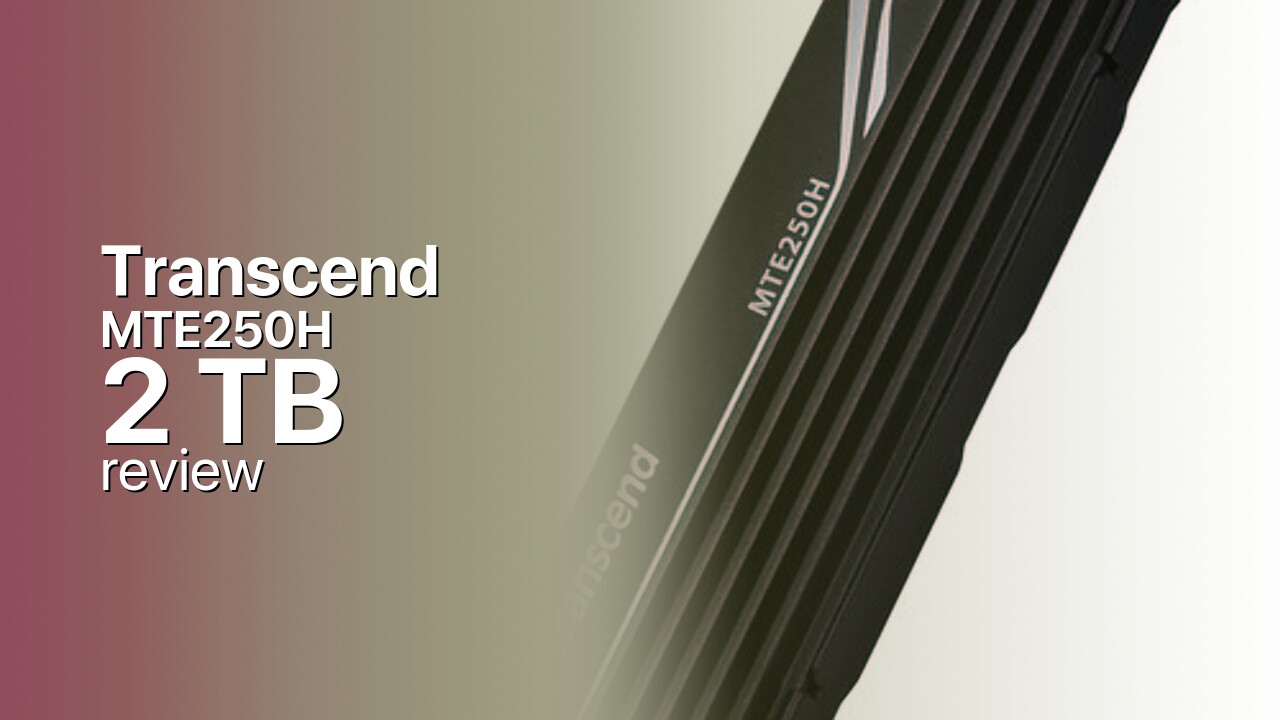
Transcend MTE250H 2TB Review: The Family's Balanced Middle Child (2026)
Quick answer
The Transcend MTE250H 2TB fits builders who want mid-size Gen4 storage with cooling already solved: a game library, a creator scratch disk or PS5 expansion, with 6,500 MB/s writes and 1,560 TBW of endurance behind it.
Read: 7100 MB/s Write: 6500 MB/s Endurance: 1560 TBW Warranty: 5 years Interface: M.2 4.0 x 4
The Transcend MTE250H 2TB is the family's balance point — 6,500 MB/s writes, double the 1TB's endurance budget, and the finned aluminum heatsink pre-fitted.
Controller & Memory
The Transcend MTE250H 2TB shares its platform with the rest of the 250H family: Silicon Motion's SM2264F eight-channel controller, Kioxia BiCS5 112-layer TLC NAND, a DRAM cache — 1GB of Samsung DDR4-3200 is documented on the 1TB sibling, and the DRAM-cache design runs across the range — all over PCIe 4.0 x4 with NVMe 1.4. This capacity rates 7,100 MB/s sequential reads, 6,500 MB/s writes and 530K/420K random IOPS, and the finned aluminum heatsink arrives pre-fitted at 9.2 mm thick and roughly 34 grams. The drive is ready for a motherboard slot the moment it leaves the box.
Within the ladder, the 2TB is the balance point. It gives up 100 MB/s of read speed to the 1TB (7,200) but gains 300 MB/s of writes (6,200 becomes 6,500) and doubles endurance from 780 to 1,560 TBW; the 4TB above it pushes ratings to 7,500/6,700 and 3,120 TBW. The graphene-padded MTE250S twin offers identical per-capacity numbers in a 3.77 mm-thin body, so the choice between them is purely thermal and mechanical: slim laptop slots take the S, desktop boards with airflow take this finned H.
The audience is the mid-size library builder: a 2TB pool holds a Windows installation, a large game shelf and a working video project without juggling uninstall cycles, and the 1,560 TBW budget means heavy installs never flirt with the warranty cap. Tom's Hardware's review of the family found performance adequate and US pricing steep but praised the warranty, thermals and the SSD Scope utility. Against the DRAM-less WD Black SN770, this drive counters with real DRAM and faster writes; against Kingston's KC3000 it concedes rated speed. For PS5 storage, the fitted heatsink and 7,100 MB/s read rating clear every published Sony requirement.
Storage Comparisons:
MTE250H Performance & Benchmarks
Transcend rates the 2TB MTE250H at 7,100 MB/s sequential reads and 6,500 MB/s writes, with 530K random-read and 420K random-write IOPS. TechPowerUp's testing of the 1TB sibling sized its dynamic pseudo-SLC cache at roughly 100 GB, with post-cache writes settling near 788 MB/s; the cache scales with capacity on this platform, so expect the same character — long cache stretches during normal use, then a lower steady-state floor on very large sustained transfers.
Transcend MTE250H 2 TB vs M.2 4.0 x 4 peers
Switch between sequential throughput and random IOPS to see how this drive stacks up against other M.2 4.0 x 4 SSDs in our database. The highlighted bar is the drive on this page — click any other bar to open that drive.
- Patriot Viper PV593 1 TB: 14,500 MB/s read, 14,000 MB/s write
- Patriot Viper PV593 2 TB: 14,500 MB/s read, 14,000 MB/s write
- Patriot Viper PV593 4 TB: 14,500 MB/s read, 14,000 MB/s write
- Patriot Viper PV573 2 TB: 14,000 MB/s read, 12,000 MB/s write
- Transcend MTE250H 2 TB (this drive): 7,100 MB/s read, 6,500 MB/s write
Thermal behavior is where the factory fins earn their space: Tom's Hardware found the 250H runs cool under sustained load, which keeps write throttling at bay during big installs. Day to day, 6,500 MB/s writes move a 100 GB game install in well under a minute while the cache holds, and 7,100 MB/s reads load levels indistinguishably from 7,400 MB/s flagships. The 420K random-write rating trails DRAM-based flagships such as Kingston's KC3000, but that gap shows only in extreme queue-depth workloads — desktop use, gaming and content creation sit nowhere near it. DirectStorage titles benefit from the Gen4 read bandwidth, and the DRAM cache keeps mixed workloads responsive.
Transcend MTE250H vs Competitors
See how the MTE250H stacks up against other M.2 4.0 x 4 drives in our database:
Compare with rival drives:
Endurance, TBW & Warranty
Transcend covers the 2TB MTE250H for five years against 1,560 TBW of writes, whichever arrives first — 0.43 drive writes per day across the term. At a typical 20 GB of daily writes the budget lasts more than two centuries, so the flash will never be the limiting factor; the doubled endurance over the 1TB's 780 TBW is the quiet argument for stepping up a capacity. MTBF is listed at 3.0 million hours, a fleet statistic rather than a per-unit prediction. Two practical notes: the aluminum heatsink is a factory-fitted part, and Transcend's documentation warns that removing it can cause damage not covered under warranty, so install the drive as-is. The bundled SSD Scope utility monitors health, remaining endurance and firmware.
Transcend MTE250H 2 TB Specifications
| Category | Value |
|---|---|
| Capacity [?] | 2 TB |
| Interface [?] | M.2 4.0 x 4 |
| Controller [?] | SMI SM2264 8 Channel |
| Memory type [?] | Kioxia 112-L TLC |
| DRAM [?] | Yes |
| Read speed (MB/s) [?] | 7100 |
| Write speed (MB/s) [?] | 6500 |
| Read IOPS [?] | 530000 |
| Write IOPS [?] | 420000 |
| Endurance (TBW) [?] | 1560 |
| MTBF (million hours) [?] | 3000000 |
| Warranty (years) [?] | 5 |
Verdict: Is the MTE250H Worth It in 2026?
The Transcend MTE250H 2TB fits builders who want mid-size Gen4 storage with cooling already solved: a game library, a creator scratch disk or PS5 expansion, with 6,500 MB/s writes and 1,560 TBW of endurance behind it. Skip it when shelf price leads — Tom's Hardware found the family pricey for US buyers, and the DRAM-less WD Black SN770 2TB undercuts it while rating 5,150 MB/s. Kingston's KC3000 is the step up for speed hunters, and Transcend's own 4TB doubles endurance again for big libraries. We think this is the family's most sensible capacity: the write-speed and endurance gains over the 1TB cost almost nothing in daily use, which makes it the default choice within the range.
+ Pros
- Rated 7,100/6,500 MB/s on PCIe 4.0
- 1,560 TBW endurance, five-year warranty
- Pre-fitted aluminum finned heatsink
- Writes gain 300 MB/s over the 1TB
- DRAM cache platform, not HMB-only
- PS5-eligible dimensions with cooler fitted
- Cons
- Reads give up 100 MB/s to the 1TB
- Priced high in the US, per Tom's Hardware
- Post-cache floor measured near 788 MB/s on 1TB
- 9.2 mm height fouls some laptop M.2 slots
- 420K random-write rating trails DRAM flagships
Buy this or similar SSD Storage:
Video Review
ТОПовый не ТОП!!! Обзор SSD TRANSCEND MTE250H 2TB (TS2TMTE250H) с радиатором