Transcend MTE250S 2TB Review: A Graphene-Thin Gen4 Contender (2026)
Quick answer
Buy the Transcend MTE250S 2TB when a Gen4 system needs a slim, DRAM-equipped drive with an endurance budget most rivals don't match — thin laptops, small-form-factor builds and PS5 storage all fit.
Read: 7100 MB/s Write: 6500 MB/s Endurance: 1560 TBW Warranty: 5 years Interface: M.2 4.0 x 4
The Transcend MTE250S 2TB pairs 7,100 MB/s Gen4 reads with 1,560 TBW endurance and a graphene pad so thin it disappears into a laptop slot.
Controller & Memory
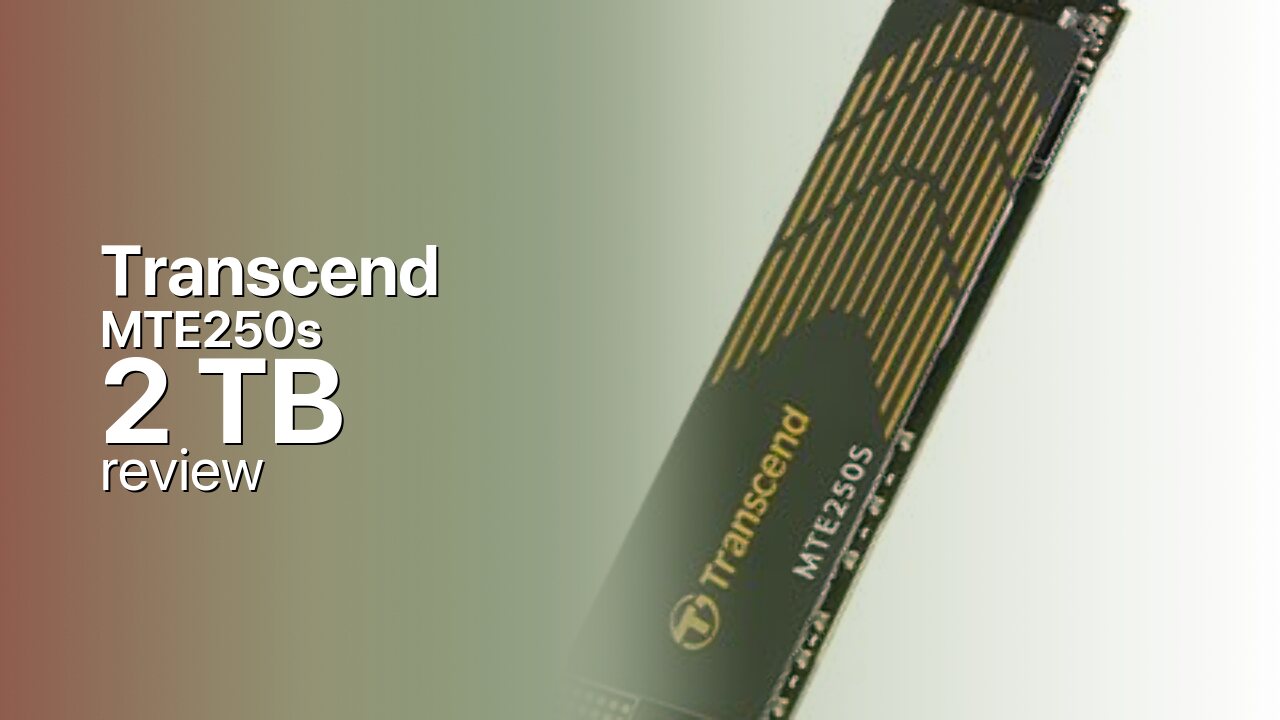
Under the graphene skin of the Transcend MTE250S 2TB sits a serious Gen4 platform: Silicon Motion's SM2264F eight-channel controller on a 12nm die, Kioxia BiCS5 112-layer TLC NAND and a dedicated 2GB DDR4-3200 DRAM cache — TechPowerUp's teardown confirms all three components. Transcend rates this capacity at 7,100 MB/s sequential reads and 6,500 MB/s writes, with 530K random-read and 420K random-write IOPS over PCIe 4.0 x4 and NVMe 1.4. The PCB is double-sided, yet the bonded graphene pad holds total thickness to 3.77 mm and weight to 10 grams — thin enough for slim laptop slots and console installs where a finned cooler would never fit.
The MTE250S is the thinner half of a two-drive family. Its sibling, the MTE250H, swaps graphene for a finned aluminum heatsink that adds height (9.2 mm) and heft but promises roughly 15 percent lower temperatures — the better pick for open desktop slots. Both share the same platform and the same capacity ladder: the 1TB model rates 7,200/6,200 MB/s with 780 TBW, this 2TB version trades 100 MB/s of read speed for 300 MB/s of extra write and doubles endurance to 1,560 TBW, and the 4TB tops the range at 7,500/6,700 MB/s with 3,120 TBW. Every capacity carries a five-year limited warranty.
The buyer profile is clear: anyone who wants DRAM-equipped Gen4 performance in a slot where a finned heatsink won't fit — thin laptops, small-form-factor builds, or a PS5 expansion slot where the graphene layer plus console airflow handles cooling. Against the DRAM-less WD Black SN770, the MTE250S counters with real DRAM and stronger write ratings; against Kingston's KC3000 it gives up rated speed but ships slimmer and still lands far above Gen3 drives. Samsung's 990 Pro remains the outright speed purchase, while Transcend bundles its SSD Scope toolkit for monitoring, diagnostics and cloning, and the endurance budget here is unusually generous for the class.
Storage Comparisons:
MTE250s Performance & Benchmarks
Transcend rates the 2TB MTE250S at 7,100 MB/s sequential reads and 6,500 MB/s writes, with 530K random-read and 420K random-write IOPS. ssd-tester.com's full bench of this exact model measured 7,066/6,490 MB/s in CrystalDiskMark's sequential test — effectively on spec — and its 150 GB HD Tune write pass averaged 1,802 MB/s across the whole surface, a strong sustained figure for the tier. The dynamic pseudo-SLC cache measured roughly 108 GB before throttling, after which steady-state writes settle around 1,800 MB/s, well above the several-hundred-MB/s floor typical of DRAM-less competitors.
Transcend MTE250s 2 TB vs M.2 4.0 x 4 peers
Switch between sequential throughput and random IOPS to see how this drive stacks up against other M.2 4.0 x 4 SSDs in our database. The highlighted bar is the drive on this page — click any other bar to open that drive.
- Patriot Viper PV593 1 TB: 14,500 MB/s read, 14,000 MB/s write
- Patriot Viper PV593 2 TB: 14,500 MB/s read, 14,000 MB/s write
- Patriot Viper PV593 4 TB: 14,500 MB/s read, 14,000 MB/s write
- Patriot Viper PV573 2 TB: 14,000 MB/s read, 12,000 MB/s write
- Transcend MTE250s 2 TB (this drive): 7,100 MB/s read, 6,500 MB/s write
In practice, 7 GB/s-class reads boot Windows, install games and stream DirectStorage assets with no perceptible penalty against 7,400 MB/s flagships, and the 2GB DRAM cache keeps random access responsive under multitasking. The 420K random-write rating is modest next to Phison E18-based flagships such as Kingston's KC3000, but desktop, gaming and mixed creator workloads rarely probe that ceiling. For video editors the sustained post-cache write floor matters more than burst, and here the 2TB model holds up well; queue-depth-1 4K work remains controller-bound, as on every NVMe drive. The same run's high-queue random results — roughly 650K read and 660K write IOPS at Q32T16 — indicate the official 530K/420K ratings are conservative rather than optimistic.
Transcend MTE250s vs Competitors
See how the MTE250s stacks up against other M.2 4.0 x 4 drives in our database:
Compare with rival drives:
Endurance, TBW & Warranty
Transcend backs the MTE250S 2TB with a five-year limited warranty rated to 1,560 TBW, whichever arrives first — a 0.43 drive-writes-per-day endurance class that comfortably covers desktop workloads. At a steady 20 GB of writes per day, the budget stretches past two centuries, so the warranty term is the realistic limit, not the flash. That rating doubles the 1TB model's 780 TBW and halves the gap to the 4TB's 3,120, making the 2TB the balance point of the ladder. TechPowerUp lists MTBF at 3.0 million hours; treat that as a fleet statistic rather than a promise about any single unit. Claims run through Transcend's regional support network with proof of purchase, and the bundled SSD Scope utility tracks remaining life, health and firmware so wear surfaces early rather than at failure.
Transcend MTE250s 2 TB Specifications
| Category | Value |
|---|---|
| Capacity [?] | 2 TB |
| Interface [?] | M.2 4.0 x 4 |
| Controller [?] | SMI SM2264F |
| Memory type [?] | Kioxia 112-L TLC |
| DRAM [?] | Yes |
| Read speed (MB/s) [?] | 7100 |
| Write speed (MB/s) [?] | 6500 |
| Read IOPS [?] | 530000 |
| Write IOPS [?] | 420000 |
| Endurance (TBW) [?] | 1560 |
| MTBF (million hours) [?] | 3000000 |
| Warranty (years) [?] | 5 |
Verdict: Is the MTE250s Worth It in 2026?
Buy the Transcend MTE250S 2TB when a Gen4 system needs a slim, DRAM-equipped drive with an endurance budget most rivals don't match — thin laptops, small-form-factor builds and PS5 storage all fit. ssd-tester's bench of this exact model confirms the ratings translate into real transfers, with sequential results landing within half a percent of spec. Skip it if raw speed decides the purchase: Samsung's 990 Pro and WD's SN850X outrate it, and where a finned cooler fits the build, the aluminum-clad MTE250H sibling does the same job with better sustained cooling. Kingston's KC3000 is the alternative for maximum rated throughput. We think the graphene-thin profile, verified DRAM hardware and 1,560 TBW endurance make this the family's most flexible capacity.
+ Pros
- Rated 7,100/6,500 MB/s on PCIe 4.0
- 1,560 TBW endurance, five-year warranty
- 2GB DDR4 DRAM cache confirmed by teardown
- Graphene pad keeps height at 3.77 mm
- Holds roughly 1,800 MB/s writes after cache
- Kioxia BiCS5 112-layer TLC NAND
- Cons
- Reads rate 300 MB/s under 7,400 MB/s flagships
- Random-write rating trails DRAM-based KC3000 rivals
- 1TB variant gives up 300 MB/s of writes
- Double-sided PCB needs 3.77 mm of clearance
- Graphene sheds less heat than finned aluminum
Buy this or similar SSD Storage:



Video Review
Transcend Announces MTE250S High Performance M 2 NVMe Gen 4 SSD