Western Digital WD SN5100 2TB Review — Fastest QLC, With Caveats (2026)
Quick answer
The Western Digital WD SN5100 2TB is the capacity to pick in the fastest QLC platform TechPowerUp has ever tested: full 7,100/6,700 MB/s speed, 900 TBW of endurance, five years of warranty and idle draw measured in milliwatts, all in the configuration every major review chose to test.
Read: 7100 MB/s Write: 6700 MB/s Endurance: 900 TBW Warranty: 5 years Interface: M.2 4.0 x 4
TechPowerUp calls the Western Digital WD SN5100 2TB the fastest QLC SSD it has ever tested — 7,100 MB/s reads, 900 TBW of endurance and a 5-year warranty.
Controller & Memory
The Western Digital WD SN5100 2TB is the capacity every major review chose, and the verdicts converge: TechPowerUp calls it the fastest QLC SSD the site has ever tested, Tom's Hardware opens its review with best QLC SSD we have tested, and StorageReview measured 7,329 MB/s reads and 6,740 MB/s writes — above the official ratings. The platform is a single-sided M.2 2280 board on PCIe 4.0 x4 and NVMe 2.0: SanDisk's Polaris 3 controller, 218-layer BiCS8 3D QLC NAND in CMOS-bonded-array form, up to 64 MB of Host Memory Buffer instead of DRAM, and SanDisk's nCache 4.0 hybrid pseudo-SLC cache. Western Digital and SanDisk branding now refer to the same hardware.
At 2 TB the ratings are 7,100 MB/s sequential reads and 6,700 MB/s writes with 1,000K random reads and 1,300K random writes — identical to the 1 TB model — and endurance is rated at 900 TBW under a 5-year warranty. The 500 GB variant steps down to 6,600/5,600 MB/s; the 4 TB runs at 6,900/6,700 MB/s with 1,200 TBW. Tom's Hardware's saturation test showed the 2 TB sample sustaining roughly 6.45 GB/s for over a minute on a pseudo-SLC cache larger than 500 GB before throughput dropped hard — TechPowerUp measured around 400 MB/s once the cache empties, still faster than most QLC rivals but far below TLC.
The buyer profile: a secondary game-library drive, a creator's bulk project disk, or a laptop upgrade where 4-milliwatt idle draw and a cool two-chip board matter. Crucial's P310 is the direct QLC rival — ahead in random reads per StorageReview, behind in sequential burst — and the TLC-based WD Black SN7100 remains the family-internal answer for sustained-write workloads, having launched cheaper with a stronger endurance-per-terabyte story.
Storage Comparisons:
WD SN5100 Performance & Benchmarks
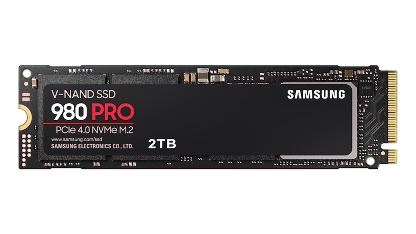
Western Digital rates the 2 TB SN5100 at 7,100 MB/s sequential reads, 6,700 MB/s writes, 1,000K random reads and 1,300K random writes, and this is the capacity with the deepest independent record. StorageReview's instrumented testing measured 7,329 MB/s reads and 6,740 MB/s writes, with 931K random-write IOPS in its fio runs; TechPowerUp's verdict was the fastest QLC drive we have ever tested, placing its behavior alongside the Samsung 980 Pro, Kingston KC3000 and Lexar NM790; Tom's Hardware called it the best QLC SSD it has tested while flagging poor sustained write performance as the one honest con.
Western Digital WD SN5100 2 TB vs M.2 4.0 x 4 peers
Switch between sequential throughput and random IOPS to see how this drive stacks up against other M.2 4.0 x 4 SSDs in our database. The highlighted bar is the drive on this page — click any other bar to open that drive.
- Patriot Viper PV593 1 TB: 14,500 MB/s read, 14,000 MB/s write
- Patriot Viper PV593 2 TB: 14,500 MB/s read, 14,000 MB/s write
- Patriot Viper PV593 4 TB: 14,500 MB/s read, 14,000 MB/s write
- Patriot Viper PV573 2 TB: 14,000 MB/s read, 12,000 MB/s write
- Western Digital WD SN5100 2 TB (this drive): 7,100 MB/s read, 6,700 MB/s write
The two halves of that verdict explain each other. The nCache 4.0 pseudo-SLC buffer is enormous at this capacity — Tom's Hardware watched roughly 6.45 GB/s hold for more than 78 seconds, a cache exceeding 500 GB — so real-world transfers up to hundreds of gigabytes run at near-rated speed. Empty the cache and the QLC underneath shows: TechPowerUp measured throughput dropping to around 400 MB/s, faster than most QLC competitors but a fraction of TLC drives. Power efficiency earned explicit praise from both Tom's Hardware and StorageReview, with rated draw near 4 watts and 4 milliwatts at idle. For game libraries, boot drives and burst-heavy desktop work, none of the QLC penalty is visible; for daily terabyte-scale writes, it very much is.
Western Digital WD SN5100 vs Competitors
See how the WD SN5100 stacks up against other M.2 4.0 x 4 drives in our database:
Compare with rival drives:
Endurance, TBW & Warranty
The SN5100 2TB carries a 5-year limited warranty rated to 900 TBW of writes, whichever arrives first — the family ladder runs 300 TBW at 500 GB, 600 TBW at 1 TB and 1,200 TBW at 4 TB, so this capacity's per-terabyte allowance (450 TBW) sits below the small models' 600. Nine hundred terabytes absorbs about 120 GB of daily writes for twenty years, a figure no game-library or desktop workload approaches, so the calendar is the practical limit. Tom's Hardware noted the rating is a warranty boundary rather than a NAND failure prediction. The QLC NAND stores four bits per cell and wears faster than TLC, which is why the endurance-per-terabyte story trails the TLC-based SN7100; claims run through Western Digital's standard support channels with proof of purchase.
Western Digital WD SN5100 2 TB Specifications
| Category | Value |
|---|---|
| Capacity [?] | 2 TB |
| Interface [?] | M.2 4.0 x 4 |
| Controller [?] | SanDisk Polaris 3 |
| Memory type [?] | BiCS8 218-layer 3D QLC |
| DRAM [?] | No |
| Read speed (MB/s) [?] | 7100 |
| Write speed (MB/s) [?] | 6700 |
| Read IOPS [?] | 1000000 |
| Write IOPS [?] | 1300000 |
| Endurance (TBW) [?] | 900 |
| MTBF (million hours) [?] | n/a |
| Warranty (years) [?] | 5 |
Verdict: Is the WD SN5100 Worth It in 2026?
The Western Digital WD SN5100 2TB is the capacity to pick in the fastest QLC platform TechPowerUp has ever tested: full 7,100/6,700 MB/s speed, 900 TBW of endurance, five years of warranty and idle draw measured in milliwatts, all in the configuration every major review chose to test. Skip it if the workload is sustained writing — video scratch disks and daily terabyte transfers belong on the WD Black SN7100, which Tom's Hardware called the better drive — and Crucial's P310 wins random-read-heavy desktop duty. For everyone else, this is the rare QLC drive that does not feel like a compromise: as a game library, burst-transfer disk or laptop upgrade, nothing else on four-bit flash comes close.
+ Pros
- 7,100 MB/s reads and 6,700 MB/s writes rated
- 900 TBW endurance with 5-year warranty
- Fastest QLC verdict in TechPowerUp testing
- pSLC cache exceeds 500 GB on the 2 TB model
- 4 mW idle draw, cool two-chip board
- Above-rating results in StorageReview testing
- Cons
- Post-cache writes drop to roughly 400 MB/s
- Random reads trail Crucial's P310
- No DRAM cache; HMB only
- Ships without a heatsink
- TLC-based SN7100 launched cheaper
Buy this or similar SSD Storage:
Video Review
Please Stop Buying the Wrong SSD