ADATA XPG Gammix S70 Blade 2 TB (Original Version): An IG5236 PCIe 4.0 SSD (2026)
Quick answer
Buy the ADATA XPG Gammix S70 Blade 2 TB (Old Version) on the used market or clearance when the price undercuts a new DRAM-equipped PCIe 4.0 2 TB drive, because the IG5236 platform, full 6,400 MB/s writes, and 1,480 TBW endurance deliver a capable Gen4 experience for gaming, general use, and moderate write workloads.
Read: 7400 MB/s Write: 6400 MB/s Endurance: 1480 TBW Warranty: 5 years Interface: M.2 4.0 x 4
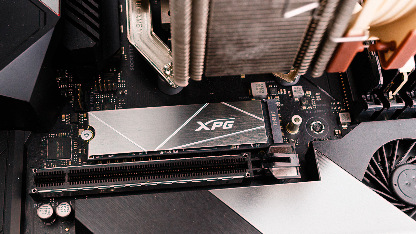
The ADATA XPG Gammix S70 Blade 2 TB -- the larger of the two original IG5236-driven S70 Blade capacities, distinct from the later 2023 Update -- pairs 7,400 MB/s reads and 6,400 MB/s writes with a five-year, 1,480 TBW warranty that still holds up in 2026.
Controller & Memory
The ADATA XPG Gammix S70 Blade 2 TB (Old Version) is the flagship capacity of the original launch edition of ADATA's enthusiast PCIe 4.0 line, powered by InnoGrit's IG5236 "Rainier" eight-channel controller paired with Micron 96-layer 3D TLC NAND and 2 GB of Samsung DDR4-2666 DRAM across two dies. ADATA later refreshed the platform as the 2023 Update, which replaced the 96-layer flash with Micron 176-layer TLC and pushed sequential writes from 6,400 MB/s to 6,800 MB/s, but the original Blade reviewed here defined the value proposition: near-flagship Gen4 throughput at street pricing that undercut the Samsung 980 Pro and WD Black SN850 at launch. The drive sits on a standard M.2 2280 single-sided PCB and ships with a thin pre-applied heatsink that keeps total height below 11.25 millimetres, clearing the Sony PS5 expansion slot clearance requirement, though desktop users should plan on motherboard M.2 heatsink coverage for sustained writes.
ADATA sold the original S70 Blade in 1 TB and 2 TB capacities only. Both share the same IG5236 controller, DRAM architecture, and 7,400 MB/s peak sequential read rating, but the 2 TB is the stronger capacity on every meaningful metric. It reaches the IG5236 platform's full 6,400 MB/s sequential write ceiling because twice the NAND dies supply twice the write striping parallelism, while the 1 TB is capped at 5,500 MB/s writes per ADATA's product-page specification sheet. The 2 TB also carries a larger SLC cache, so it sustains full-speed burst writes longer before settling to the native TLC rate. Endurance doubles to 1,480 TBW from the 1 TB's 740 TBW -- a linear per-terabyte scale that keeps the drive competitive with class leaders. The drive is now discontinued and the 2023 Update is the current revision, so the original Blade is primarily a used-market or clearance-aisle find. That does not make it irrelevant -- the IG5236 remains a capable Gen4 controller, and 1,480 TBW on a 2 TB drive is a healthy endurance budget for anything short of a write-heavy database server.
The S70 Blade's natural competition at launch included the Samsung 980 Pro, WD Black SN850, and Seagate FireCuda 530, all PCIe 4.0 flagships with DRAM caches. The 980 Pro 2 TB and SN850 2 TB both delivered marginally faster sustained writes in independent benchmarks, and the FireCuda 530 2 TB carried a higher 2,550 TBW rating but cost more at launch. In 2026 the competitive field is deeper: the Samsung 990 Pro 2 TB and WD Black SN850X 2 TB sit on the PCIe 4.0 top tier, and countless DRAM-less HMB drives at the budget end match the Blade's burst reads but fall well short on sustained writes and mixed-I/O latency. The original Blade occupies a defensible middle ground as a PS5-ready Gen4 drive with a discrete DRAM cache, a proven IG5236 platform, and a 2 TB capacity that handles a large game library with room to spare. The only reason to skip it for its 2023 Update sibling is the newer NAND's 6,800 MB/s write ceiling and the longer production support runway.
Storage Comparisons:
XPG Gammix S70 Blade Old Version Performance & Benchmarks
On the 2 TB ADATA XPG Gammix S70 Blade Old Version, sequential reads are rated at up to 7,400 MB/s over a PCIe 4.0 x4 link, and sequential writes hit the IG5236 platform ceiling at 6,400 MB/s -- the full write speed the controller can sustain, unlocked by the 2 TB's doubled NAND die count versus the 1 TB model. Random performance is rated at up to 650,000 read IOPS and 740,000 write IOPS per johnnylucky.org's specification entry for the 2 TB Old Version. The SLC cache absorbs burst writes at the full rated speed until it fills, after which writes settle to the native Micron TLC rate, and the 2 TB's larger cache means it stays in burst mode longer than the 1 TB under a contiguous transfer.
ADATA XPG Gammix S70 Blade Old Version 2 TB vs M.2 4.0 x 4 peers
Switch between sequential throughput and random IOPS to see how this drive stacks up against other M.2 4.0 x 4 SSDs in our database. The highlighted bar is the drive on this page — click any other bar to open that drive.
- Patriot Viper PV593 1 TB: 14,500 MB/s read, 14,000 MB/s write
- Patriot Viper PV593 2 TB: 14,500 MB/s read, 14,000 MB/s write
- Patriot Viper PV593 4 TB: 14,500 MB/s read, 14,000 MB/s write
- Patriot Viper PV573 2 TB: 14,000 MB/s read, 12,000 MB/s write
- ADATA XPG Gammix S70 Blade Old Version 2 TB (this drive): 7,400 MB/s read, 6,400 MB/s write
In daily use the S70 Blade 2 TB is quick but not class-leading. Independent reviewers at launch found game load times within a second of the Samsung 980 Pro and WD Black SN850, meaning the gap is invisible outside of stopwatch testing. Where the IG5236 platform earns its keep is on mixed-I/O workloads: the eight-channel controller and 2 GB of discrete DRAM keep latency low when the drive is serving reads and writes simultaneously, something DRAM-less HMB designs struggle with. For a pure gaming desktop or a PS5 that largely reads from the drive, the 2 TB Blade is indistinguishable from newer PCIe 4.0 flagships at a distance and holds a practical advantage over the 1 TB in its larger capacity headroom. For a video scratch disk or a moderate write workload, the 2 TB's 6,400 MB/s write ceiling and 1,480 TBW endurance make it a meaningfully stronger choice than the 1 TB sibling -- the combination of full-speed writes, larger SLC cache, and doubled endurance narrows the gap against current PCIe 4.0 leaders. No heatsink beyond the pre-applied strip is included in the box, and the IG5236 runs warm enough under sustained load that motherboard heatsink coverage is recommended.
ADATA XPG Gammix S70 Blade Old Version vs Competitors
See how the XPG Gammix S70 Blade Old Version stacks up against other M.2 4.0 x 4 drives in our database:
Compare with rival drives:
Endurance, TBW & Warranty
ADATA covers the XPG Gammix S70 Blade 2 TB with a five-year limited warranty, ending early only if the 1,480 TBW endurance rating is exceeded. That figure doubles the 1 TB model's 740 TBW and sits well above the PCIe 4.0 class average of roughly 600 TBW per terabyte. At a typical consumer workload of around 20 GB of writes per day, the 2 TB Blade would need roughly two centuries to exhaust the NAND, so in practice the five-year warranty term expires long before the flash endurance does. Even at a heavier 50 GB per day the drive clears eight decades. ADATA rates the drive at two million hours MTBF, but treat that figure as a population-reliability projection across a large fleet rather than a lifespan promise for any single unit. The warranty is handled through ADATA's standard RMA process, and ADATA has maintained reasonably responsive warranty service for XPG-branded SSDs, though turnaround times vary by region.
ADATA XPG Gammix S70 Blade Old Version 2 TB Specifications
| Category | Value |
|---|---|
| Capacity [?] | 2 TB |
| Interface [?] | M.2 4.0 x 4 |
| Controller [?] | Innogrit IG5236 |
| Memory type [?] | Micron 96-L TLC |
| DRAM [?] | Yes |
| Read speed (MB/s) [?] | 7400 |
| Write speed (MB/s) [?] | 6400 |
| Read IOPS [?] | 650000 |
| Write IOPS [?] | 740000 |
| Endurance (TBW) [?] | 1480 |
| MTBF (million hours) [?] | 2000000 |
| Warranty (years) [?] | 5 |
Verdict: Is the XPG Gammix S70 Blade Old Version Worth It in 2026?
Buy the ADATA XPG Gammix S70 Blade 2 TB (Old Version) on the used market or clearance when the price undercuts a new DRAM-equipped PCIe 4.0 2 TB drive, because the IG5236 platform, full 6,400 MB/s writes, and 1,480 TBW endurance deliver a capable Gen4 experience for gaming, general use, and moderate write workloads. Skip it at full retail or when the 2023 Update is priced similarly, since the newer version's 176-layer TLC brings 6,800 MB/s writes and a longer production support runway. Skip the 1 TB sibling for any workload that involves sustained writes or large file transfers, because the 2 TB's doubled NAND die count unlocks the platform's full write speed and doubles endurance for a modest price premium on the used market. The Samsung 980 Pro 2 TB is the closest alternative -- similar peak reads, marginally faster sustained writes in independent benchmarks, and a more established firmware support record -- while the WD Black SN850 2 TB trades a slight TBW deficit for a longer independent review history. The verdict on the original S70 Blade 2 TB is that it is the better buy of the two original capacities and the IG5236 platform at its best: full-speed writes, doubled endurance, and a larger SLC cache make it a serviceable, DRAM-backed Gen4 drive in 2026, provided the price reflects its discontinued status.
+ Pros
- 7,400 MB/s reads and 6,400 MB/s writes over PCIe 4.0 x4
- 1,480 TBW endurance on the 2 TB model
- InnoGrit IG5236 eight-channel controller with 2 GB DRAM
- Single-sided M.2 2280 PCB fits PS5 and thin laptops
- Pre-applied low-profile heatsink clears PS5 height limit
- Five-year warranty, TBW-limited
- Larger SLC cache than the 1 TB variant
- Cons
- Discontinued; replaced by the 2023 Update with 176L NAND
- No independent firmware support track record like Samsung or WD
- IG5236 runs warm under sustained writes without motherboard heatsink
- Slower sustained writes than PCIe 4.0 leaders like 990 Pro or SN850X
- Read IOPS slightly behind the 1 TB variant (650K vs 740K)
- Seagate FireCuda 530 2 TB offers higher 2,550 TBW endurance
Buy this or similar SSD Storage:



Video Review
Ултра бързо NVMe - XPG Gammix S70 Blade Ревю