ADATA XPG S50 Lite 2TB Review — Budget PCIe 4.0 NVMe SSD (2026)
Quick answer
The ADATA XPG Gammix S50 Lite 2 TB is the capacity to buy if you want the most endurance per dollar in a budget PCIe 4.0 drive.
Read: 3900 MB/s Write: 3200 MB/s Endurance: 1480 TBW Warranty: 5 years Interface: M.2 4.0 x 4
The ADATA XPG Gammix S50 Lite 2 TB doubles the endurance of its 1 TB sibling to 1,480 TBW while keeping the same budget-friendly DRAM-less HMB design, making it the value pick for a roomy game library on a single M.2 slot.
Controller & Memory
The 2 TB XPG Gammix S50 Lite is the fully populated variant of ADATA's Silicon Motion SM2267 platform — a 4-channel, DRAM-less controller that relies on Host Memory Buffer (HMB) to borrow system RAM instead of carrying dedicated DRAM. The NAND is Micron 3D TLC, and the drive sits on a single-sided M.2 2280 PCB. The 2 TB capacity does not increase the sequential speed ratings — they remain 3,900 MB/s read and 3,200 MB/s write, the ceiling of the SM2267's 4-channel design — but it doubles the endurance to 1,480 TBW and gives the drive a larger SLC write cache thanks to the extra NAND real estate.
ADATA also sells the S50 Lite in a 1 TB capacity, which drops to 740 TBW endurance with the same speed ratings. The 2 TB variant reviewed here is the one to pick if you want a single-drive solution for a budget gaming desktop — enough space for a large OS partition, a deep Steam library, and room for media and projects without juggling multiple drives. The single-sided PCB and low thermal output make this a practical drop-in for laptops as well, though most laptop M.2 slots top out at PCIe 3.0 speeds and will cap the drive at roughly 3,500 MB/s anyway.
The S50 Lite 2 TB competes in the budget-capacity segment against the Samsung 980 2 TB, WD Blue SN580 2 TB, and Crucial P3 2 TB. The Samsung 980 is another DRAM-less PCIe 3.0 drive with lower endurance (1,200 TBW); the SN580 brings PCIe 4.0 but similar real-world throughput; the Crucial P3 uses QLC NAND and drops to dramatically lower sustained write speeds after its cache fills. The S50 Lite's advantage in this group is its TLC NAND paired with the 1,480 TBW endurance rating — the highest in the budget DRAM-less class at 2 TB.
Storage Comparisons:
XPG Gammix S50 Lite Performance & Benchmarks
The 2 TB S50 Lite is rated for up to 3,900 MB/s sequential reads and 3,200 MB/s sequential writes — figures that barely clear the PCIe 3.0 ceiling and place it firmly in the budget tier of Gen 4 drives. Random performance is rated at up to 490,000 read IOPS and 540,000 write IOPS. In real-world gaming and desktop use, the experience is indistinguishable from any NVMe drive — game levels load in seconds, Windows boots in single-digit seconds, and the HMB design keeps latency tight for the bursty workloads that define consumer use.
ADATA XPG Gammix S50 Lite 2 TB vs M.2 4.0 x 4 peers
Switch between sequential throughput and random IOPS to see how this drive stacks up against other M.2 4.0 x 4 SSDs in our database. The highlighted bar is the drive on this page — click any other bar to open that drive.
- Patriot Viper PV593 1 TB: 14,500 MB/s read, 14,000 MB/s write
- Patriot Viper PV593 2 TB: 14,500 MB/s read, 14,000 MB/s write
- Patriot Viper PV593 4 TB: 14,500 MB/s read, 14,000 MB/s write
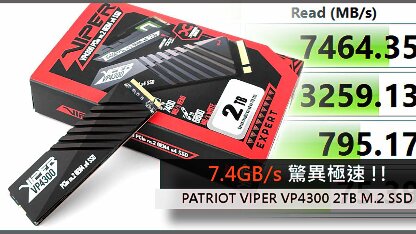
- Patriot Viper PV573 2 TB: 14,000 MB/s read, 12,000 MB/s write
- ADATA XPG Gammix S50 Lite 2 TB (this drive): 3,900 MB/s read, 3,200 MB/s write
The 2 TB capacity benefits from a larger pSLC write cache than the 1 TB variant — independent testing of the SM2267 platform suggests roughly 100—130 GB of cached write headroom on the 2 TB model before the controller drops to direct-to-TLC writes at roughly 800—1,000 MB/s. This is still slower than DRAM-equipped PCIe 4.0 drives, but the larger cache means most real-world transfers complete at full speed. For a game library drive where writes are mostly large initial installs followed by long stretches of reads, the post-cache slowdown is an infrequent concern. The drive runs cool under load and does not require a heatsink in a desktop with any airflow or in a laptop with a factory thermal pad.
ADATA XPG Gammix S50 Lite vs Competitors
See how the XPG Gammix S50 Lite stacks up against other M.2 4.0 x 4 drives in our database:
Compare with rival drives:
Endurance, TBW & Warranty
The 2 TB XPG Gammix S50 Lite carries a 1,480 TBW endurance rating and a 5-year limited warranty, whichever limit is reached first. At a typical desktop write rate of 20—50 GB per day, this works out to roughly 80 to 200 years of usable life — the warranty will expire long before the NAND approaches its rated write endurance. The MTBF is rated at 2 million hours, a population-level statistic rather than a per-drive lifespan indicator. For context, the Samsung 980 2 TB — another DRAM-less drive — is rated at 1,200 TBW, while the WD Blue SN580 2 TB is also at 1,200 TBW. The S50 Lite's 1,480 TBW is the highest in the budget DRAM-less 2 TB class. ADATA handles warranty claims through its standard RMA process.
ADATA XPG Gammix S50 Lite 2 TB Specifications
| Category | Value |
|---|---|
| Capacity [?] | 2 TB |
| Interface [?] | M.2 4.0 x 4 |
| Controller [?] | Silicon Motion SM2267 |
| Memory type [?] | Micron 3D TLC |
| DRAM [?] | SLC Caching and Host Memory Buffer |
| Read speed (MB/s) [?] | 3900 |
| Write speed (MB/s) [?] | 3200 |
| Read IOPS [?] | 490000 |
| Write IOPS [?] | 540000 |
| Endurance (TBW) [?] | 1480 |
| MTBF (million hours) [?] | 2 |
| Warranty (years) [?] | 5 |
Verdict: Is the XPG Gammix S50 Lite Worth It in 2026?
The ADATA XPG Gammix S50 Lite 2 TB is the capacity to buy if you want the most endurance per dollar in a budget PCIe 4.0 drive. It delivers 1,480 TBW — the highest in the DRAM-less class — in a cool-running single-sided form factor that fits anywhere an M.2 2280 drive goes. The performance ceiling is modest: you are getting PCIe 3.0-class speeds on a Gen 4 interface, and the HMB design means sustained mixed-workload throughput will not match a DRAM-equipped drive. Skip the S50 Lite if your workflow involves heavy video editing, large database operations, or sustained sequential transfers — the small SLC cache will be a recurring bottleneck. For those use cases, step up to the WD Black SN770 2 TB or the ADATA XPG Gammix S70 2 TB. For a budget gaming library, a laptop upgrade, or a secondary drive that holds your Steam folder, the S50 Lite 2 TB does exactly what it promises and is easy to recommend at its price point.
+ Pros
- 1,480 TBW endurance — highest in the budget DRAM-less 2 TB class
- Single-sided PCB fits thin laptops and ultrabooks
- 3,900 MB/s reads on a PCIe 4.0 interface
- 5-year warranty matches premium drives
- TLC NAND avoids the sustained-write cliff of QLC competitors
- Cool-running under normal desktop workloads
- Cons
- DRAM-less HMB design limits sustained mixed-workload throughput
- Post-cache write speed drops to roughly 800—1,000 MB/s
- 3,200 MB/s writes are closer to PCIe 3.0 than Gen 4 territory
- No hardware encryption support
- PCIe 4.0 speeds only apply when installed in a Gen 4 slot
Buy this or similar SSD Storage:



Video Review
Are Budget PCIe 4 SSDs Worth It?? - ADATA XPG GAMMIX S50 Lite