Addlink AddGame A93 4TB: The Flagship DRAM-less PCIe 4.0 NVMe (2026)
Quick answer
The Addlink AddGame A93 4 TB earns its place as the endurance king of the budget PCIe 4.0 HMB tier.
Read: 7400 MB/s Write: 6500 MB/s Endurance: 3000 TBW Warranty: 5 years Interface: M.2 4.0 x 4
The Addlink AddGame A93 4 TB is the top-capacity variant of Addlink's budget PCIe 4.0 line, delivering 7,400 MB/s reads and 3,000 TBW endurance from a DRAM-less Maxio MAP1602A controller and YMTC 232-layer TLC — with an aluminium heatsink in the box and PS5 compatibility at a competitive price per terabyte.
Controller & Memory
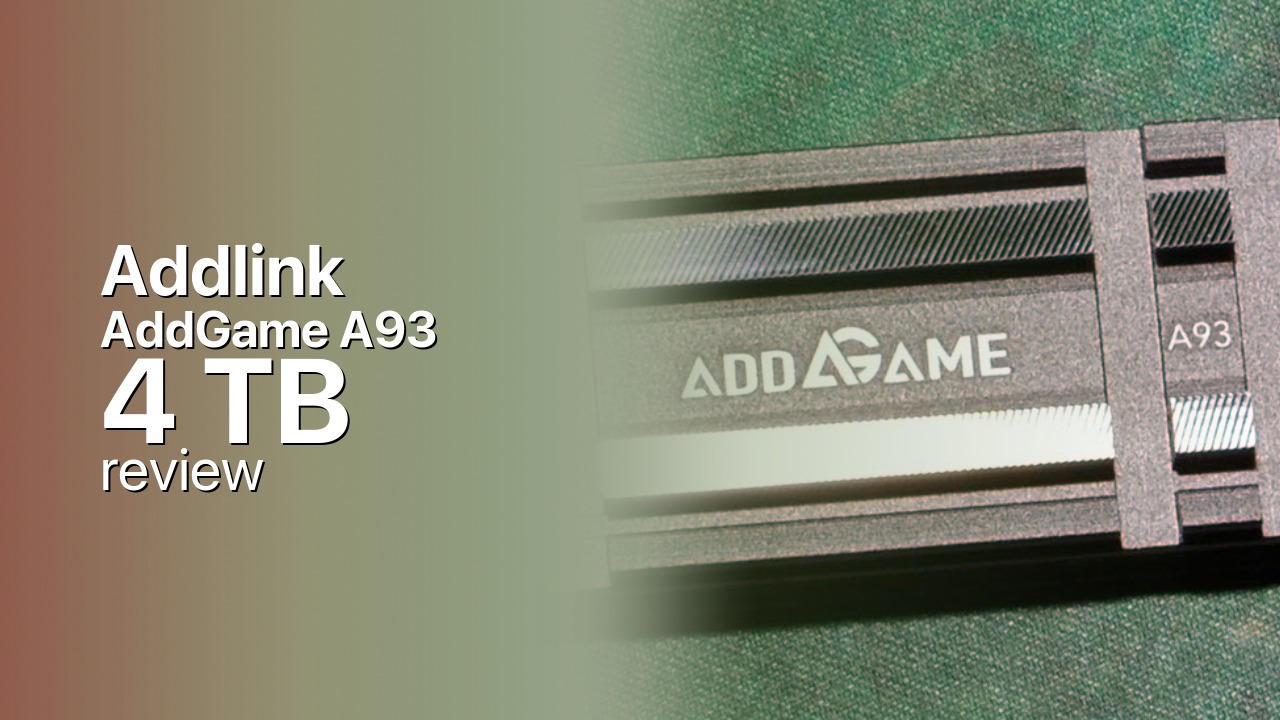
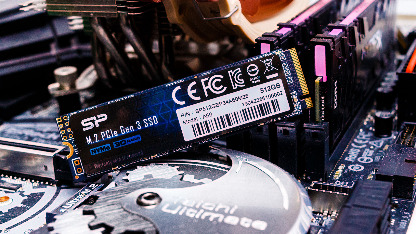
The Addlink AddGame A93 4 TB runs the same Maxio MAP1602A Falcon Lite controller as its 1 TB and 2 TB siblings — a four-channel DRAM-less design on TSMC 12 nm silicon that leans on Host Memory Buffer to borrow roughly 32 MB of system RAM for the flash translation layer instead of carrying discrete DRAM. The NAND is YMTC 232-layer TLC with Xtacking 3.0, and the drive lands on a single-sided M.2 2280 PCB behind a PCIe 4.0 x4 link. Addlink ships every A93 with a low-profile aluminium heatsink — an 8.75 mm crosscut-grid plate with a pre-applied silica thermal pad — that claims a 20 percent temperature reduction versus bare operation. The 4 TB reviewed here is the flagship: it hits the same 7,400 MB/s sequential read and 6,500 MB/s write ceiling as the 2 TB model, both faster than the 1 TB at 7,200/6,100 MB/s, and its endurance quadruples the entry model at 3,000 TBW.
The speed gap between the 1 TB and the 4 TB comes from NAND parallelism — the higher capacities populate more of the controller's four channels with denser dies, giving the MAP1602A more flash packages to interleave across. Random IOPS are controller-limited at 1,000,000 read and 820,000 write across all three capacities, so the real-world upgrade from the smaller variants is not about peak burst throughput — it is about sustained write headroom. The 4 TB's SLC write cache is the largest in the family, proportional to total NAND, so it absorbs longer sequential writes at full speed before dropping to native TLC rate. For a content creator moving hundreds of gigabytes of footage or a gamer carrying a triple-digit Steam library, this is the capacity that turns the A93 from a competent boot drive into a genuine workhorse.
At 4 TB the competitive field shifts. The 1 TB A93 trades blows with the WD Black SN770 and Team Group MP44 at the entry tier; the 4 TB faces fewer direct rivals because most budget DRAM-less drives top out at 2 TB. The closest spec-sheet match is the Lexar NM790 4 TB — same MAP1602A controller, same YMTC 232L NAND, same 7,400/6,500 MB/s speeds, same 3,000 TBW endurance, even the same single-sided PCB — though the Lexar ships bare while the A93 includes the heatsink. The Team Group MP44 4 TB pushes writes to 6,900 MB/s but carries 2,500 TBW against the A93's 3,000 TBW. The Samsung 990 EVO Plus 4 TB is the pricier HMB alternative at 7,250/6,900 MB/s and 2,400 TBW. At the budget QLC end, the Crucial P3 Plus 4 TB is cheaper but delivers 4,800 MB/s reads and just 800 TBW — less than a third of the A93's endurance. Compatibility is standard PCIe 4.0 fare: the drive works in any M.2 NVMe slot, is backward-compatible with PCIe 3.0 at half throughput, clears Sony's 5,500 MB/s PS5 recommendation, and the bundled 8.75 mm heatsink fits under the console's 11.25 mm ceiling.
Storage Comparisons:
AddGame A93 Performance & Benchmarks
On the 4 TB AddGame A93, Addlink rates sequential reads at 7,400 MB/s and writes at 6,500 MB/s over a PCIe 4.0 x4 link, with random performance rated up to 1,000,000 read IOPS and 820,000 write IOPS — identical to the 2 TB sibling and matching the controller-limited ceiling of the MAP1602A platform. The 4 TB matches the peak speeds of the 2 TB and sits roughly 3 percent ahead of the 1 TB variant in sequential reads and 6 percent ahead in writes, a gap that is invisible in game loads and OS boots but noticeable in sustained large-file transfers where the additional NAND parallelism shortens completion times by seconds to tens of seconds.
Addlink AddGame A93 4 TB vs M.2 4.0 x 4 peers
Switch between sequential throughput and random IOPS to see how this drive stacks up against other M.2 4.0 x 4 SSDs in our database. The highlighted bar is the drive on this page — click any other bar to open that drive.
- Patriot Viper PV593 1 TB: 14,500 MB/s read, 14,000 MB/s write
- Patriot Viper PV593 2 TB: 14,500 MB/s read, 14,000 MB/s write
- Patriot Viper PV593 4 TB: 14,500 MB/s read, 14,000 MB/s write
- Patriot Viper PV573 2 TB: 14,000 MB/s read, 12,000 MB/s write
- Addlink AddGame A93 4 TB (this drive): 7,400 MB/s read, 6,500 MB/s write
What distinguishes the 4 TB from the smaller capacities is the sustained write profile. The SLC write cache scales with total NAND capacity, so the 4 TB absorbs roughly four times the burst-write volume of the 1 TB before exhausting the cache and dropping to native YMTC TLC speed. For workloads that move large project files, video footage, or extensive game installations, the 4 TB stays at full PCIe 4.0 throughput for longer stretches. Under PCMag's testing the 1 TB A93 delivered sequential CrystalDiskMark results that matched its rated speeds and scored above average in PCMark 10 Storage traces; the 4 TB shares the same controller and NAND so the random-access latency and application-load profile carries over, with the larger cache shifting the sustained-write knee further out. The bundled aluminium heatsink is a genuine contributor to sustained throughput — the MAP1602A runs cool under typical desktop loads, but extended sequential writes raise controller temperature, and the factory heatsink keeps the drive out of thermal throttling territory longer than a bare PCB would manage. For a 4 TB drive that may realistically see bulk write workloads — something less common on a 1 TB boot drive — the factory cooling is more than a convenience.
Addlink AddGame A93 vs Competitors
See how the AddGame A93 stacks up against other M.2 4.0 x 4 drives in our database:
Compare with rival drives:
Endurance, TBW & Warranty
Addlink covers the AddGame A93 4 TB with a five-year limited warranty, capped by whichever arrives first between the five-year term and the 3,000 TBW endurance rating. That TBW figure is the ceiling of a line that scales from 750 TBW at 1 TB through 1,500 TBW at 2 TB, holding a consistent 750 TBW per terabyte across all three capacities — a scaling pattern that tracks YMTC 232-layer TLC's rated cycle life and sits well above the budget PCIe 4.0 average. The closest rival at 4 TB is the Lexar NM790, which also carries 3,000 TBW and the same MAP1602A platform, but the Team Group MP44 4 TB stops at 2,500 TBW and the Samsung 990 EVO Plus 4 TB at 2,400 TBW. Even the WD Black SN850X 4 TB, a pricier drive with discrete DRAM, is rated for 2,400 TBW — the A93's endurance lead is substantial at every capacity tier.
At a typical consumer workload of 20 GB of writes per day the 4 TB would need more than 400 years to exhaust its write budget, so the five-year warranty term expires long before the NAND approaches its rated limit. Even a heavy 100 GB-per-day content-creation workflow clears 80 years. Addlink rates the drive at 2 million hours MTBF, which is a population-reliability statistic describing expected failure rates across a large fleet rather than a lifespan prediction for any individual unit. The warranty is serviced through the retailer or distributor; Addlink does not operate a direct end-user RMA portal in most regions, and warranty fulfilment depends on the point-of-sale channel.
Addlink AddGame A93 4 TB Specifications
| Category | Value |
|---|---|
| Capacity [?] | 4 TB |
| Interface [?] | M.2 4.0 x 4 |
| Controller [?] | Maxio Tech MAP1602-C |
| Memory type [?] | YMTC 232-L TLC |
| DRAM [?] | No |
| Read speed (MB/s) [?] | 7400 |
| Write speed (MB/s) [?] | 6500 |
| Read IOPS [?] | 1000000 |
| Write IOPS [?] | 820000 |
| Endurance (TBW) [?] | 3000 |
| MTBF (million hours) [?] | 2000000 |
| Warranty (years) [?] | 5 |
Verdict: Is the AddGame A93 Worth It in 2026?
The Addlink AddGame A93 4 TB earns its place as the endurance king of the budget PCIe 4.0 HMB tier. At 3,000 TBW it outlasts every direct competitor at the 4 TB capacity — including drives with discrete DRAM that sell at a higher price — and the bundled aluminium heatsink removes the hassle of sourcing third-party cooling. The 7,400/6,500 MB/s speed ceiling is competitive although not class-leading, and the single-sided PCB keeps installation straightforward in thin laptops and the PS5 expansion bay.
Buyers who do not need 4 TB should look at the 2 TB sibling, which offers the same peak speeds and 1,500 TBW at a meaningfully lower price. The 1 TB is the entry ticket for pure gaming builds where a larger library fits on a secondary drive. The Lexar NM790 4 TB is the closest alternative — same controller, same NAND, same endurance, same speeds — but ships bare, so anyone who would otherwise add a heatsink should default to the A93. The A93 is not built for write-intensive workstation scratch-disk duty where discrete DRAM and higher channel counts matter; for that workload the WD Black SN850X 4 TB justifies its premium. For a large, fast, durable game-and-media drive that arrives with everything needed in the box, the A93 4 TB is the best value in its class.
+ Pros
- 3,000 TBW endurance leads the budget PCIe 4.0 tier
- 7,400/6,500 MB/s sequential speeds on PCIe 4.0
- Aluminium heatsink included in the box
- Single-sided M.2 2280 fits thin laptops and PS5
- YMTC 232-layer TLC at 4 TB — no QLC at this price
- Five-year warranty with per-terabyte endurance scaling
- Largest SLC cache in the A93 family
- Cons
- DRAM-less HMB design limits sustained random I/O versus discrete DRAM
- No AES 256-bit hardware encryption
- Warranty serviced through retailer, no direct end-user RMA portal
- 4 TB premium over 2 TB may exceed most buyers' needs
- No independent 4 TB review — performance data scaled from 1 TB PCMag unit
Buy this or similar SSD Storage:
Video Review
Ultimate PS5 SSD Upgrade? Addlink A93 4TB Tested!