Lexar NM710 2TB Review — Budget Capacity Done Properly (2026)
Quick answer
Buy the Lexar NM710 2TB when the mission is capacity on a budget and the workload is read-heavy: game libraries, media archives, and second-PC storage all suit it, and the 1,200 TBW rating plus 5-year warranty remove the usual anxieties about cheap high-capacity drives.
Read: 4850 MB/s Write: 4500 MB/s Endurance: 1200 TBW Warranty: 5 years Interface: M.2 4.0 x 4
The Lexar NM710 2TB tops its budget range with 1,200 TBW of endurance and 4,500 MB/s writes, asking only 150 MB/s of read speed as the trade.
Controller & Memory
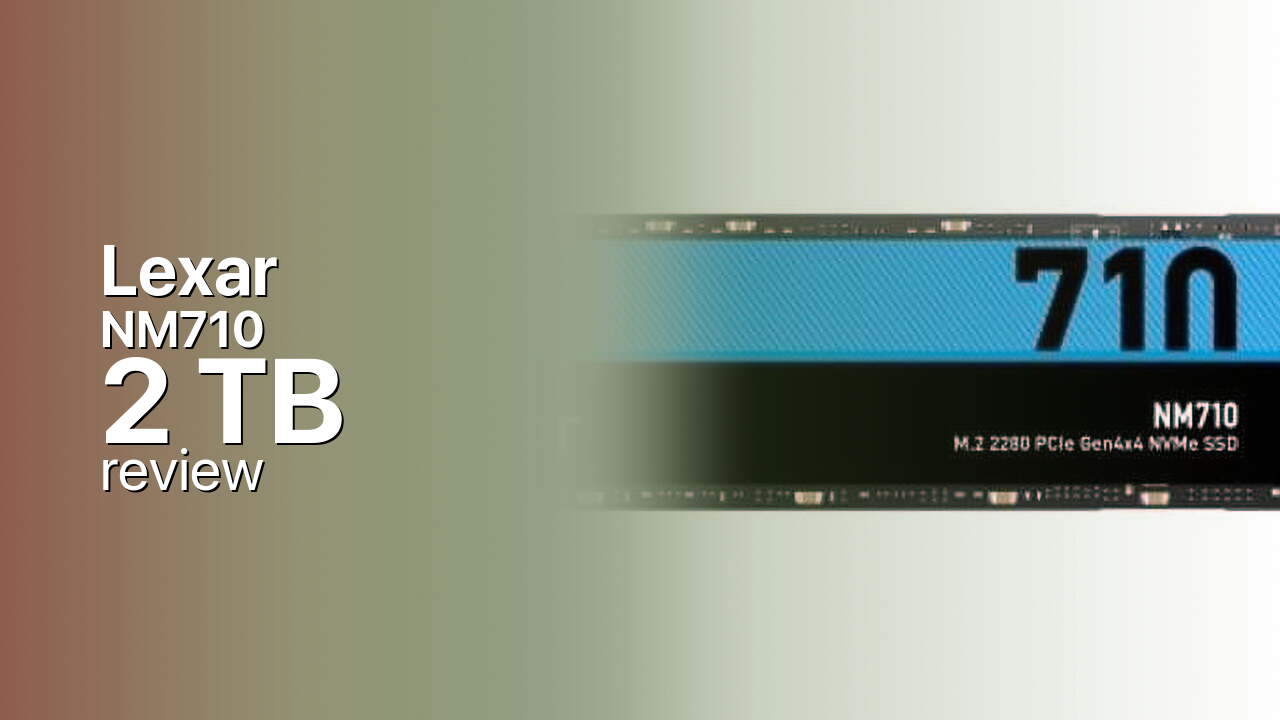
The Lexar NM710 2TB is the capacity leader of Lexar's budget PCIe 4.0 line, built on the same platform as its siblings: a Maxio MAP1602 controller running four channels with no DRAM, HMB 3.0 borrowing system memory for the mapping tables, and a dynamic SLC cache in front of Micron 176-layer TLC NAND per the launch-era specifications. It is a 7-gram, 2.45 mm-thin M.2 2280 stick on PCIe 4.0 x4 with NVMe 1.4, rated at 4,850 MB/s reads and 4,500 MB/s writes.
The read figure tells the range's one story of compromise: the 2 TB model gives back 150 MB/s against the 5,000 MB/s of the 500 GB and 1 TB models, the price of packing double the NAND into the same footprint. Everything else scales the way buyers hope. Writes hold at the full 4,500 MB/s, and endurance doubles again to 1,200 TBW — four times the 512 GB model's budget — under the same 5-year warranty and 1.5 million-hour MTBF rating that runs line-wide. Directly above sits the NM790 2TB, Lexar's mainstream alternative, which raises the stakes to 7,400/6,500 MB/s and 1,500 TBW for somewhat more money.
The buyer here is a capacity-first planner: a game library that outgrew 1 TB, a media archive, or a secondary drive for a second PC. Against same-tier rivals such as the Kingston NV2 and WD Blue SN580 at 2 TB, the NM710 competes on ratings, warranty terms, and a spec sheet with no hidden traps. As a PS5 drive it falls just short of Sony's 5,500 MB/s read guidance, so console planners should look to faster options.
Storage Comparisons:
NM710 Performance & Benchmarks
Lexar rates the 2TB NM710 at 4,850 MB/s sequential reads and 4,500 MB/s writes over PCIe 4.0 x4, and like the rest of the range it publishes no random IOPS figures — TechPowerUp's database lists them as officially unknown. The sequential numbers are the practical story: reads sit at the front of the budget tier and embarrass every SATA drive ever made, while 4,500 MB/s writes match the 1 TB model outright.
Lexar NM710 2 TB vs M.2 4.0 x 4 peers
Switch between sequential throughput and random IOPS to see how this drive stacks up against other M.2 4.0 x 4 SSDs in our database. The highlighted bar is the drive on this page — click any other bar to open that drive.
- Patriot Viper PV593 1 TB: 14,500 MB/s read, 14,000 MB/s write
- Patriot Viper PV593 2 TB: 14,500 MB/s read, 14,000 MB/s write
- Patriot Viper PV593 4 TB: 14,500 MB/s read, 14,000 MB/s write
- Patriot Viper PV573 2 TB: 14,000 MB/s read, 12,000 MB/s write
- Lexar NM710 2 TB (this drive): 4,850 MB/s read, 4,500 MB/s write
The behavior under load follows the standard DRAM-less playbook. A dynamic SLC cache absorbs game installs and batch copies at full speed, then throughput settles to native TLC rates once very large transfers exhaust it — at 2 TB, the cache is generous, so most real-world workloads never see the drop. Random-heavy write sessions are where the missing DRAM shows, and that simply is not what this drive is for. Reviewers across the NM710 line describe the same character: burst performance that feels like a mainstream drive, honest sustained behavior, and no thermal drama in a well-ventilated slot thanks to the frugal 7-gram single-stick design. For bulk storage duty, that is exactly the profile that matters.
Lexar NM710 vs Competitors
See how the NM710 stacks up against other M.2 4.0 x 4 drives in our database:
Compare with rival drives:
Endurance, TBW & Warranty
Lexar backs the NM710 2TB with a 5-year limited warranty rated to 1,200 TBW, whichever arrives first. That is the best endurance in the range — quadruple the 512 GB model and double the 1 TB — and at a demanding 40 GB written per day it would take more than eight decades to exhaust. The rated MTBF is 1.5 million hours, a fleet-level statistic rather than a promise about any individual drive. The 5-year coverage runs line-wide, matching what Lexar gives its premium NM790 series and beating the 3-year terms still common on budget drives. Claims are handled through Lexar directly in most regions, so keeping proof of purchase is worthwhile.
Lexar NM710 2 TB Specifications
| Category | Value |
|---|---|
| Capacity [?] | 2 TB |
| Interface [?] | M.2 4.0 x 4 |
| Controller [?] | Maxio MAP1602A 4 Channel |
| Memory type [?] | Micron 176-L TLC |
| DRAM [?] | No |
| Read speed (MB/s) [?] | 4850 |
| Write speed (MB/s) [?] | 4500 |
| Read IOPS [?] | |
| Write IOPS [?] | |
| Endurance (TBW) [?] | 1200 |
| MTBF (million hours) [?] | 1500000 |
| Warranty (years) [?] | 5 |
Verdict: Is the NM710 Worth It in 2026?
Buy the Lexar NM710 2TB when the mission is capacity on a budget and the workload is read-heavy: game libraries, media archives, and second-PC storage all suit it, and the 1,200 TBW rating plus 5-year warranty remove the usual anxieties about cheap high-capacity drives. Skip it when speed is the point — sustained write sessions and PS5 upgrades both want more than a DRAM-less design reading at 4,850 MB/s. The obvious step-up is the NM790 2TB, which buys 7,400 MB/s reads and 1,500 TBW for a premium, while the Kingston NV2 and WD Blue SN580 play the same budget game with their own trade-offs. As cheap, warrantied 2 TB PCIe 4.0 storage, this is a sound pick.
+ Pros
- 4,850 MB/s reads and 4,500 MB/s writes
- 1,200 TBW endurance with 5-year warranty
- Double the endurance of the 1 TB model
- Largest capacity in the NM710 range
- DRAM-less HMB design runs cool
- Cons
- No DRAM cache on the PCB
- Reads derate 150 MB/s versus smaller models
- Random IOPS ratings unpublished by Lexar
- Just misses Sony's 5,500 MB/s PS5 guidance
Buy this or similar SSD Storage:
Video Review
Lexar NM710 SSD 1TB Review | Blazing Fast Storage!