MSI Spatium M460 1TB Review — Budget QLC, Flagship Warranty (2026)
Quick answer
The MSI Spatium M460 1TB makes sense for budget builders who want Gen4-rated speed and a five-year warranty at QLC money — a boot-and-games drive first and foremost.
Read: 5000 MB/s Write: 4500 MB/s Endurance: 600 TBW Warranty: 5 years Interface: M.2 4.0 x 4
The MSI Spatium M460 1TB is a DRAM-less QLC oddity — 5,000/4,500 MB/s Gen4 ratings and 550K/950K IOPS backed by a five-year, 600 TBW warranty.
Controller & Memory
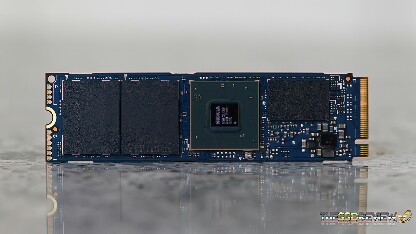
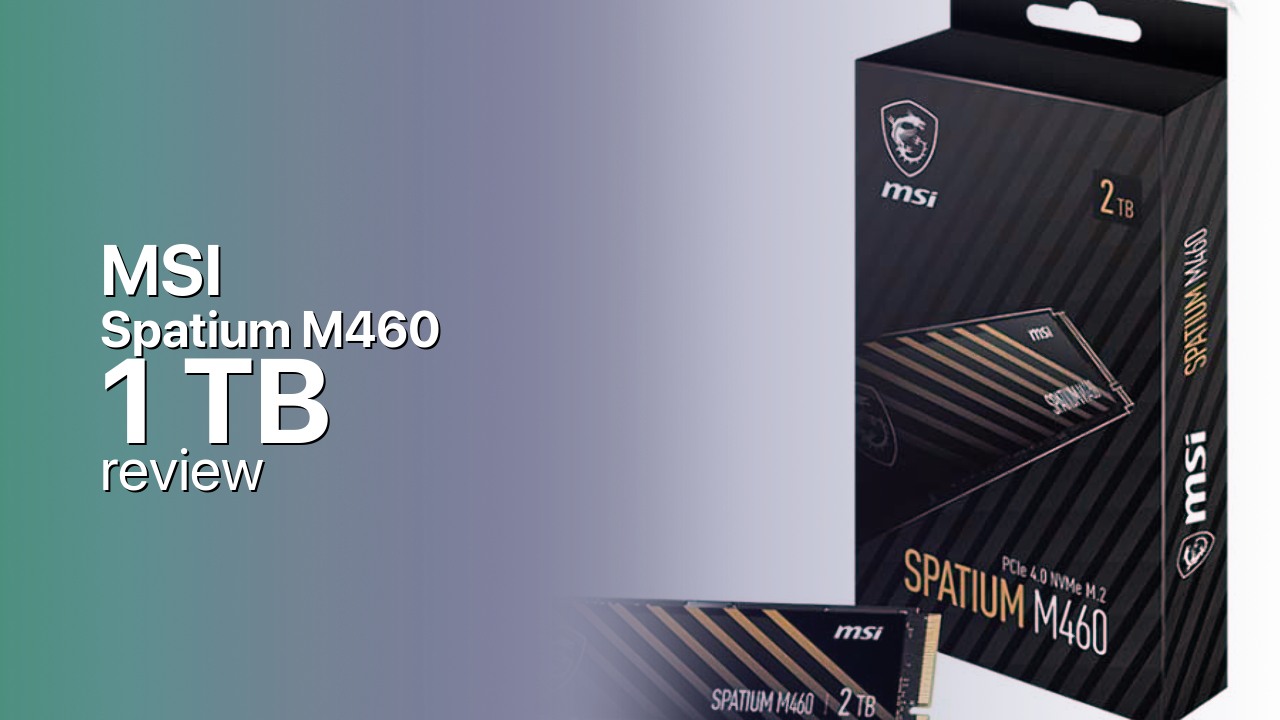
The MSI Spatium M460 1TB sits at the value end of MSI's storage range, and its internals explain the price: a four-channel Phison E21T controller running DRAM-less with Host Memory Buffer, paired with QLC NAND that is widely reported to come from Micron's 176-layer generation, the same flash class used in budget OEM drives. Rated throughput lands at 5,000 MB/s sequential reads and 4,500 MB/s writes over PCIe 4.0 x4, with 550K random-read and 950K random-write IOPS, all in a standard M.2 2280 layout. MSI also sells an M460 HS variant that bolts on a factory heatsink; the bare drive reviewed here needs an aftermarket cooler for any console duty.
The range runs from 250 GB to 2 TB, and the capacities are not interchangeable on paper. The 1 TB model posts the family's best write rating at 4,500 MB/s and even edges the 2 TB (4,900/4,400 MB/s) on both ends of the scale, while carrying 600 TBW of endurance to the 2 TB's 1,200 TBW. Endurance scales 200/300/600/1,200 TBW across the lineup, all under the same five-year warranty — unusually generous terms for QLC flash at this tier.
The audience is the budget builder who wants a fast boot drive or game-storage upgrade and is willing to trade TLC endurance and sustained-write muscle for capacity per dollar. Its direct peers are the Crucial P3 Plus, another QLC design that manages just 220 TBW at 1 TB, and Kingston's NV2, while the WD Blue SN580 is the TLC escape hatch at 4,150 MB/s with triple the P3 Plus's endurance. MSI's own Spatium M480, a TLC design with DRAM, is the in-house step-up. Availability is already patchy in some markets as MSI rotates newer Spatium models in, so stock depends on the seller.
Storage Comparisons:
Spatium M460 Performance & Benchmarks
MSI rates the 1 TB Spatium M460 at 5,000 MB/s sequential reads, 4,500 MB/s writes, 550K random-read IOPS and 950K random-write IOPS — manufacturer figures, and worth treating that way, because independent benchmark coverage of this drive is thin. The strong random-write rating is the pleasant surprise: DRAM-less QLC drives usually publish modest write IOPS, and 950K promises a responsive disk for installs, game patching and everyday multitasking.
MSI Spatium M460 1 TB vs M.2 4.0 x 4 peers
Switch between sequential throughput and random IOPS to see how this drive stacks up against other M.2 4.0 x 4 SSDs in our database. The highlighted bar is the drive on this page — click any other bar to open that drive.
- Patriot Viper PV593 1 TB: 14,500 MB/s read, 14,000 MB/s write
- Patriot Viper PV593 2 TB: 14,500 MB/s read, 14,000 MB/s write
- Patriot Viper PV593 4 TB: 14,500 MB/s read, 14,000 MB/s write
- Patriot Viper PV573 2 TB: 14,000 MB/s read, 12,000 MB/s write
- MSI Spatium M460 1 TB (this drive): 5,000 MB/s read, 4,500 MB/s write
In practice the 5,000 MB/s read rating puts game load times and operating system boots effectively on par with the 7,000 MB/s club, since real-world differences between Gen4 ratings barely register outside large file transfers. The QLC caveat lives in sustained writes: a pseudo-SLC cache absorbs bursts, and once it fills, throughput drops to the flash's native QLC rate, far below the 4,500 MB/s headline. Boot-and-games duty rarely empties the cache; multi-hundred-GB video ingest will, and that is the workload where this drive is the wrong tool.
The rated figures also fall just short of Sony's 5,500 MB/s PS5 recommendation, so console upgraders should look at MSI's faster Spatium models. Every number here is a rated ceiling, not a measured result — at this tier, sustained-write behavior matters more than burst.
MSI Spatium M460 vs Competitors
See how the Spatium M460 stacks up against other M.2 4.0 x 4 drives in our database:
Compare with rival drives:
Endurance, TBW & Warranty
MSI backs the Spatium M460 1TB with a five-year limited warranty or 600 TBW of writes, whichever arrives first — long coverage for a QLC drive at this tier, where three years is common. At a modest 20 GB of writes per day, the 600 TBW budget stretches past 80 years, so the warranty term, not the endurance rating, is the practical limit for nearly every buyer. MSI rates the drive at up to 1.5 million hours MTBF, a population statistic rather than a promise about any individual drive. Claims run through MSI's standard support channels with proof of purchase; as with most consumer SSDs, it pays to check whether your retailer handles the first return or routes you to MSI directly, since that distinction shapes how painless a failure actually is.
MSI Spatium M460 1 TB Specifications
| Category | Value |
|---|---|
| Capacity [?] | 1 TB |
| Interface [?] | M.2 4.0 x 4 |
| Controller [?] | Phison E21T 4 Channel |
| Memory type [?] | QLC |
| DRAM [?] | No |
| Read speed (MB/s) [?] | 5000 |
| Write speed (MB/s) [?] | 4500 |
| Read IOPS [?] | 550000 |
| Write IOPS [?] | 950000 |
| Endurance (TBW) [?] | 600 |
| MTBF (million hours) [?] | 1500000 |
| Warranty (years) [?] | 5 |
Verdict: Is the Spatium M460 Worth It in 2026?
The MSI Spatium M460 1TB makes sense for budget builders who want Gen4-rated speed and a five-year warranty at QLC money — a boot-and-games drive first and foremost. Skip it if you move large files regularly or edit video off this disk, because QLC sustained writes collapse long before the burst cache empties, and the WD Blue SN580's TLC handles that job better. Crucial's P3 Plus offers only 220 TBW at 1 TB, so MSI's 600 TBW rating is the strongest argument for choosing this drive over its closest QLC rival. As a value pick with an unusually premium warranty, the M460 1TB earns a cautious recommendation — provided the price reflects its budget positioning and stock is still findable.
+ Pros
- 5,000/4,500 MB/s Gen4 speed ratings
- 600 TBW endurance with a 5-year warranty
- 950K rated random-write IOPS
- Faster writes than the 2TB model
- QLC keeps cost per gigabyte low
- Cons
- QLC NAND collapses sustained writes
- DRAM-less design with HMB only
- Reads trail the 7,000 MB/s Gen4 tier
- No heatsink on the bare drive
- Availability thinning as MSI rotates stock
Buy this or similar SSD Storage:



Video Review
MSI SPATIUM M460: The Fastest 1TB NVMe SSD You Can Buy?