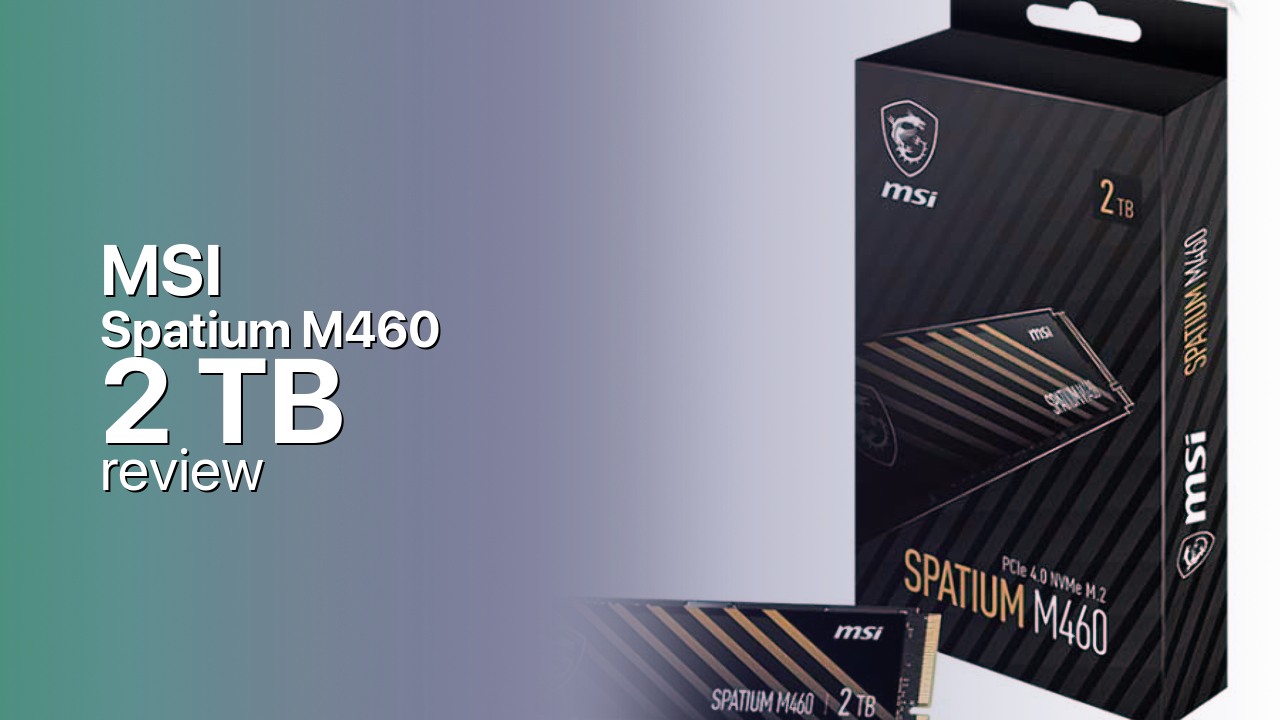
MSI Spatium M460 2TB Review — QLC Storage At Its Largest (2026)
Quick answer
The MSI Spatium M460 2TB is the capacity to buy in this range when the goal is bulk storage on a budget: 1,200 TBW of endurance, a five-year warranty and Gen4-class responsiveness at QLC pricing.
Read: 4900 MB/s Write: 4400 MB/s Endurance: 1200 TBW Warranty: 5 years Interface: M.2 4.0 x 4
The MSI Spatium M460 2TB closes the range with 1,200 TBW of endurance and 4,900/4,400 MB/s Gen4 ratings — budget QLC storage at its largest and longest-lived.
Controller & Memory
As the top capacity of MSI's value Gen4 line, the MSI Spatium M460 2TB runs the same platform as its siblings: a four-channel Phison E21T controller operating DRAM-less with Host Memory Buffer, driving QLC NAND that is widely reported to come from Micron's 176-layer generation. Where the 2 TB differs is the numbers themselves — and they are not simply bigger. MSI's own capacity-specific table rates this model at 4,900 MB/s sequential reads and 4,400 MB/s writes over PCIe 4.0 x4, a hair slower than the 1 TB's 5,000/4,500, with random ratings of 525K reads and 950K writes. The endurance budget, though, doubles: 1,200 TBW against the 1 TB's 600 TBW.
That capacity-versus-speed trade is the story of this drive. Buyers give up roughly 100 MB/s on each end of the scale versus the smaller model and receive twice the flash pool in return, all inside a standard M.2 2280 footprint with a five-year warranty unchanged across the range. The bare drive ships without a heatsink; MSI's M460 HS variant adds a factory cooler if console or hot-case duty awaits.
The audience is the budget buyer filling a game library, a media stash or a secondary slot with as much storage as possible while still getting Gen4-class responsiveness. Rivals at 2 TB include the Crucial P3 Plus, another DRAM-less QLC drive that sacrifices write speed and endurance for price, and Kingston's NV2, whose flash and controller vary by batch. The WD Blue SN580 is the TLC alternative for buyers who would rather have consistent sustained writes than the lowest sticker. MSI's own Spatium M480 remains the step-up for anyone who wants TLC, DRAM and a 7,000 MB/s rating.
Storage Comparisons:
Spatium M460 Performance & Benchmarks
MSI rates the 2 TB Spatium M460 at 4,900 MB/s sequential reads, 4,400 MB/s writes, 525K random-read IOPS and 950K random-write IOPS. These are manufacturer figures — independent benchmark coverage of the M460 family is thin — but they map cleanly onto the platform: a DRAM-less QLC build whose burst performance carries the headline numbers and whose sustained writes settle well below them.
MSI Spatium M460 2 TB vs M.2 4.0 x 4 peers
Switch between sequential throughput and random IOPS to see how this drive stacks up against other M.2 4.0 x 4 SSDs in our database. The highlighted bar is the drive on this page — click any other bar to open that drive.
- Patriot Viper PV593 1 TB: 14,500 MB/s read, 14,000 MB/s write
- Patriot Viper PV593 2 TB: 14,500 MB/s read, 14,000 MB/s write
- Patriot Viper PV593 4 TB: 14,500 MB/s read, 14,000 MB/s write
- Patriot Viper PV573 2 TB: 14,000 MB/s read, 12,000 MB/s write
- MSI Spatium M460 2 TB (this drive): 4,900 MB/s read, 4,400 MB/s write
The 4,900 MB/s read rating loads games and operating systems with no penalty worth noticing against faster Gen4 drives; the gaps between Gen4 ratings only show in large file transfers. The 950K random-write rating is the strongest number on the sheet and the one that shapes daily feel — installs, patches and multitasking all hit random-write paths first. Sustained writes are the known weakness: once the pseudo-SLC cache fills, throughput falls to native QLC rates. At 2 TB the cache has more NAND to work with than the smaller capacities, but a multi-hundred-gigabyte transfer will still expose the drop, and that is the workload to avoid on this drive.
For PS5 upgraders, the rated read speed sits under Sony's 5,500 MB/s recommendation and the bare drive lacks a heatsink, so MSI's faster Spatium models fit Sony's guidance better. Treat every figure here as a rated ceiling rather than a measured result.
MSI Spatium M460 vs Competitors
See how the Spatium M460 stacks up against other M.2 4.0 x 4 drives in our database:
Compare with rival drives:
Endurance, TBW & Warranty
MSI warrants the Spatium M460 2TB for five years or 1,200 TBW of writes, whichever comes first. At a heavy 50 GB of writes per day, the endurance budget still stretches past 65 years, so for virtually every buyer the five-year term — not the TBW figure — is the practical limit. That is a healthy allocation for QLC flash, which ages faster than TLC per cell, and it doubles the 1 TB model's 600 TBW. MSI rates the drive at up to 1.5 million hours MTBF, a population statistic that describes fleet-level failure rates rather than any individual drive's lifespan. Claims run through MSI's standard support channels with proof of purchase; whether the retailer or MSI handles the first return varies by seller, and it is worth confirming before problems arise.
MSI Spatium M460 2 TB Specifications
| Category | Value |
|---|---|
| Capacity [?] | 2 TB |
| Interface [?] | M.2 4.0 x 4 |
| Controller [?] | Phison E21T 4 Channel |
| Memory type [?] | QLC |
| DRAM [?] | No |
| Read speed (MB/s) [?] | 4900 |
| Write speed (MB/s) [?] | 4400 |
| Read IOPS [?] | 525000 |
| Write IOPS [?] | 950000 |
| Endurance (TBW) [?] | 1200 |
| MTBF (million hours) [?] | 1500000 |
| Warranty (years) [?] | 5 |
Verdict: Is the Spatium M460 Worth It in 2026?
The MSI Spatium M460 2TB is the capacity to buy in this range when the goal is bulk storage on a budget: 1,200 TBW of endurance, a five-year warranty and Gen4-class responsiveness at QLC pricing. Skip it if sustained write speed matters more than capacity — video scratch disks and regular large transfers will expose the QLC drop, where the WD Blue SN580's TLC flash holds up better. Crucial's P3 Plus competes on price alone, giving up write speed and endurance to get there. For a game library or secondary drive in a build where dollars per terabyte decide, the M460 2TB is an easy drive to justify — as long as its slightly slower ratings suit the task.
+ Pros
- 4,900/4,400 MB/s Gen4 ratings
- 1,200 TBW endurance with 5-year warranty
- 950K rated random-write IOPS
- Largest, longest-lived M460 capacity
- QLC keeps cost per gigabyte low
- Cons
- QLC NAND collapses sustained writes
- DRAM-less design with HMB only
- Marginally slower than the 1TB model
- No heatsink on the bare drive
- Reads trail the 7,000 MB/s Gen4 tier
Buy this or similar SSD Storage:



Video Review
MSI SPATIUM M460: The Fastest 1TB NVMe SSD You Can Buy?