Orico O7000 1TB Review — Budget Gen4 That Reviews Well (2026)
Quick answer
Buy the Orico O7000 1TB when the build needs a complete 1 TB Gen4 drive and the budget keeps flagging the name brands: 7,000 MB/s reads, 6,600 MB/s writes, 600 TBW, and five years of coverage in a 2 mm PCB is a package with no obvious hole for the money.
Read: 7000 MB/s Write: 6600 MB/s Endurance: 600 TBW Warranty: 5 years Interface: M.2 4.0 x 4
The Orico O7000 1TB pairs 7,000 MB/s reads with 600 TBW of endurance on a 2 mm-thin PCB — the budget sweet spot TechRadar called great for the money.
Controller & Memory
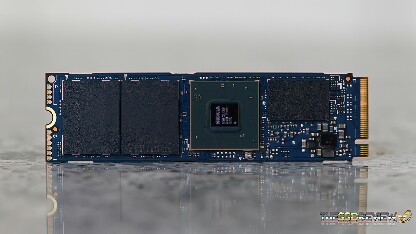
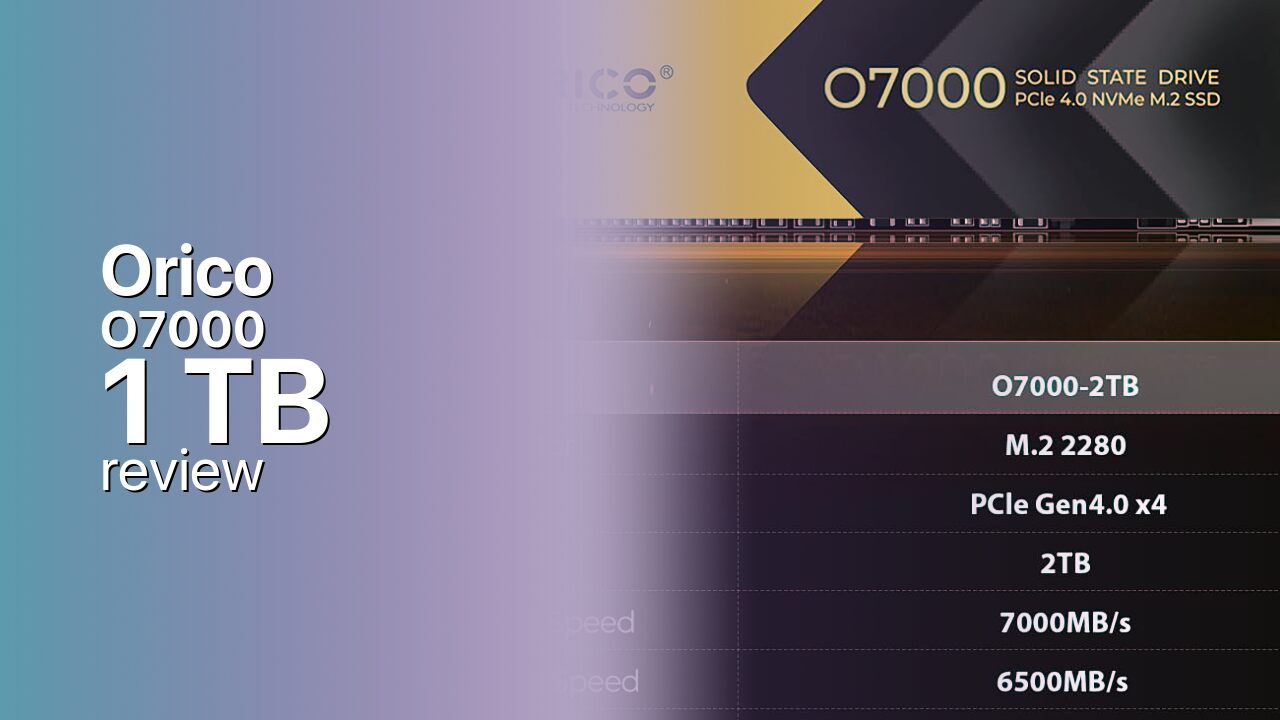
The Orico O7000 1TB is the capacity that made reviewers take the line seriously: TechRadar's verdict called it a great drive for anyone operating on a budget, praising performance that its price had no right to include. The platform is DRAM-less — a Maxio-class controller with Host Memory Buffer over YMTC TLC — rated at 7,000 MB/s reads and 6,600 MB/s writes over PCIe 4.0 x4. The physical design is a quiet differentiator: a 2 mm-thick, 5-to-6-gram PCB that slips into laptops and console-adjacent builds where thicker sticks fight for clearance.
At 1 TB, the endurance budget reaches the range's sensible middle: 600 TBW under a 5-year warranty, double the 512 GB model's 300 TBW and half of the 2 TB flagship's 1,200 TBW, with the 1.5 million-hour MTBF rating constant across the range. Orico publishes a single speed rating across capacities rather than per-capacity derates, and the 1 TB model is where that single rating is most credible — enough NAND to parallelize, without the entry size's compromises. The bracket rivals are familiar: the Kingston NV3 fights on brand, the Silicon Power UD90 on price, and the platform-adjacent Lexar NM790 1TB sits above at 7,400/6,500 MB/s with 1,000 TBW.
This is the configuration most buyers should actually consider: 1 TB holds an operating system, a working game rotation, and the general clutter of a real machine, while the price keeps the whole build on budget. The PS5 angle even opens up here — the 7,000 MB/s rating clears Sony's 5,500 MB/s recommendation and 1 TB is a viable starter capacity, provided a heatsink is added and buyers accept a newer brand inside their console.
Storage Comparisons:
O7000 Performance & Benchmarks
Orico rates the O7000 1TB at 7,000 MB/s sequential reads and 6,600 MB/s writes over PCIe 4.0 x4, and like the rest of the line it publishes no random IOPS figures. The sequential numbers are the story: 7,000 MB/s sits within a few percent of the fastest Gen4 drives ever sold, and 6,600 MB/s of rated write speed exceeds several drives costing considerably more. Reviewers of the line found real-world sequential performance landing right around the rated figures, and TechRadar's testing concluded the performance-per-price balance simply works — high-end Gen4 behavior at value-tier money.
Orico O7000 1 TB vs M.2 4.0 x 4 peers
Switch between sequential throughput and random IOPS to see how this drive stacks up against other M.2 4.0 x 4 SSDs in our database. The highlighted bar is the drive on this page — click any other bar to open that drive.
- Patriot Viper PV593 1 TB: 14,500 MB/s read, 14,000 MB/s write
- Patriot Viper PV593 2 TB: 14,500 MB/s read, 14,000 MB/s write
- Patriot Viper PV593 4 TB: 14,500 MB/s read, 14,000 MB/s write
- Patriot Viper PV573 2 TB: 14,000 MB/s read, 12,000 MB/s write
- Orico O7000 1 TB (this drive): 7,000 MB/s read, 6,600 MB/s write
The DRAM-less fine print applies, softened by the capacity. The pseudo-SLC cache absorbs bursts at rated speed; 1 TB is enough NAND that everyday transfers — game installs, batch updates, library moves — mostly stay inside the fast zone, with native TLC rates appearing only on sustained multi-hundred-gigabyte copies. HMB keeps random performance honest for a design without DRAM, and the thin 2 mm PCB manages thermals well in laptops, though a motherboard heatsink remains worthwhile for desktop duty under sustained load. For a boot-and-games drive, reviewers found nothing missing that the price suggested should be.
Orico O7000 vs Competitors
See how the O7000 stacks up against other M.2 4.0 x 4 drives in our database:
Compare with rival drives:
Endurance, TBW & Warranty
Orico rates the O7000 1TB at 600 TBW under a 5-year limited warranty, whichever arrives first — the range's midpoint, doubling the 512 GB model's 300 TBW and half of the 2 TB model's 1,200 TBW. At a modest 20 GB of writes per day, the endurance budget stretches past eight decades; at a gaming drive's realistic write profile, the 5-year warranty term is the only limit an owner will ever test. The rated MTBF is 1.5 million hours, a fleet-level reliability statistic rather than an individual promise. Orico's 5-year coverage matches the established brands on paper; its support network is the younger variable, which keeps the retailer's return window practically important.
Orico O7000 1 TB Specifications
| Category | Value |
|---|---|
| Capacity [?] | 1 TB |
| Interface [?] | M.2 4.0 x 4 |
| Controller [?] | Maxio MAP1602A |
| Memory type [?] | YMTC 232-L TLC |
| DRAM [?] | No |
| Read speed (MB/s) [?] | 7000 |
| Write speed (MB/s) [?] | 6600 |
| Read IOPS [?] | |
| Write IOPS [?] | |
| Endurance (TBW) [?] | 600 |
| MTBF (million hours) [?] | 1500000 |
| Warranty (years) [?] | 5 |
Verdict: Is the O7000 Worth It in 2026?
Buy the Orico O7000 1TB when the build needs a complete 1 TB Gen4 drive and the budget keeps flagging the name brands: 7,000 MB/s reads, 6,600 MB/s writes, 600 TBW, and five years of coverage in a 2 mm PCB is a package with no obvious hole for the money. Skip it if brand track record is the deciding factor — Kingston and WD sell reassurance alongside their NAND — or for sustained professional writes, where DRAM-equipped designs remain the right tool. The Lexar NM790 1TB out-rates it for a little more, and the Kingston NV3 undercuts it with less speed. As the value pick that reviewers actually rated, the O7000 1TB is the O7000 to buy.
+ Pros
- 7,000 MB/s reads and 6,600 MB/s writes
- 600 TBW endurance with 5-year warranty
- Thin 2 mm, 6 g PCB suits tight builds
- Clears Sony's PS5 speed recommendation
- TechRadar-endorsed performance per dollar
- Cons
- No DRAM cache on the PCB
- Random IOPS ratings unpublished by Orico
- Younger brand with a smaller support network
- Sustained writes settle below the burst rating
Buy this or similar SSD Storage:
Video Review
ORICO o7000 vs WD Black SN850x - Should you spend more on an SSD?