OWC Mercury M2 250GB Review — MLC-Based PCIe 3.0 NVMe SSD (2026)
Quick answer
The OWC Mercury M2 250GB is an older PCIe 3.0 NVMe SSD whose main selling point is MLC NAND durability in a standard M.2 form factor.
Read: 1872 MB/s Write: 1087 MB/s Endurance: 185 TBW Warranty: 3 years Interface: M.2 3.0 x 4
The OWC Mercury M2 250GB is a standard M.2 NVMe SSD built around the Silicon Motion SM2260 controller and MLC NAND — an older but durability-focused PCIe 3.0 drive from OWC's general-purpose lineup.
Controller & Memory
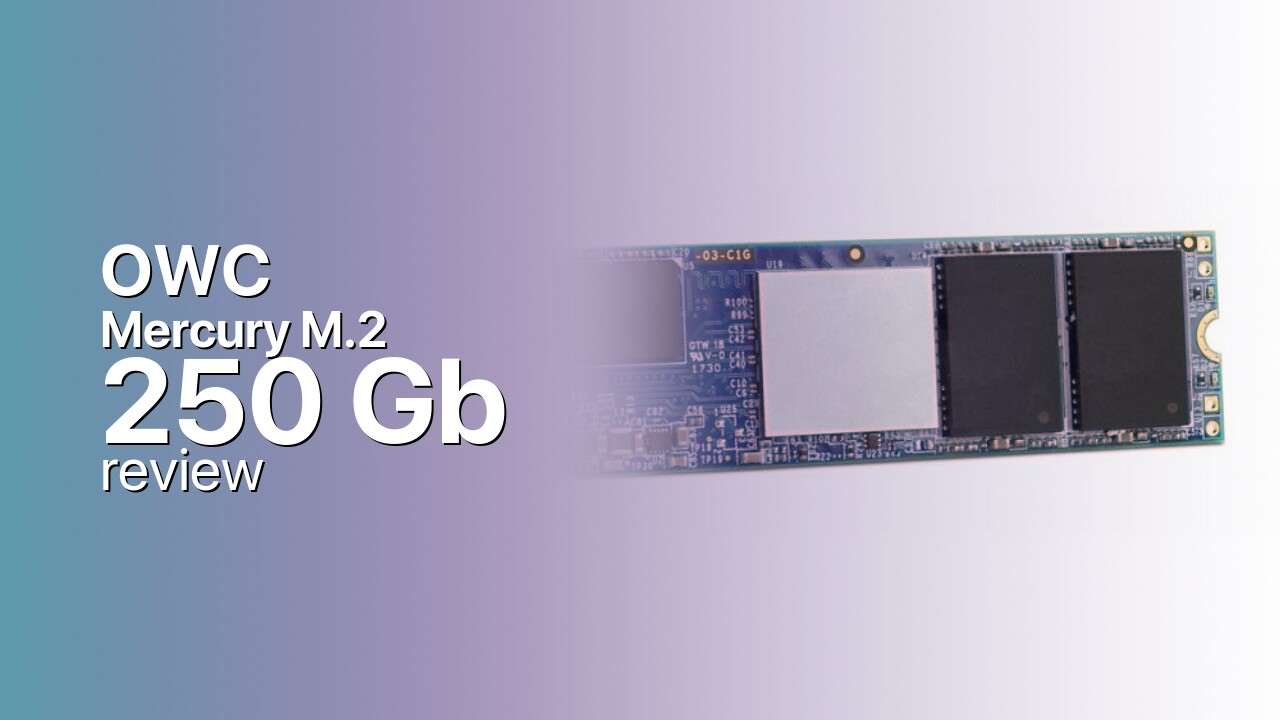
The Mercury M2 uses the Silicon Motion SM2260, one of the earlier eight-channel PCIe 3.0 x4 NVMe 1.2 controllers. Announced at Flash Memory Summit 2015, the SM2260 was Silicon Motion's first consumer NVMe controller, predating the more widely known SM2262EN. It's paired with MLC (multi-level cell) NAND flash, which offers better endurance and sustained write performance than the TLC NAND that became standard in later generations. Whether the Mercury M2 includes a DRAM cache is not specified by OWC, though most NVMe drives using the SM2260 included discrete DRAM for the flash translation layer.
The Mercury M2 was OWC's general-purpose M.2 2280 NVMe SSD, as opposed to the Mac-specific Aura Pro X2 line. It uses a standard M.2 M-key connector, fitting any motherboard or laptop with an M.2 NVMe slot. This makes it broadly compatible with desktop PCs, laptops, and even some NAS devices that accept M.2 NVMe drives.
At 250 GB, this drive is a basic boot drive capacity. The 1,872 MB/s reads and 1,087 MB/s writes are modest for a PCIe 3.0 drive — the interface can theoretically reach roughly 4,000 MB/s, and mainstream Gen3 drives like the Samsung 970 EVO achieved 3,500 MB/s reads. The SM2260 was an early controller and couldn't fully saturate the PCIe 3.0 x4 bandwidth. The MLC NAND, however, gives it an endurance advantage over TLC-based competitors of the same era.
The Mercury M2 competed with the Samsung 960 EVO, Intel 760p, and Plextor M8Se series. Its MLC NAND was a differentiator, but the SM2260's performance limitations and OWC's relatively limited presence in the general-purpose SSD market kept it from mainstream adoption. OWC appears to have discontinued the Mercury M2 line in favor of newer products.
Storage Comparisons:
Mercury M.2 Performance & Benchmarks
The OWC Mercury M2 250GB is rated at up to 1,872 MB/s sequential reads and 1,087 MB/s sequential writes over its PCIe 3.0 x4 NVMe interface. These figures are modest for a PCIe 3.0 drive — the interface's theoretical ceiling is roughly 4,000 MB/s, and mainstream Gen3 drives like the Samsung 960 EVO reached 3,200 MB/s reads. The SM2260 controller was Silicon Motion's first consumer NVMe design and couldn't fully saturate the PCIe 3.0 x4 bandwidth. That said, the MLC NAND provides better sustained write performance than TLC alternatives — after the SLC cache fills on a TLC drive, write speeds can drop to 300–500 MB/s, while MLC maintains higher direct-write speeds. Random 4K performance on the SM2260 typically reaches 130,000–150,000 IOPS reads and 120,000–140,000 IOPS writes based on controller specifications, which is adequate for desktop responsiveness but below the 200,000+ IOPS that the later SM2262EN achieved. For everyday desktop tasks — booting Windows, launching applications, browsing the web — the Mercury M2 performs competently. Under sustained writes, the MLC NAND's advantage becomes visible, maintaining higher speeds than TLC drives once the SLC cache is exhausted. The 250 GB capacity has the fewest NAND dies in the Mercury M2 family, so it has the lowest write speeds — the 500 GB, 1 TB, and 2 TB variants reach the same rated speeds but sustain them longer. Independent benchmark reviews of the Mercury M2 specifically are scarce. For a budget PCIe 3.0 drive, the performance is serviceable, but modern NVMe drives at similar price points significantly outperform it.
OWC Mercury M.2 250 GB vs M.2 3.0 x 4 peers
Switch between sequential throughput and random IOPS to see how this drive stacks up against other M.2 3.0 x 4 SSDs in our database. The highlighted bar is the drive on this page — click any other bar to open that drive.
- ADATA SX 8800 Pro 512 GB: 3,500 MB/s read, 2,700 MB/s write
- ADATA SX 8800 Pro 1 TB: 3,500 MB/s read, 2,700 MB/s write
- ADATA XPG Spectrix S40G RGB 256 GB: 3,500 MB/s read, 3,000 MB/s write
- ADATA XPG Spectrix S40G RGB 512 GB: 3,500 MB/s read, 3,000 MB/s write
- OWC Mercury M.2 250 GB (this drive): 1,872 MB/s read, 1,087 MB/s write
OWC Mercury M.2 vs Competitors
See how the Mercury M.2 stacks up against other M.2 3.0 x 4 drives in our database:
Compare with rival drives:
Endurance, TBW & Warranty
OWC provides a three-year limited warranty for the Mercury M2 250GB, which is shorter than the five-year coverage on OWC's Aura Pro X2 line and mid-range drives from Samsung, Crucial, and Western Digital. The company does not publish a TBW (terabytes written) endurance rating for the Mercury M2 series. For a 250 GB drive using MLC NAND, endurance is likely in the 150–250 TBW range — MLC cells typically endure 3,000–5,000 program/erase cycles compared to 1,000–3,000 for TLC, so the MLC advantage is meaningful. At a typical 20–40 GB per day write workload, the drive should last well beyond the three-year warranty period. OWC does not publish an MTBF figure for the Mercury M2. Warranty service is handled through OWC's distributor network, and international buyers should verify local support availability. The three-year warranty is adequate but unremarkable for the segment. The lack of published endurance specs is a gap — buyers have to trust the MLC NAND's inherent durability without a manufacturer-backed TBW figure. For documented endurance at this capacity, the Samsung 960 EVO 250 GB (100 TBW published) and Intel 760p 256 GB (85 TBW published) provide transparent specs, though their TLC NAND may not match the Mercury M2's raw cell endurance.
OWC Mercury M.2 250 GB Specifications
| Category | Value |
|---|---|
| Capacity [?] | 250 GB |
| Interface [?] | M.2 3.0 x 4 |
| Controller [?] | Silicon Motion SM2260 |
| Memory type [?] | MLC |
| DRAM [?] | Yes |
| Read speed (MB/s) [?] | 1872 |
| Write speed (MB/s) [?] | 1087 |
| Read IOPS [?] | 155000 |
| Write IOPS [?] | 190000 |
| Endurance (TBW) [?] | 185 |
| MTBF (million hours) [?] | 2000000 |
| Warranty (years) [?] | 3 |
Verdict: Is the Mercury M.2 Worth It in 2026?
The OWC Mercury M2 250GB is an older PCIe 3.0 NVMe SSD whose main selling point is MLC NAND durability in a standard M.2 form factor. The 1,872 MB/s reads are well below what modern Gen3 and Gen4 drives achieve, and the three-year warranty is shorter than the competition's five-year coverage. The MLC NAND offers better endurance than TLC, but the lack of published TBW specs makes it hard to quantify. For most buyers in 2026, a modern NVMe drive like the Crucial P3 Plus or WD Blue SN580 offers significantly better performance at a similar price. The Mercury M2 makes sense only for buyers who specifically want MLC NAND and can find it at a discount.
+ Pros
- MLC NAND for better endurance than TLC
- Standard M.2 2280 form factor
- SM2260 eight-channel NVMe controller
- Competent for everyday desktop tasks
- Cons
- 1,872 MB/s reads slow for PCIe 3.0
- No published TBW endurance rating
- 3-year warranty shorter than competition
- Limited independent review coverage
- Appears to be discontinued
Buy this or similar SSD Storage:



Video Review
OWC Aura Pro SSD Upgrades Give You More Storage & Let You Repurpose Your Old SSD