Sabrent Rocket 4 2TB Review — The Refresh At Full Size (2026)
Quick answer
The Sabrent Rocket 4 2TB is the capacity to buy in this line and one of the strongest 2 TB Gen4 drives for the single-slot buyer: game library, boot disk and PS5 expansion in one single-sided board with 1,200 TBW behind it.
Read: 7400 MB/s Write: 6400 MB/s Endurance: 1200 TBW Warranty: 5 years Interface: M.2 4.0 x 4
The refreshed Sabrent Rocket 4 2TB pairs 7,400/6,400 MB/s Gen4 ratings with 1,200 TBW on a single-sided, DRAM-less board — TweakTown's refreshed standard bearer.
Controller & Memory
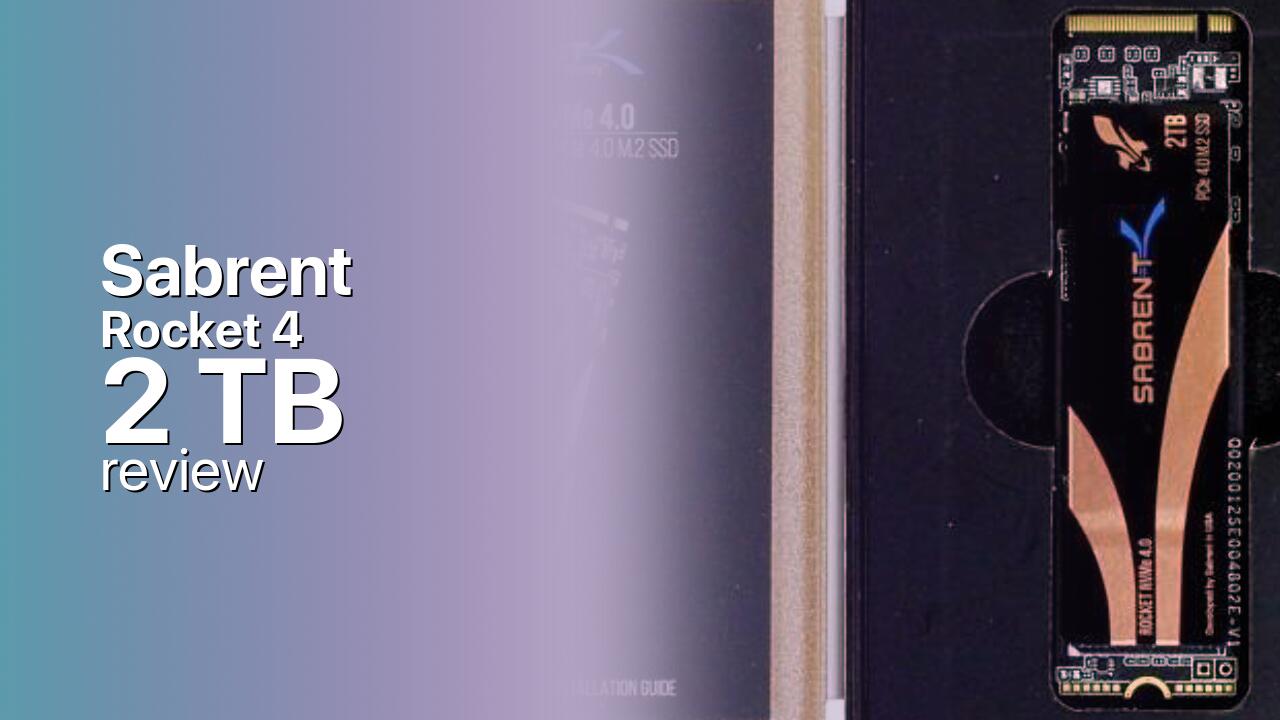
The Sabrent Rocket 4 2TB is the flagship of the line's refresh, and it is the version reviewers coalesced around. The hardware: Phison's four-channel PS5027-E27T controller running DRAM-less with Host Memory Buffer, Kioxia BiCS6 TLC behind it, and every chip on a single-sided M.2 2280 board. Rated at 7,400 MB/s sequential reads and 6,400 MB/s writes over PCIe 4.0 x4, with 1,000K random-read and 950K random-write IOPS, it is the same silicon Corsair deploys in the MP600 Elite — and TweakTown's review scored it 95 percent, tying that Corsair as the best-performing 2 TB DRAM-less drive the outlet had tested.
The 2 TB capacity is where the refresh's design choices pay off most. Single-sided construction fits thin laptops, handhelds and the PS5 without adapters, while the doubled endurance budget — 1,200 TBW against the 1 TB's 600 — makes it the durable pick of the line. Tom's Hardware's review called the drive a welcome update and found its power efficiency beating even Crucial's T500, the Gen4 field's efficiency reference.
The competitive frame is clear. The Corsair MP600 Elite shares the platform and usually costs less; the WD Black SN850X and Samsung 990 Pro retain DRAM caches and win sustained work; Crucial's T500 contests the same DRAM-less flagship tier. Sabrent's pitch is the no-registration five-year warranty — a break from the company's older registration requirements — on top of ratings at the Gen4 ceiling. For buyers who want one 2 TB drive to serve as a boot disk, game library and PS5 expansion at once, this is the configuration of the line to buy.
Storage Comparisons:
Rocket 4 Performance & Benchmarks
Sabrent rates the 2 TB Rocket 4 at 7,400 MB/s sequential reads, 6,400 MB/s writes, 1,000K random-read IOPS and 950K random-write IOPS, and independent testing has painted the picture behind the numbers. TweakTown measured 828K random-read IOPS at high queue depth in Anvil and 104 MB/s at 4K Q1T1 — the best low-queue random-read figure it had recorded from a DRAM-less drive — while the platform's DirectStorage and I/O+ support position it for modern game-streaming features. In TweakTown's PS5 testing, the drive read at 6,497 MB/s.
Sabrent Rocket 4 2 TB vs M.2 4.0 x 4 peers
Switch between sequential throughput and random IOPS to see how this drive stacks up against other M.2 4.0 x 4 SSDs in our database. The highlighted bar is the drive on this page — click any other bar to open that drive.
- Patriot Viper PV593 1 TB: 14,500 MB/s read, 14,000 MB/s write
- Patriot Viper PV593 2 TB: 14,500 MB/s read, 14,000 MB/s write
- Patriot Viper PV593 4 TB: 14,500 MB/s read, 14,000 MB/s write
- Patriot Viper PV573 2 TB: 14,000 MB/s read, 12,000 MB/s write
- Sabrent Rocket 4 2 TB (this drive): 7,400 MB/s read, 6,400 MB/s write
Tom's Hardware characterized the write behavior precisely: the pseudo-SLC cache absorbs bursts at an average 6.45 GB/s for roughly eight seconds of continuous writing before throughput settles to the post-cache rate, which sits well below the 6,400 MB/s headline. That is the DRAM-less trade in one sentence, and at 2 TB the cache has enough room to swallow most real-world writes — game installs, batch downloads, project checkpoints — without exposing the drop.
Efficiency is the underrated result: Tom's Hardware's testing showed the drive drawing less power than the Crucial T500, itself the Gen4 efficiency benchmark, which matters in laptops, handhelds and passively cooled consoles. No reviewer found the ratings exaggerated; both outlets concluded the refresh delivers exactly what its specification sheet promises, at the top of the DRAM-less class.
Sabrent Rocket 4 vs Competitors
See how the Rocket 4 stacks up against other M.2 4.0 x 4 drives in our database:
Compare with rival drives:
Endurance, TBW & Warranty
Sabrent covers the Rocket 4 2TB with a five-year warranty that the current listing states requires no registration — a policy shift from older Sabrent SSDs, which locked the full term behind registration. Endurance is rated at 1,200 TBW for the 2 TB model: Tom's Hardware's launch coverage of the refresh describes Sabrent's allocation as 600 TBW per 1 TB of capacity, and johnnylucky's SSD database independently records the family at 1.2 PBW, matching the 2 TB figure. At a demanding 50 GB of writes per day, that budget stretches past 65 years, so the five-year term is the practical limit for any buyer. Sabrent publishes no MTBF figure for this revision. Claims run directly through Sabrent's US-based support, a channel known in the enthusiast community for responsive, replacement-oriented handling — one of the brand's genuine differentiators at this tier.
Sabrent Rocket 4 2 TB Specifications
| Category | Value |
|---|---|
| Capacity [?] | 2 TB |
| Interface [?] | M.2 4.0 x 4 |
| Controller [?] | Phison PS5027-E27T |
| Memory type [?] | Kioxia BiCS6 TLC |
| DRAM [?] | No |
| Read speed (MB/s) [?] | 7400 |
| Write speed (MB/s) [?] | 6400 |
| Read IOPS [?] | 1000000 |
| Write IOPS [?] | 950000 |
| Endurance (TBW) [?] | 1200 |
| MTBF (million hours) [?] | n/a |
| Warranty (years) [?] | 5 |
Verdict: Is the Rocket 4 Worth It in 2026?
The Sabrent Rocket 4 2TB is the capacity to buy in this line and one of the strongest 2 TB Gen4 drives for the single-slot buyer: game library, boot disk and PS5 expansion in one single-sided board with 1,200 TBW behind it. Skip it for sustained-write professions — video scratch disks and constant multi-hundred-gigabyte transfers want the WD Black SN850X's DRAM cache, which holds its pace long after the Rocket 4's pseudo-SLC cache empties. The Corsair MP600 Elite carries identical silicon and deserves a price check before buying; Sabrent's premium buys its warranty terms and support, not speed. TweakTown's refreshed standard bearer title lands correctly: within the DRAM-less 2 TB class, this is the drive the others are measured against.
+ Pros
- 7,400/6,400 MB/s Gen4 ratings
- 1,200 TBW endurance with 5-year warranty
- Single-sided PCB suits laptops and PS5
- 828K random-read IOPS measured by TweakTown
- Lower power draw than Crucial T500
- 5-year warranty, no registration needed
- Cons
- DRAM-less: HMB instead of onboard cache
- Sustained writes settle after ~8s pSLC burst
- No heatsink included
- Priced above the identically equipped MP600 Elite
Buy this or similar SSD Storage:
Video Review
Blazing Fast - SABRENT ROCKET 4 PLUS Gen4x4 M.2 SSD