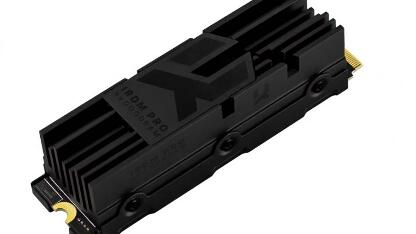
Seagate Lightsaber Collection Special Edition 2TB — Showpiece, Serious Inside (2026)
Quick answer
The Seagate Lightsaber Collection Special Edition 2TB is the capacity to buy of the two: full FireCuda 530 ratings with 6,900 MB/s writes, 2,550 TBW of endurance and the complete lightsaber presentation — heatsink, light bar and three swappable faceplates.
Read: 7300 MB/s Write: 6900 MB/s Endurance: 2550 TBW Warranty: 5 years Interface: M.2 4.0 x 4
The Seagate Lightsaber Collection Special Edition 2TB pairs full FireCuda 530 ratings — 7,300/6,900 MB/s and 2,550 TBW — with a lightsaber heatsink and swappable faceplates.
Controller & Memory
The Seagate Lightsaber Collection Special Edition 2TB is the full-capacity expression of Seagate's Star Wars collaboration, and the hardware underneath is entirely serious. Tom's Hardware called the drive a FireCuda 530 in disguise, and TechPowerUp's database confirms the shared platform: a Phison PS5018-E18-41 controller, 2 GB of DDR4 DRAM at the ideal 1 GB-per-terabyte ratio, and Micron B47R 176-layer TLC over PCIe 4.0 x4. Ratings reach 7,300 MB/s sequential reads, 6,900 MB/s writes and 1,000K random IOPS in both directions, with endurance rated at 2,550 TBW — flagship Gen4 figures that arrived in 2023.
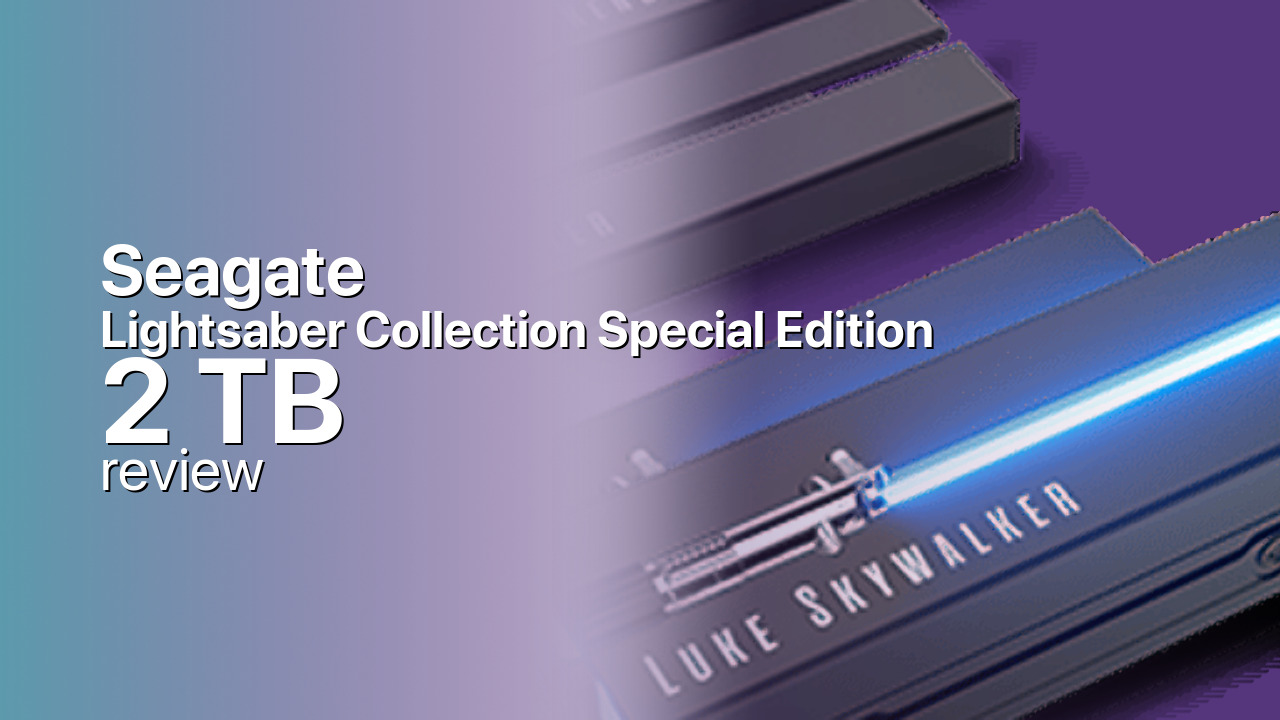
The Special Edition packaging is the point. An EKWB-designed aluminium heatsink carries a lightsaber light bar on a 3-pin 5V ARGB header, and three swappable faceplates honor Obi-Wan Kenobi, Darth Vader and Luke Skywalker. StorageReview measured the assembly at roughly 19 mm tall — nearly double Sony's 11.25 mm PS5 ceiling — so this is a desktop showpiece, not a console drive. KitGuru's 2 TB review measured power draw at 7.8 W average active, 25 mW idle and under 5 mW in low-power states, confirming the platform's efficiency beneath the costume. The 5-year warranty includes 3-year Rescue Data Recovery Services.
As a purchase it faces the Samsung 990 Pro and WD Black SN850X on performance, but its honest rival is Seagate's own FireCuda 530 or 530R — the same platform without the collector premium. The styling is the product; the silicon happens to be excellent. KitGuru's thermals and power numbers back that claim at this exact capacity.
Storage Comparisons:
Lightsaber Collection Special Edition Performance & Benchmarks
Seagate rates the 2 TB Lightsaber Collection drive at 7,300 MB/s sequential reads, 6,900 MB/s writes and 1,000K random read/write IOPS — the full ratings of the FireCuda 530 at this capacity, with no capacity penalty of the kind the 1 TB model carries on writes. Everyday behavior matches any DRAM-equipped Gen4 flagship: boots, game loads and application launches are indistinguishable from the 990 Pro class, and the 2 GB DRAM cache keeps random performance steady when the drive doubles as a busy game library.
Seagate Lightsaber Collection Special Edition 2 TB vs M.2 4.0 x 4 peers
Switch between sequential throughput and random IOPS to see how this drive stacks up against other M.2 4.0 x 4 SSDs in our database. The highlighted bar is the drive on this page — click any other bar to open that drive.
- Patriot Viper PV593 1 TB: 14,500 MB/s read, 14,000 MB/s write
- Patriot Viper PV593 2 TB: 14,500 MB/s read, 14,000 MB/s write
- Patriot Viper PV593 4 TB: 14,500 MB/s read, 14,000 MB/s write
- Patriot Viper PV573 2 TB: 14,000 MB/s read, 12,000 MB/s write
- Seagate Lightsaber Collection Special Edition 2 TB (this drive): 7,300 MB/s read, 6,900 MB/s write
Sustained behavior is where the 2 TB capacity earns its keep over the 1 TB: TechPowerUp's database lists a 225 GB pseudo-SLC cache, post-cache writes of 3,850 MB/s and folding at 1,600 MB/s, so large transfers degrade gracefully rather than dropping off a cliff. The EKWB-designed heatsink keeps the assembly controlled during sustained work — KitGuru measured just 7.8 W average active power — though the light bar needs a motherboard ARGB header to function. For gaming the drive is overqualified; for a showpiece build that also edits video or archives footage, the ratings, cache behavior and endurance hold their own at the flagship tier.
Seagate Lightsaber Collection Special Edition vs Competitors
See how the Lightsaber Collection Special Edition stacks up against other M.2 4.0 x 4 drives in our database:
Compare with rival drives:
Endurance, TBW & Warranty
The 2 TB model carries a 2,550 TBW endurance rating under a 5-year limited warranty — the same terms as the FireCuda 530 it is built from, and among the strongest per-terabyte coverage of the 2023 Gen4 flagship generation. At 20 GB of writes per day the endurance budget would run past 340 years, so the warranty clock is the practical limit. The bundled 3-year Rescue Data Recovery Services plan covers in-lab recovery after drive failure, a worthwhile inclusion on a drive many buyers will treat as a long-term collectible. The rated 1.8 million hours MTBF is a fleet-level statistic rather than a per-unit promise. Claims route through Seagate's standard support with proof of purchase; the cosmetic accessories do not alter the terms.
Seagate Lightsaber Collection Special Edition 2 TB Specifications
| Category | Value |
|---|---|
| Capacity [?] | 2 TB |
| Interface [?] | M.2 4.0 x 4 |
| Controller [?] | Phison PS5018-E18 |
| Memory type [?] | Micron 3D TLC |
| DRAM [?] | Yes |
| Read speed (MB/s) [?] | 7300 |
| Write speed (MB/s) [?] | 6900 |
| Read IOPS [?] | 1000000 |
| Write IOPS [?] | 1000000 |
| Endurance (TBW) [?] | 2550 |
| MTBF (million hours) [?] | 1800000 |
| Warranty (years) [?] | 5 |
Verdict: Is the Lightsaber Collection Special Edition Worth It in 2026?
The Seagate Lightsaber Collection Special Edition 2TB is the capacity to buy of the two: full FireCuda 530 ratings with 6,900 MB/s writes, 2,550 TBW of endurance and the complete lightsaber presentation — heatsink, light bar and three swappable faceplates. Skip it as a rational purchase, because the same silicon costs less as a plain FireCuda 530 or 530R, and the roughly 19 mm-tall assembly bars PS5 use. Samsung's 990 Pro is the pure-performance alternative. As collectible storage with flagship credentials, it delivers exactly what its audience wants. KitGuru's review of this capacity found the platform efficient and composed beneath the styling, and the doubled endurance rating makes it the sensible collector pick.
+ Pros
- FireCuda 530 hardware: E18-41, Micron 176-layer TLC
- 7,300/6,900 MB/s full flagship ratings
- 2,550 TBW endurance with 5-year warranty
- 3-year Rescue Data Recovery Services included
- 225GB pseudo-SLC cache, 3,850 MB/s post-cache writes
- Swappable faceplates and ARGB lightsaber light bar
- Cons
- Premium over the plain FireCuda 530 for identical hardware
- About 19 mm tall with cover — exceeds PS5 clearance
- ARGB light bar needs a 3-pin 5V motherboard header
- Showpiece appeal rests entirely on Star Wars branding
- No 4TB option for larger libraries
Buy this or similar SSD Storage:



Video Review
Seagate Lightsaber Collection SE Firecuda NVME ssd #starwars