Silicon Power XS75 1TB Review — Heatsink-Equipped Gen4 for the PS5 (2026)
Quick answer
Buy the Silicon Power XS75 1TB when a PS5 expansion or a cool-running PC game drive is the goal and the heatsink should be included in the box: 7,000 MB/s rated reads, 700 TBW of endurance, NVMe 2.0 and a cooler that fits Sony's dimensions without adapters.
Read: 7000 MB/s Write: 6000 MB/s Endurance: 700 TBW Warranty: 5 years Interface: M.2 4.0 x 4
The Silicon Power XS75 1TB arrives with its own heatsink, 7,000 MB/s of rated Gen4 bandwidth and a 5-year warranty — sized for PS5 owners and PC builders alike.
Controller & Memory
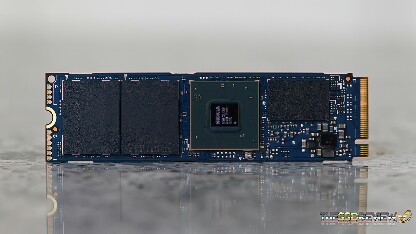
The Silicon Power XS75 1TB is the entry point of Silicon Power's XPOWER heatsink line: MAXIO's MAP1602A-F3C four-channel controller running DRAM-less with Host Memory Buffer, TLC NAND behind intelligent SLC caching, and a PCIe 4.0 x4 interface speaking NVMe 2.0. Rated speeds are 7,000 MB/s reads and — uniquely for this family — 6,000 MB/s writes, because the 1 TB variant is rated 500 MB/s below the 6,500 MB/s that the 2 TB and 4 TB models carry. Silicon Power's official TBW document rates the 1 TB card at 700 TBW under a 5-year warranty.
The heatsink is the reason this drive exists. It measures 24.6 x 80.0 x 10.8 mm and weighs 33 grams, which sits inside Sony's published PS5 expansion limit of 110 x 25 x 11.25 mm, and Silicon Power explicitly markets the XS75 for console use — no separate cooler purchase, no fiddling with thermal pads. In a PC the same cooler removes the guesswork for unventilated GPU-adjacent M.2 slots. Madshrimps' review of the 2 TB sibling found the large heatsink keeps temperatures comfortably in check even without active airflow.
Buyers should know the internal hierarchy: Silicon Power's own XS70 outrates the XS75 on paper at 7,300/6,800 MB/s, and the WD Black SN850X with heatsink and Seagate FireCuda 530 remain the flagship PS5 benchmarks. The XS75's pitch is simpler — near-flagship rated speeds, TLC instead of QLC, and a plug-and-play cooler for less than the flagships typically command. At 1 TB it suits a PS5 boost or a fast PC game drive, with the 2 TB and 4 TB models above it offering full write ratings and larger TBW budgets.
Storage Comparisons:
XS75 Performance & Benchmarks
Silicon Power rates the 1 TB XS75 at 7,000 MB/s sequential reads and 6,000 MB/s writes over PCIe 4.0, with no official IOPS figure published. Rated read speed is the headline for console use: it clears Sony's 5,500 MB/s recommendation with room to spare, so PS5 game loads run at the speed Sony's own internal testing showed to be perceptible rather than theoretical. On a PC, 7,000 MB/s reads translate into fast level streaming and full benefit for DirectStorage titles, while 6,000 MB/s writes handle 100 GB game installs briskly.
Silicon Power XS75 1 TB vs M.2 4.0 x 4 peers
Switch between sequential throughput and random IOPS to see how this drive stacks up against other M.2 4.0 x 4 SSDs in our database. The highlighted bar is the drive on this page — click any other bar to open that drive.
- Patriot Viper PV593 1 TB: 14,500 MB/s read, 14,000 MB/s write
- Patriot Viper PV593 2 TB: 14,500 MB/s read, 14,000 MB/s write
- Patriot Viper PV593 4 TB: 14,500 MB/s read, 14,000 MB/s write
- Patriot Viper PV573 2 TB: 14,000 MB/s read, 12,000 MB/s write
- Silicon Power XS75 1 TB (this drive): 7,000 MB/s read, 6,000 MB/s write
The DRAM-less fine print applies: an SLC cache absorbs burst writes and throughput settles to native TLC rates once it fills, which for game loading is irrelevant and for repeated large transfers is the difference between rated and sustained speed. Host Memory Buffer handles the translation tables from system RAM, and everyday responsiveness stays competitive with DRAM-equipped drives. Thermal behavior is the quiet strength — Madshrimps' testing of the 2 TB model showed the tall heatsink holding temperatures down even in still air, and the 1 TB card carries the same cooler over fewer NAND packages. No independent benchmark results for this exact capacity have been published yet, so treat the manufacturer ratings as the reference points.
Silicon Power XS75 vs Competitors
See how the XS75 stacks up against other M.2 4.0 x 4 drives in our database:
Compare with rival drives:
Endurance, TBW & Warranty
Silicon Power backs the XS75 1TB with a 5-year limited warranty rated to 700 TBW, whichever arrives first. Writing 50 GB per day — an aggressive gaming workload — would exhaust that budget in roughly 38 years, so the warranty term is the realistic ceiling for nearly every buyer. The family scales endurance with capacity: the 2 TB model carries 1,400 TBW and the 4 TB model 3,000 TBW, per Silicon Power's official TBW document. Claims run through Silicon Power's regional support network with proof of purchase, and the TBW-based coverage matches what WD and Seagate offer on their heatsink-equipped PS5 drives. One caveat: the 1 TB variant's 6,000 MB/s write rating does not affect the endurance budget, which is rated identically across the line.
Silicon Power XS75 1 TB Specifications
| Category | Value |
|---|---|
| Capacity [?] | 1 TB |
| Interface [?] | M.2 4.0 x 4 |
| Controller [?] | MAXIO MAP1602A-F3C 4 Channel |
| Memory type [?] | TLC |
| DRAM [?] | No |
| Read speed (MB/s) [?] | 7000 |
| Write speed (MB/s) [?] | 6000 |
| Read IOPS [?] | n/a |
| Write IOPS [?] | n/a |
| Endurance (TBW) [?] | 700 |
| MTBF (million hours) [?] | 2000000 |
| Warranty (years) [?] | 5 |
Verdict: Is the XS75 Worth It in 2026?
Buy the Silicon Power XS75 1TB when a PS5 expansion or a cool-running PC game drive is the goal and the heatsink should be included in the box: 7,000 MB/s rated reads, 700 TBW of endurance, NVMe 2.0 and a cooler that fits Sony's dimensions without adapters. Skip it if peak rated speed is the priority — Silicon Power's own XS70 and the WD Black SN850X both rate higher. The 1 TB capacity also writes 500 MB/s slower than the 2 TB and 4 TB models, so stepping up one size buys back the full rating. As a fuss-free, warranty-backed console upgrade, it covers the essentials well. Just confirm that 1 TB of console storage is genuinely enough before committing.
+ Pros
- 7,000 MB/s rated reads clear Sony's PS5 guidance
- Heatsink included and PS5-compatible
- 700 TBW endurance with 5-year warranty
- NVMe 2.0 with Host Memory Buffer
- TLC NAND with intelligent SLC caching
- Cons
- 1 TB writes rated lower, at 6,000 MB/s
- Rated below Silicon Power's own XS70
- DRAM-less design with HMB only
- 1 TB is the bare minimum for a console library
Buy this or similar SSD Storage:



Video Review
Silicon Power: Xpower PCIe Gen 4x4 SSD XS70 1TB