Silicon Power XS75 2TB Review — Full-Speed Gen4 Under a Big Heatsink (2026)
Quick answer
Buy the Silicon Power XS75 2TB as the default choice of its line: it is the capacity where the full 7,000/6,500 MB/s rating, 1,400 TBW of endurance and the PS5-compatible heatsink all line up, verified by Madshrimps' thermally positive review.
Read: 7000 MB/s Write: 6500 MB/s Endurance: 1400 TBW Warranty: 5 years Interface: M.2 4.0 x 4
The Silicon Power XS75 2TB is the sweet spot of its line — full 7,000/6,500 MB/s ratings, 1,400 TBW of endurance and a PS5-ready heatsink in the box.
Controller & Memory
The Silicon Power XS75 2TB runs MAXIO's MAP1602A-F3C four-channel controller in a DRAM-less configuration with Host Memory Buffer, pairs it with TLC NAND and intelligent SLC caching, and speaks NVMe 2.0 over PCIe 4.0 x4. At this capacity it carries the family's full rating — 7,000 MB/s reads and 6,500 MB/s writes — because only the 1 TB model is derated to 6,000 MB/s. Silicon Power's official TBW document rates the 2 TB card at 1,400 TBW under a 5-year warranty, twice the budget of the 1 TB variant.
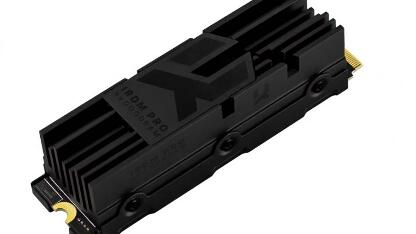
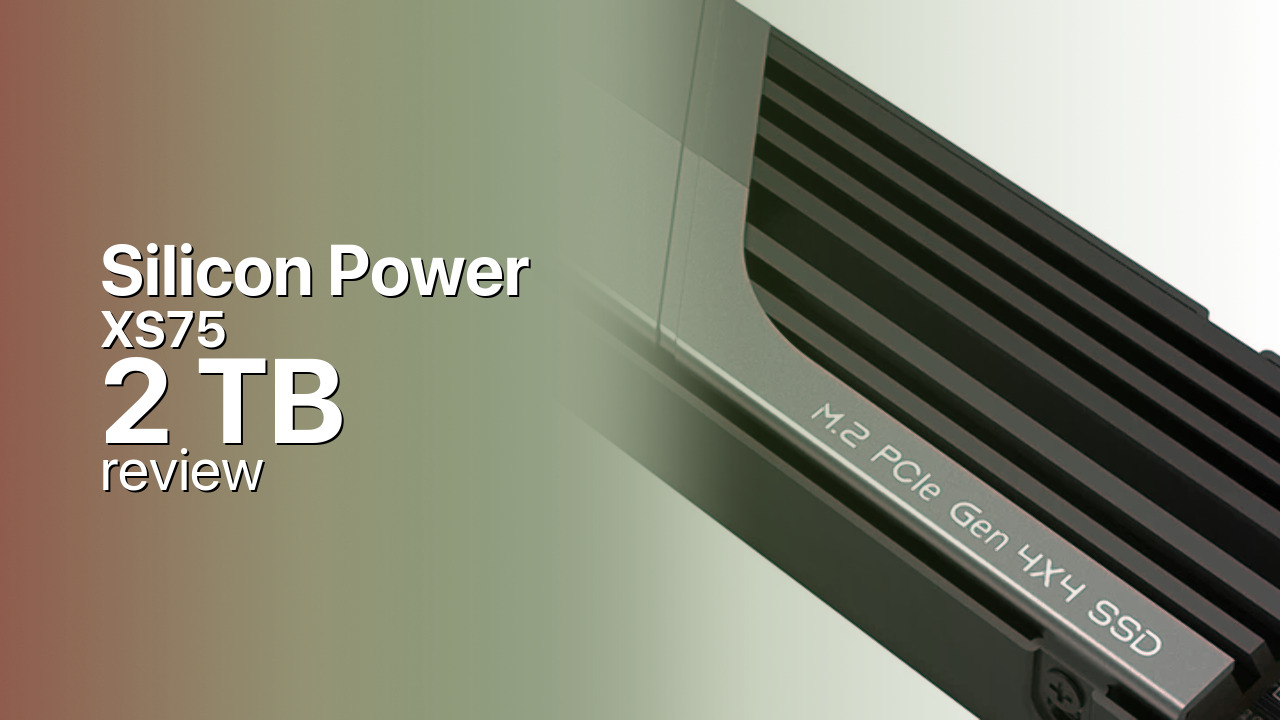
The heatsink defines the product. It stands 10.8 mm tall, spans 24.6 x 80 mm and weighs 33 grams — inside Sony's published PS5 expansion limit of 110 x 25 x 11.25 mm — and Silicon Power markets the XS75 directly at console owners who want expansion storage without shopping for a separate cooler. The same logic works in a PC: Madshrimps' August 2025 review of this exact 2 TB model found the large heatsink kept temperatures at bay even without active airflow, confirming the MAP1602A-F3C and TLC platform as a competent mainstream performer rather than a throttling risk.
Against the field, the WD Black SN850X with heatsink and Seagate FireCuda 530 remain the enthusiast PS5 picks, and Silicon Power's own XS70 rates slightly higher at 7,300/6,800 MB/s. The XS75's argument is value at the top of the Gen4 band: flagship-adjacent rated speeds, TLC rather than QLC flash, a 1,400 TBW endurance budget and plug-and-play cooling, aimed at PS5 libraries and PC game drives rather than sustained-write workstations.
Storage Comparisons:
XS75 Performance & Benchmarks
Silicon Power rates the 2 TB XS75 at 7,000 MB/s sequential reads and 6,500 MB/s writes, with no official IOPS figure published. The read rating clears Sony's 5,500 MB/s PS5 recommendation by a wide margin, so console game loads run at the speed band where Sony's own testing showed perceptible gains. On a PC, the same figure covers DirectStorage titles and fast level streaming, while 6,500 MB/s writes make 100 GB-plus game installs a minutes-long affair rather than a coffee break.
Silicon Power XS75 2 TB vs M.2 4.0 x 4 peers
Switch between sequential throughput and random IOPS to see how this drive stacks up against other M.2 4.0 x 4 SSDs in our database. The highlighted bar is the drive on this page — click any other bar to open that drive.
- Patriot Viper PV593 1 TB: 14,500 MB/s read, 14,000 MB/s write
- Patriot Viper PV593 2 TB: 14,500 MB/s read, 14,000 MB/s write
- Patriot Viper PV593 4 TB: 14,500 MB/s read, 14,000 MB/s write
- Patriot Viper PV573 2 TB: 14,000 MB/s read, 12,000 MB/s write
- Silicon Power XS75 2 TB (this drive): 7,000 MB/s read, 6,500 MB/s write
The DRAM-less architecture means a pseudo-SLC cache absorbs burst writes and throughput settles to native TLC rates once it fills — at 2 TB the cache is large enough that most buyers will never notice. Host Memory Buffer manages the translation tables from system RAM, and everyday responsiveness matches DRAM-equipped drives in gaming and desktop work. Thermals are the drive's quiet strength: Madshrimps' benchmarking showed the tall factory heatsink holding temperatures down in still air, so the drive is equally at home in a cramped console bay or a GPU-adjacent motherboard slot. Independent benchmark data on this exact model remains limited to that single review, so the manufacturer ratings are the reference until broader testing appears.
Silicon Power XS75 vs Competitors
See how the XS75 stacks up against other M.2 4.0 x 4 drives in our database:
Compare with rival drives:
Endurance, TBW & Warranty
Silicon Power covers the XS75 2TB with a 5-year limited warranty rated to 1,400 TBW, whichever arrives first. That endurance budget equates to writing roughly 760 GB per day across the full warranty term — an implausible figure for a gaming drive, so the 5-year period is the practical limit. Even a heavy 100 GB-per-day creator workload would run for over 38 years against the TBW rating. The 1 TB model below carries 700 TBW and the 4 TB model 3,000 TBW, per Silicon Power's official TBW document. Claims go through Silicon Power's regional support channels with proof of purchase, and the coverage terms match the TBW-limited warranties WD and Seagate attach to their heatsink-equipped PS5 drives.
Silicon Power XS75 2 TB Specifications
| Category | Value |
|---|---|
| Capacity [?] | 2 TB |
| Interface [?] | M.2 4.0 x 4 |
| Controller [?] | MAXIO MAP1602A-F3C 4 Channel |
| Memory type [?] | TLC |
| DRAM [?] | No |
| Read speed (MB/s) [?] | 7000 |
| Write speed (MB/s) [?] | 6500 |
| Read IOPS [?] | n/a |
| Write IOPS [?] | n/a |
| Endurance (TBW) [?] | 1400 |
| MTBF (million hours) [?] | 2000000 |
| Warranty (years) [?] | 5 |
Verdict: Is the XS75 Worth It in 2026?
Buy the Silicon Power XS75 2TB as the default choice of its line: it is the capacity where the full 7,000/6,500 MB/s rating, 1,400 TBW of endurance and the PS5-compatible heatsink all line up, verified by Madshrimps' thermally positive review. Skip it for sustained-write creator work — a DRAM-less Gen4 drive is the wrong tool there — and look at the WD Black SN850X heatsink edition if maximum rated speed and deeper review coverage matter more. For a PS5 library expansion or a PC game drive that needs no extra cooling purchases, this is an easy recommendation with a warranty to match. With 1,400 TBW and verified cool thermals, it is also the capacity the line's independent reviews actually cover.
+ Pros
- Full 7,000/6,500 MB/s family rating at 2 TB
- 1,400 TBW endurance with 5-year warranty
- Heatsink included and PS5-compatible
- Keeps temperatures low even without active airflow
- TLC NAND with intelligent SLC caching
- Cons
- DRAM-less design with HMB only
- Rated below Silicon Power's own XS70
- Heatsink adds 10.8 mm of height and 33 g
- Independent review coverage still thin
Buy this or similar SSD Storage:
Video Review
Silicon Power US75 1TB M.2 SSD Review (Good Quality & Performance)