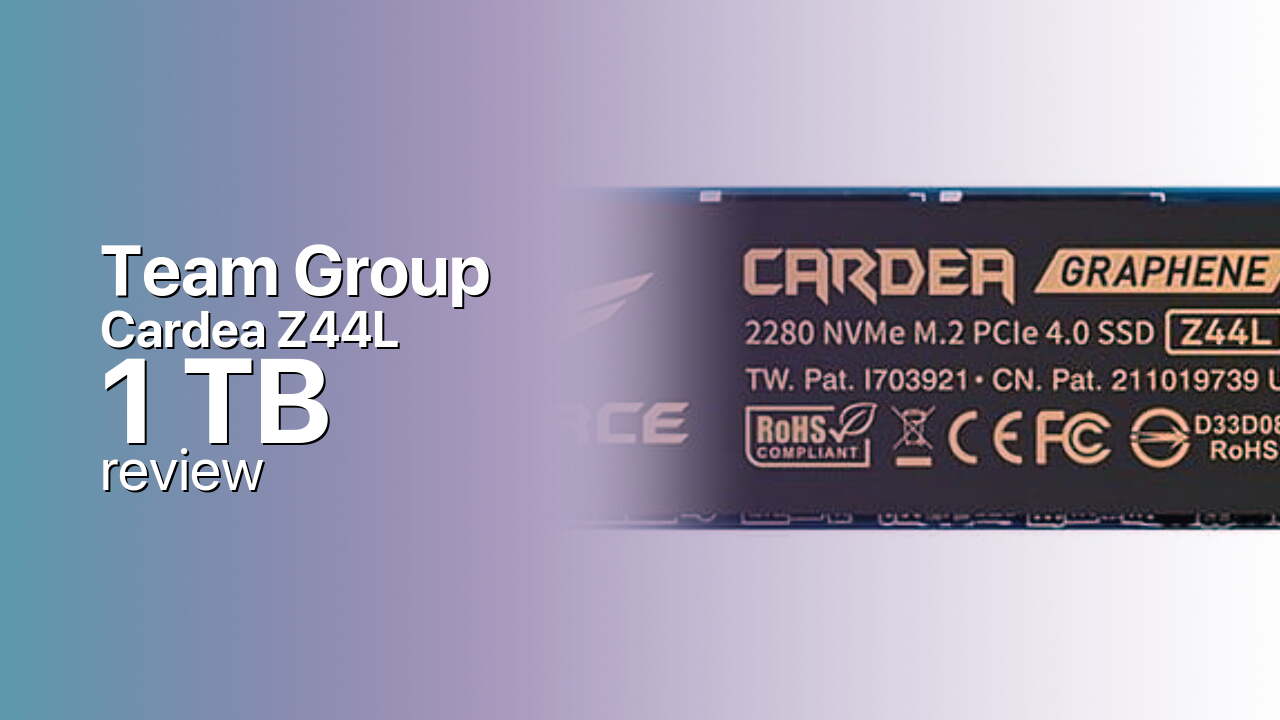
TeamGroup Cardea Z44L 1TB Review — Budget Gen4, Full Size (2026)
Quick answer
The TeamGroup Cardea Z44L 1TB is the capacity to buy in this family: family-best 3,500 MB/s reads, a real 2,700 MB/s write rating, 600 TBW of endurance and an independent verdict praising its cool-headed budget performance.
Read: 3500 MB/s Write: 2700 MB/s Endurance: 600 TBW Warranty: 5 years Interface: M.2 4.0 x 4
The TeamGroup Cardea Z44L 1TB pairs 3,500 MB/s reads with 600 TBW of endurance, a DRAM-less budget build that independent reviewers found runs cool under load.
Controller & Memory
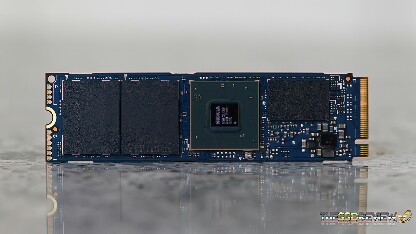
The TeamGroup Cardea Z44L 1TB is the balanced heart of TeamGroup's budget Gen4 family: a Phison E19T controller running DRAM-less with Host Memory Buffer, 3D TLC NAND, and a single-sided M.2 2280 PCB fitted with TeamGroup's patented ultra-thin graphene heat spreader. The platform uses NVMe 1.4 features such as Predictable Latency Mode and Read Recovery Levels, which TeamGroup credits for steadier latency and improved flash longevity, and the spreader sits low enough to coexist with any motherboard heatsink. The bare PCB weighs 7 g, and the graphene layer keeps total height at 3.7 mm, inside every M.2 clearance specification.
TeamGroup's spec sheet rates this capacity at 3,500/2,700 MB/s with 600 TBW — the family's top read rating, with writes stepping up from the 500GB's 2,400 MB/s and only the 2TB above it at 3,000 MB/s. Endurance doubles from the 500GB and doubles again at 2 TB, scaling at a consistent 0.6 TBW per gigabyte. Tech-Legends' review of this exact capacity concluded the Z44L 1TB delivers good performance for a budget M.2 SSD and remains cool even under load, which matches the platform's low-power, DRAM-less character.
The audience is the mainstream upgrader: a 1 TB boot drive with room for a proper game library, or a secondary slot for project files. Direct rivals are the WD Blue SN580 and Kingston NV3 at the same capacity, while Crucial's QLC-based P3 Plus undercuts on price at the cost of endurance headroom. TeamGroup sells the Z44L in 250GB, 500GB, 1TB and 2TB, with part number TM8FPL001T0C127 marking this capacity.
Storage Comparisons:
Cardea Z44L Performance & Benchmarks
TeamGroup rates the Z44L 1TB at 3,500 MB/s sequential reads and 2,700 MB/s sequential writes over PCIe 4.0 x4, with random performance rated up to 500K read and 550K write IOPS. Those are the best-rated figures in the family alongside the 2TB, and the 1 TB of NAND gives the pseudo-SLC cache enough room to hold realistic bursts — full-game downloads and project archives — at or near rated speed before throughput settles to sustained TLC rates.
Team Group Cardea Z44L 1 TB vs M.2 4.0 x 4 peers
Switch between sequential throughput and random IOPS to see how this drive stacks up against other M.2 4.0 x 4 SSDs in our database. The highlighted bar is the drive on this page — click any other bar to open that drive.
- Patriot Viper PV593 1 TB: 14,500 MB/s read, 14,000 MB/s write
- Patriot Viper PV593 2 TB: 14,500 MB/s read, 14,000 MB/s write
- Patriot Viper PV593 4 TB: 14,500 MB/s read, 14,000 MB/s write
- Patriot Viper PV573 2 TB: 14,000 MB/s read, 12,000 MB/s write
- Team Group Cardea Z44L 1 TB (this drive): 3,500 MB/s read, 2,700 MB/s write
In use, the Z44L 1TB behaves like a proper mainstream NVMe. Boot times, application launches and game loading are read-dominated, low-queue workloads where the DRAM-less design costs nothing perceptible, and 3,500 MB/s moves a 100 GB game in well under a minute at rated speed. Sustained writes are the honest limit: past the cache wall, throughput drops, and heavy multitasking with many parallel small writes is where a DRAM-equipped drive would hold an advantage. Tech-Legends' 1TB review reported good performance overall with thermals remaining cool under load — the graphene spreader and efficient E19T platform make heatsink worries unnecessary in most builds. The PS5 question has a straight answer: 3,500 MB/s sits below Sony's 5,500 MB/s recommendation, so this remains a PC-first drive.
Team Group Cardea Z44L vs Competitors
See how the Cardea Z44L stacks up against other M.2 4.0 x 4 drives in our database:
Compare with rival drives:
Endurance, TBW & Warranty
TeamGroup covers the Z44L 1TB with a 5-year limited warranty rated to 600 TBW of host writes, whichever arrives first. The endurance scales at 0.6 TBW per gigabyte across the family — 150 TBW at 250GB, 300 TBW at 500GB, 1,200 TBW at 2 TB — and 600 TBW represents roughly 82 years of writing at a moderate 20 GB per day, so the five-year calendar term is the practical limit for any desktop workload. TBW is calculated to JEDEC definitions, with TeamGroup's SMART tool as the reference in any dispute. The spec sheet lists MTBF at 3,000,000 hours, a population-level statistic rather than a per-unit promise. Service runs through TeamGroup's warranty channels with proof of purchase.
Team Group Cardea Z44L 1 TB Specifications
| Category | Value |
|---|---|
| Capacity [?] | 1 TB |
| Interface [?] | M.2 4.0 x 4 |
| Controller [?] | Phison E19T |
| Memory type [?] | 3D TLC |
| DRAM [?] | No |
| Read speed (MB/s) [?] | 3500 |
| Write speed (MB/s) [?] | 2700 |
| Read IOPS [?] | 500000 |
| Write IOPS [?] | 550000 |
| Endurance (TBW) [?] | 600 |
| MTBF (million hours) [?] | 3000000 |
| Warranty (years) [?] | 5 |
Verdict: Is the Cardea Z44L Worth It in 2026?
The TeamGroup Cardea Z44L 1TB is the capacity to buy in this family: family-best 3,500 MB/s reads, a real 2,700 MB/s write rating, 600 TBW of endurance and an independent verdict praising its cool-headed budget performance. Skip it if the drive will sustain heavy writes or double as a PS5 upgrade — 3,500 MB/s falls short of Sony's 5,500 MB/s recommendation, and DRAM-equipped rivals handle sustained multitasking better. The WD Blue SN580 1TB rates roughly 4,150 MB/s both ways and is the natural alternative; the Crucial P3 Plus undercuts on price with QLC trade-offs. For a budget main drive, we would take this Z44L over the 500GB without hesitation. Its ratings are the family's best, its endurance doubles the 500GB model's, and it runs cool enough to slot anywhere in the system.
+ Pros
- 3,500/2,700 MB/s rated speeds
- 600 TBW endurance with 5-year warranty
- 500K/550K rated random IOPS
- Runs cool under load per independent review
- Graphene heat spreader included
- Single-sided PCB suits any M.2 2280 slot
- Cons
- No DRAM cache — Host Memory Buffer only
- Reads below Sony's 5,500 MB/s PS5 guidance
- Sustained writes settle after the SLC cache
- Trails WD Blue SN580 on rated write speed
Buy this or similar SSD Storage:



Video Review
High Speed Cardea Z44Q by Team Group - Review