ADATA Legend 970 Pro 1TB — PCIe 5.0 NVMe SSD with Fan Cooling (2026)
Quick answer
The ADATA Legend 970 Pro 1TB is a good choice if you want active cooling for sustained Gen5 performance but do not have room for the Mars 970 Storm's oversized liquid cooler.
Read: 14000 MB/s Write: 11000 MB/s Endurance: 740 TBW Warranty: 5 years Interface: M.2 5.0
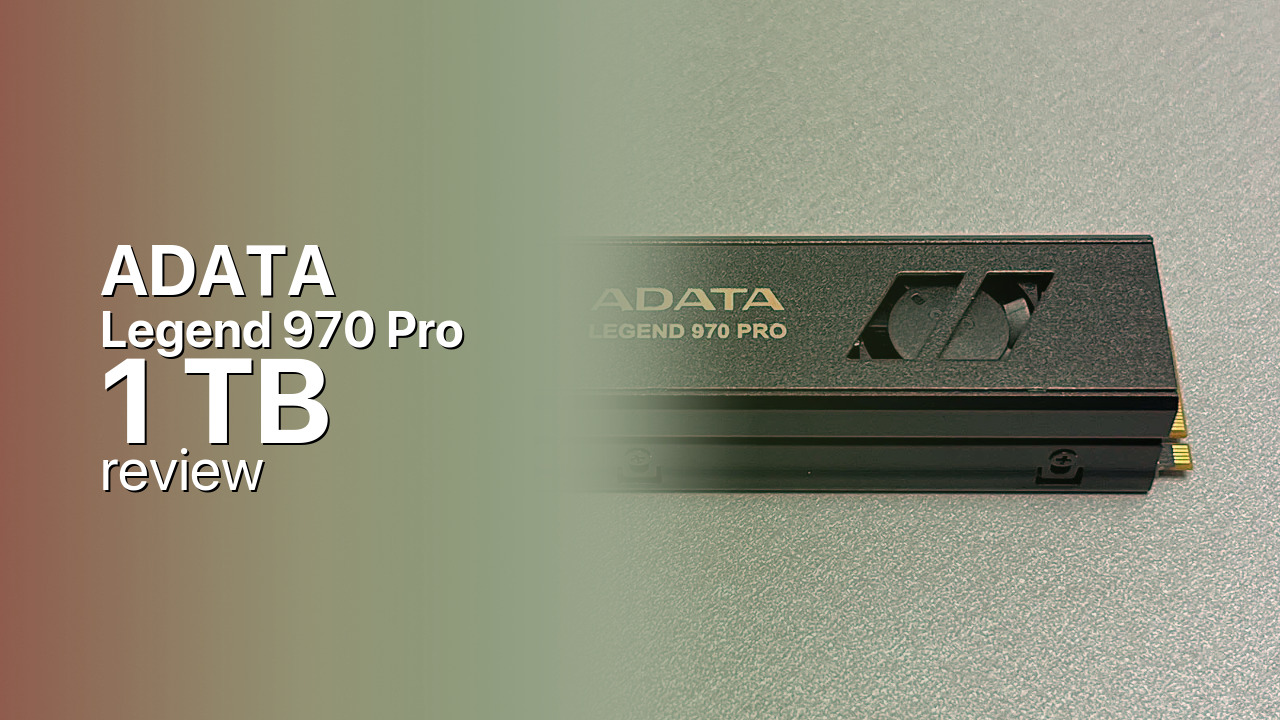
The ADATA Legend 970 Pro 1TB is a PCIe 5.0 NVMe SSD that uses an InnoGrit IG5666 controller and an active dual-layer aluminium fin heatsink with a built-in fan to sustain 14,000 MB/s reads and 11,000 MB/s writes.
Controller & Memory
The Legend 970 Pro is ADATA's first PCIe 5.0 SSD under the Legend brand, preceding the Mars series. It is built around the InnoGrit IG5666 eight-channel controller, paired with 232-layer 3D TLC NAND and a DRAM cache buffer. The IG5666 is a capable Gen5 controller that competes with the Phison E26 and Silicon Motion SM2508, though it has been less widely adopted by SSD manufacturers.
The standout feature is the active cooling solution: a dual-layer extruded aluminium fin heatsink with a built-in micro fan powered directly from the M.2 slot. This design reduces temperatures by up to 20% compared to fanless heatsinks, according to ADATA, allowing the controller to sustain peak performance without thermal throttling. The heatsink assembly measures 17.9 mm tall — substantial but still shorter than the Mars 970 Storm's liquid cooler.
At 1TB, the Legend 970 Pro delivers 14,000 MB/s reads and 11,000 MB/s writes with random IOPS up to 1,800K read and 1,300K write. The drive is available in 1 TB, 2 TB, and 4 TB capacities. It targets enthusiasts who want guaranteed sustained performance from a Gen5 drive without the size penalty of the Storm's liquid cooling system.
Storage Comparisons:
Legend 970 Pro Performance & Benchmarks
The Legend 970 Pro 1TB is rated for 14,000 MB/s sequential reads and 11,000 MB/s sequential writes over PCIe 5.0 x4, with random 4K performance reaching 1,800K IOPS reads and 1,300K IOPS writes. These figures place it in the upper tier of PCIe 5.0 SSDs, competitive with Phison E26-based drives and slightly behind the latest SM2508-based models.
ADATA Legend 970 Pro 1 TB vs M.2 5.0 peers
Switch between sequential throughput and random IOPS to see how this drive stacks up against other M.2 5.0 SSDs in our database. The highlighted bar is the drive on this page — click any other bar to open that drive.
- Corsair MP700 Pro XT 1 TB: 14,900 MB/s read, 14,200 MB/s write
- Corsair MP700 Pro XT 2 TB: 14,900 MB/s read, 14,500 MB/s write
- Corsair MP700 Pro XT 4 TB: 14,900 MB/s read, 14,400 MB/s write
- Crucial T710 1 TB: 14,900 MB/s read, 13,800 MB/s write
- ADATA Legend 970 Pro 1 TB (this drive): 14,000 MB/s read, 11,000 MB/s write
The active fan cooling makes a measurable difference in sustained write performance. In passive heatsink configurations, the IG5666 controller — like most Gen5 controllers — begins thermal throttling after extended writes, progressively reducing speed to stay within temperature limits. The Legend 970 Pro's finned aluminium heatsink and fan prevent or significantly delay this throttling, maintaining higher average write speeds during large file transfers and backup operations.
The SLC cache on the 1 TB model provides a solid burst buffer. After cache exhaustion, native TLC write speeds are sustained effectively thanks to the active cooling. The fan is powered by the M.2 slot and spins up under load, with noise levels that are generally unobtrusive in a desktop environment. For Gen5 SSDs without active cooling, the same workload would result in noticeably lower sustained speeds.
ADATA Legend 970 Pro vs Competitors
See how the Legend 970 Pro stacks up against other M.2 5.0 drives in our database:
Compare with rival drives:
Endurance, TBW & Warranty
ADATA covers the Legend 970 Pro with a 5-year limited warranty. The endurance rating for the 1TB model is 740 TBW, matching ADATA's standard of 740 TBW per TB of capacity. The MTBF is rated at 1.6 million hours. At a typical write workload of 20 GB per day, the 740 TBW endurance provides over 100 years of use. The active cooling fan is covered under the same warranty terms as the SSD itself.
ADATA Legend 970 Pro 1 TB Specifications
| Category | Value |
|---|---|
| Capacity [?] | 1 TB |
| Interface [?] | M.2 5.0 |
| Controller [?] | InnoGrit IG5666 |
| Memory type [?] | Micron 232-L TLC |
| DRAM [?] | Yes |
| Read speed (MB/s) [?] | 14000 |
| Write speed (MB/s) [?] | 11000 |
| Read IOPS [?] | 1800000 |
| Write IOPS [?] | 1300000 |
| Endurance (TBW) [?] | 740 |
| MTBF (million hours) [?] | 1600000 |
| Warranty (years) [?] | 5 |
Verdict: Is the Legend 970 Pro Worth It in 2026?
The ADATA Legend 970 Pro 1TB is a good choice if you want active cooling for sustained Gen5 performance but do not have room for the Mars 970 Storm's oversized liquid cooler. The finned aluminium heatsink with integrated fan keeps the IG5666 controller running cool without the complexity of liquid cooling.
Skip it if you do not push sustained writes hard enough to trigger thermal throttling — in that case, a passively cooled Gen5 drive like the Mars 980 Blade saves money and simplifies installation.
The Mars 980 Blade with the SM2508 controller offers higher peak write speeds and newer NAND technology at a similar price. The Seagate FireCuda 540 is the main competitor with active cooling. The Legend 970 Pro remains a solid option for those who specifically want the InnoGrit controller platform.
+ Pros
- Active fan cooling for sustained writes
- 14,000 MB/s sequential reads
- DRAM cache buffer
- Built-in cooling fan powered by M.2 slot
- 5-year warranty
- Cons
- Heatsink may not fit some motherboard M.2 slots
- Fan noise under sustained load
- IG5666 controller trails SM2508 in peak write speed
- Not compatible with PS5 (heatsink too tall)
Buy this or similar SSD Storage:
Video Review
ADATA Legend 970 SSD Review - Good Enough?