Micron 2500 1TB Review — QLC Capacity for OEM Machines (2026)
Quick answer
Buy the Micron 2500 1TB as a cheap secondary drive, a like-for-like laptop replacement, or the rare 2230-form-factor upgrade where its 7,100 MB/s reads and AES-256 encryption embarrass everything else that physically fits.
Read: 7100 MB/s Write: 5800 MB/s Endurance: 300 TBW Warranty: 5 years Interface: M.2 4.0 x 4
The Micron 2500 1TB pairs 7,100 MB/s QLC reads with 300 TBW of endurance — an OEM part that doubles as a cheap secondary drive for desktop builders.
Controller & Memory
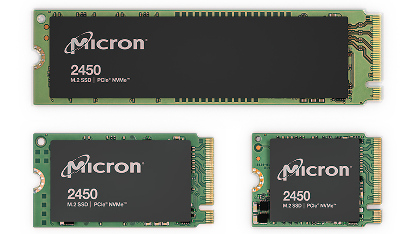
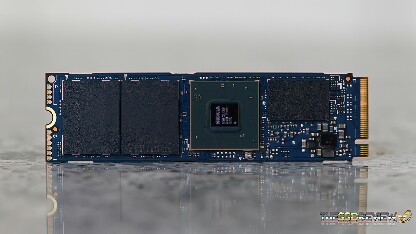
The Micron 2500 1TB is the middle child of Micron's OEM QLC line, the family that put the industry's first 232-layer QLC NAND into a client SSD. Like its siblings it runs a DRAM-less in-house Micron controller with Host Memory Buffer and a pseudo-SLC write cache, adds AES-256 hardware encryption, and ships in multiple M.2 lengths — 2230 and 2280 versions both surface at retail through upgrade kits and pulls, which matters for owners of thin laptops and Surface-class machines. The 1 TB model is rated at 7,100 MB/s reads and 5,800 MB/s writes over PCIe 4.0 x4, with 900K/1,000K random IOPS.
Within the range, the 1 TB model is where the QLC economics start working in the buyer's favor. It steps clearly above the 512 GB version — reads jump from 6,600 to 7,100 MB/s, writes from 3,650 to 5,800 MB/s, and endurance from 200 to 300 TBW. The 2 TB model tops the line at 7,100/6,000 MB/s with 1,000K IOPS in both directions and 600 TBW. Every capacity shares the same 5-year limited warranty and 2 million-hour MTTF rating, generous terms for drives that mostly live inside other companies' laptops.
In the wild, the 2500 1TB plays three roles: the OEM stick inside a prebuilt or laptop, a replacement for exactly that stick, and a cheap secondary drive for builders who catch a pull at the right price. Against the retail Crucial P3 it offers similar QLC character with stronger rated reads; against TLC budget drives like the WD Blue SN580 it trades endurance and sustained writes for cost. Demanding primary-drive buyers should look at the TLC-based Micron 2550 instead.
Storage Comparisons:
2500 Performance & Benchmarks
On paper, the 1 TB Micron 2500 is rated at 7,100 MB/s sequential reads, 5,800 MB/s writes, and 900K/1,000K random read/write IOPS. Manufacturer figures, and optimistic ones for QLC — community benchmarking via harddrivebenchmark.net measures the 1 TB model around 6,492 MB/s reads and 4,942 MB/s writes, which is the usual gap between rated burst and real-world mixed workloads. Micron's own marketing leans on system-level claims: up to 46 percent faster access times and 45 percent better PCMark 10 scores than competitor drives, numbers to treat as vendor framing rather than fact.
MICRON 2500 1 TB vs M.2 4.0 x 4 peers
Switch between sequential throughput and random IOPS to see how this drive stacks up against other M.2 4.0 x 4 SSDs in our database. The highlighted bar is the drive on this page — click any other bar to open that drive.
- Patriot Viper PV593 1 TB: 14,500 MB/s read, 14,000 MB/s write
- Patriot Viper PV593 2 TB: 14,500 MB/s read, 14,000 MB/s write
- Patriot Viper PV593 4 TB: 14,500 MB/s read, 14,000 MB/s write
- Patriot Viper PV573 2 TB: 14,000 MB/s read, 12,000 MB/s write
- MICRON 2500 1 TB (this drive): 7,100 MB/s read, 5,800 MB/s write
The character that matters is the QLC profile. Burst performance is genuinely excellent — boot times, application launches, and game loads feel identical to far pricier drives, because the pseudo-SLC cache and the strong read engine do the heavy lifting. Sustained writes are the trade: once the cache fills on a large transfer, throughput drops to native QLC rates and stays there until the cache recovers. For an office PC, a boot drive, or a game library that grows more often than it churns, that trade is invisible. For video scratch disks or constant multi-hundred-gigabyte moves, it is disqualifying — that is TLC territory, and the Micron 2550 is the family member built for it.
MICRON 2500 vs Competitors
See how the 2500 stacks up against other M.2 4.0 x 4 drives in our database:
Compare with rival drives:
Endurance, TBW & Warranty
Micron rates the 2500 1TB at 300 TBW, a 50 percent step up from the 512 GB model's 200 TBW and half of the 2 TB flagship's 600 TBW. The number is modest even by QLC standards, but the math stays comfortable: at a light 20 GB of writes per day, exhaustion would take more than four decades, and typical laptop duty writes a fraction of that. The rated MTTF is 2 million device hours per Micron's technical product specification — a fleet-level statistic, not a promise about any individual stick. The 5-year limited warranty matches Micron's standard client terms across the line, though as an OEM part number the practical coverage often flows through the laptop or system maker instead; some channel listings cite shorter terms, so verify whose warranty actually applies before relying on it.
MICRON 2500 1 TB Specifications
| Category | Value |
|---|---|
| Capacity [?] | 1 TB |
| Interface [?] | M.2 4.0 x 4 |
| Controller [?] | Micron |
| Memory type [?] | Micron 232-L QLC |
| DRAM [?] | No |
| Read speed (MB/s) [?] | 7100 |
| Write speed (MB/s) [?] | 5800 |
| Read IOPS [?] | 900000 |
| Write IOPS [?] | 1000000 |
| Endurance (TBW) [?] | 300 |
| MTBF (million hours) [?] | 2000000 |
| Warranty (years) [?] | 5 |
Verdict: Is the 2500 Worth It in 2026?
Buy the Micron 2500 1TB as a cheap secondary drive, a like-for-like laptop replacement, or the rare 2230-form-factor upgrade where its 7,100 MB/s reads and AES-256 encryption embarrass everything else that physically fits. Skip it as a primary drive for anyone who writes for a living — 300 TBW of QLC endurance and 5,800 MB/s post-cache writes are real ceilings — and skip it for a PS5, where capacity and OEM warranty both argue against it. The Crucial P3 delivers the same QLC philosophy in retail packaging, the Micron 2550 buys genuine TLC endurance for more money, and the WD Blue SN580 remains the safe budget TLC pick. As OEM pulls go, this is one of the better ones.
+ Pros
- 7,100 MB/s sequential reads
- 900K/1,000K random IOPS rating
- AES-256 hardware encryption
- Compact M.2 2230 option for thin laptops
- 300 TBW endurance with 5-year warranty
- Cons
- QLC endurance trails TLC rivals
- OEM part — warranty support is indirect
- Sustained writes slow once the pSLC cache fills
- Not a practical PS5 upgrade
Buy this or similar SSD Storage:



Video Review
SSD vs NVMe: What’s The Difference??