MSI Spatium M370 256GB Review: An Honest Gen3 Boot Drive (2026)
Quick answer
Buy the MSI Spatium M370 256GB as a cheap, honest boot drive for an older Gen3 desktop, an OEM PC revival or a thin laptop — its 2.15 mm body and TLC NAND suit exactly that job.
Read: 2300 MB/s Write: 1100 MB/s Endurance: 200 TBW Warranty: 5 years Interface: M.2 3.0 x 4
The MSI Spatium M370 256GB is a bare-bones Gen3 boot drive — 2,300 MB/s reads, Kioxia TLC NAND and a five-year warranty around a DRAM-less core.
Controller & Memory
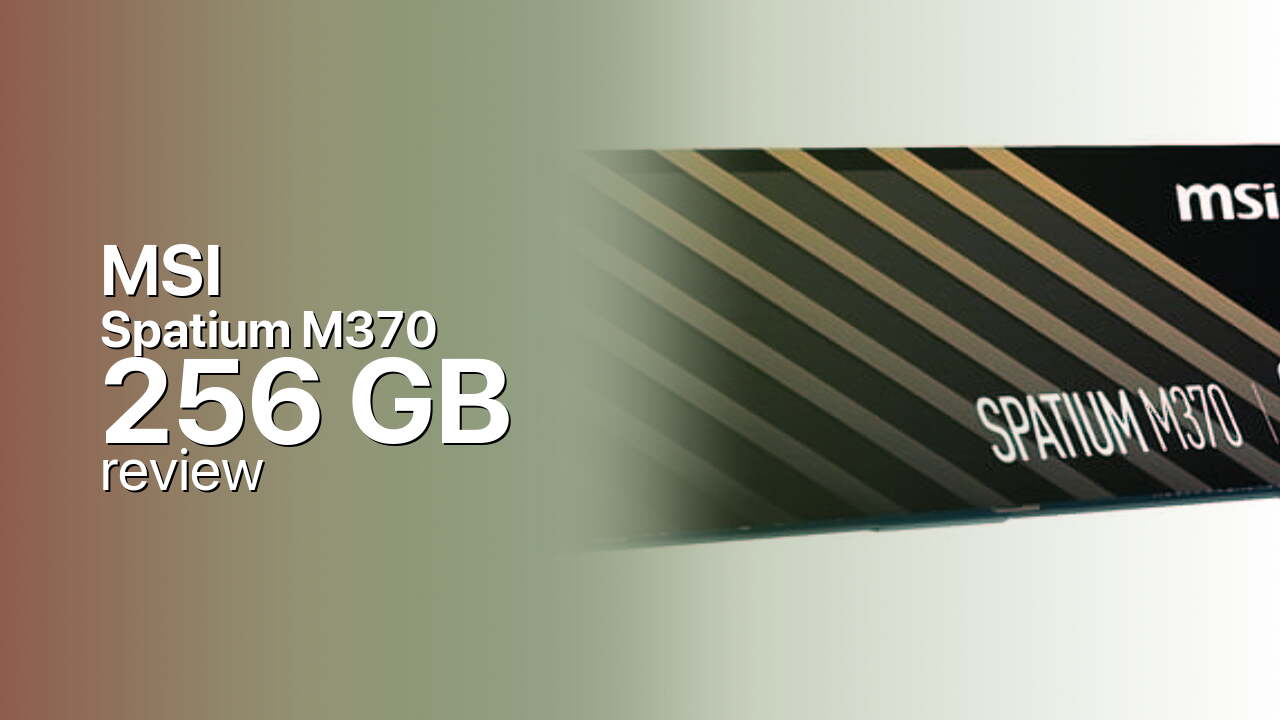
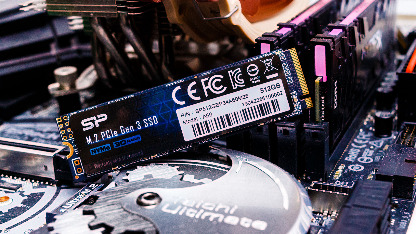
The MSI Spatium M370 256GB is MSI's entry ticket into NVMe storage, and its smallest widely stocked size. Inside sits Phison's E13T controller — the four-channel, DRAM-less design TechPowerUp identifies as the PS5015-E15 family — paired with Kioxia BiCS4 96-layer TLC NAND and Host Memory Buffer standing in for a DRAM chip. The interface is PCIe 3.0 x4 with NVMe 1.3, not Gen4: MSI rates this capacity at 2,300 MB/s sequential reads and just 1,100 MB/s writes, with 150K random-read and 230K random-write IOPS. At 2.15 mm thick in the standard 2280 outline, it slides into virtually any laptop or older desktop board.
MSI sells the M370 in 128GB, 256GB, 512GB, 1TB and 2TB, and the ladder is steep. Writes climb from 1,100 MB/s here to 1,750 MB/s on the 512GB and 1TB and 1,850 MB/s on the 2TB, while endurance runs 200, 400, 800 and 1,600 TBW across those four sizes, all under the same five-year limited warranty. The 256GB slot is honest boot-drive territory — a Windows or Linux installation, an office workload, an OEM PC revival — where the modest write rating rarely becomes the bottleneck.
Its natural rivals are the Crucial P3, the WD Blue SN570 and Kingston's NV1. Against the P3, this drive's TLC NAND is the argument: Crucial's QLC slows sharply once its cache empties, while the Kioxia flash here holds a steadier floor. The SN570 reads faster at 3,500 MB/s if the price gap is small. What the M370 256GB cannot do is console duty — PCIe 3.0 and a 2,300 MB/s read rating fall short of Sony's PS5 requirements on both generation and speed.
Storage Comparisons:
Spatium M370 Performance & Benchmarks
MSI rates the 256GB Spatium M370 at 2,300 MB/s sequential reads and 1,100 MB/s writes, with 150K random-read and 230K random-write IOPS — the lowest sequential ratings in the M370 family. Those are queue-depth burst figures. TechPowerUp's testing of the shared platform puts the 1TB model's dynamic pseudo-SLC cache at roughly 23 GB, with post-cache writes settling near 500 MB/s; the smaller cache on this 256GB unit will exhaust sooner, so sustained writes land in the same several-hundred-MB/s band once it fills.
MSI Spatium M370 256 GB vs M.2 3.0 x 4 peers
Switch between sequential throughput and random IOPS to see how this drive stacks up against other M.2 3.0 x 4 SSDs in our database. The highlighted bar is the drive on this page — click any other bar to open that drive.
- ADATA SX 8800 Pro 512 GB: 3,500 MB/s read, 2,700 MB/s write
- ADATA SX 8800 Pro 1 TB: 3,500 MB/s read, 2,700 MB/s write
- ADATA XPG Spectrix S40G RGB 256 GB: 3,500 MB/s read, 3,000 MB/s write
- ADATA XPG Spectrix S40G RGB 512 GB: 3,500 MB/s read, 3,000 MB/s write
- MSI Spatium M370 256 GB (this drive): 2,300 MB/s read, 1,100 MB/s write
As a boot drive, though, this capacity rarely touches those limits. Operating-system responsiveness depends on queue-depth-1 random reads and latency, where Phison's DRAM-less design with Host Memory Buffer behaves close to costlier hardware in desktop use. Games load within a second or two of Gen4 drives because titles are dominated by small-read patterns rather than sequential bursts. Where the 1,100 MB/s write rating shows is bulk work: moving a video project, a photo library or a 100 GB game install takes roughly half the time the 1TB and 512GB variants need. Plan around that, and the capacity stays coherent for its job.
MSI Spatium M370 vs Competitors
See how the Spatium M370 stacks up against other M.2 3.0 x 4 drives in our database:
Compare with rival drives:
Endurance, TBW & Warranty
MSI covers the Spatium M370 for five years or 200 TBW, whichever arrives first — the smallest endurance budget in a family that runs 200, 400, 800 and 1,600 TBW across its four main capacities. In daily-write terms, 200 TBW on 256GB works out near 0.43 drive writes per day, so a typical boot-drive workload clears it easily: at 10 GB of writes per day the budget lasts more than half a century. MTBF is rated up to 1.5 million hours, a fleet statistic rather than a single-drive promise. MSI's feature list for the platform includes LDPC error correction, end-to-end data path protection and TCG Pyrite encryption, and claims run through MSI's standard support channels with proof of purchase.
MSI Spatium M370 256 GB Specifications
| Category | Value |
|---|---|
| Capacity [?] | 256 GB |
| Interface [?] | M.2 3.0 x 4 |
| Controller [?] | Phison E13T 4 Channel |
| Memory type [?] | Kioxia 96-L3D TLC |
| DRAM [?] | No |
| Read speed (MB/s) [?] | 2300 |
| Write speed (MB/s) [?] | 1100 |
| Read IOPS [?] | 150000 |
| Write IOPS [?] | 230000 |
| Endurance (TBW) [?] | 200 |
| MTBF (million hours) [?] | 1500000 |
| Warranty (years) [?] | 5 |
Verdict: Is the Spatium M370 Worth It in 2026?
Buy the MSI Spatium M370 256GB as a cheap, honest boot drive for an older Gen3 desktop, an OEM PC revival or a thin laptop — its 2.15 mm body and TLC NAND suit exactly that job. Skip it for anything capacity-hungry or console-bound: 200 TBW is a small endurance budget, 1,100 MB/s writes are the family's weakest, and the PS5 is out of reach on PCIe 3.0. The Crucial P3 256GB undercuts it with QLC, and the WD Blue SN570 reads far faster if the price gap is small; the 512GB M370 is the smarter step up within the same family. Judged as what it is — a five-year-warranty boot drive — it makes sense.
+ Pros
- 2,300 MB/s reads on PCIe 3.0 x4
- Kioxia BiCS4 TLC, not QLC
- Five-year warranty at the entry tier
- 2.15 mm profile suits thin laptops
- 230K random-write IOPS on a 256GB drive
- TCG Pyrite encryption and LDPC ECC
- Cons
- Writes rate just 1,100 MB/s
- 200 TBW endurance, the family's lowest
- No PS5 compatibility on PCIe 3.0
- Post-cache writes drop toward 500 MB/s
- Reads trail the WD Blue SN570 by 1,200 MB/s
Buy this or similar SSD Storage:
Video Review
Просто NVMe SSD MSI Spatium M370 1TB S78-440L570-P83