Patriot P400 Lite 4TB Review — Bulk Storage, Budget Speeds (2026)
Quick answer
Buy the Patriot P400 Lite 4TB when the project is cheap, dependable bulk: a media archive, a home-server pool, a backup target, or a game library that reads far more often than it writes — the 5-year warranty and included heat spreader make it a complete package at a price the name brands rarely match.
Read: 3500 MB/s Write: 2700 MB/s Endurance: 380 TBW Warranty: 5 years Interface: M.2 4.0 x 4
The Patriot P400 Lite 4TB plays the bulk game at 3,500 MB/s with a graphene heat spreader included and a 5-year warranty doing the reassurance work.
Controller & Memory
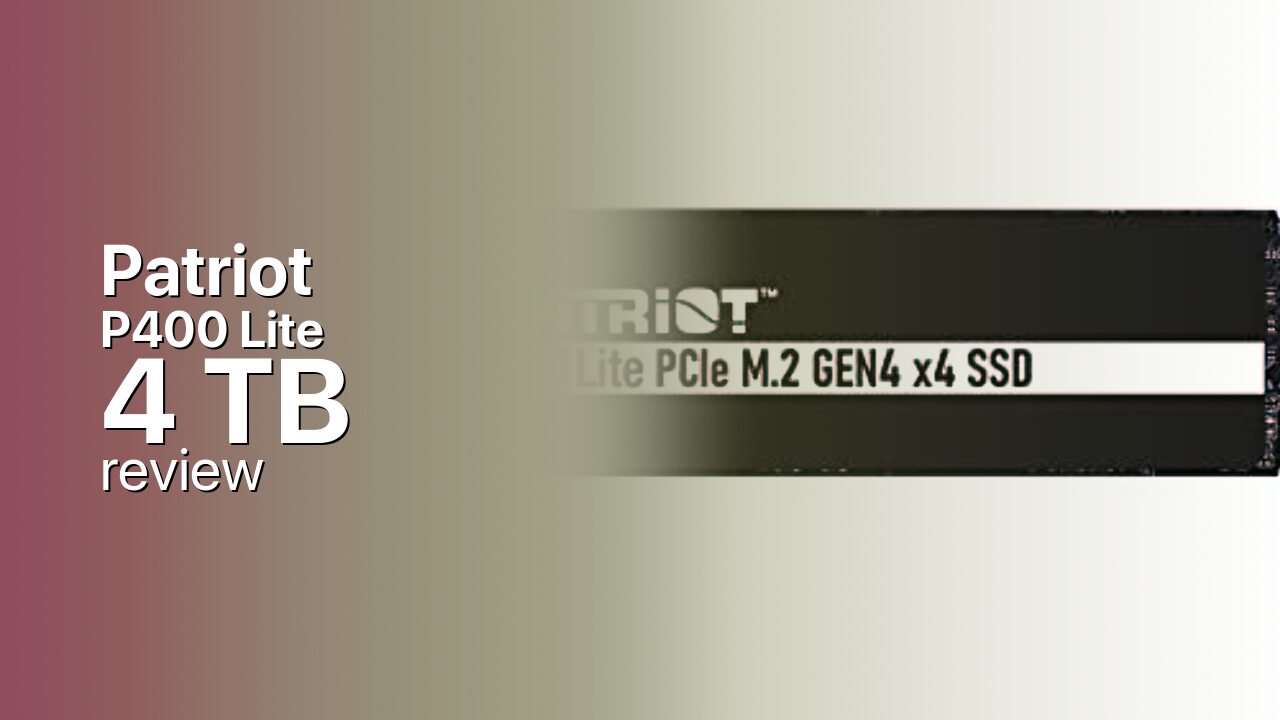
The Patriot P400 Lite 4TB is Patriot's answer to a specific question: how much honest, warrantied storage can four terabytes cost? The platform is deliberately mid-tier — a DRAM-less Maxio MAP1602A-class controller with Host Memory Buffer, YMTC TLC behind it, and line-wide ratings of 3,500 MB/s reads and 2,700 MB/s writes over PCIe 4.0 x4. Those are not flagship numbers and are not pretending to be; they are roughly triple SATA speed with Gen4 convenience, aimed squarely at the bulk-storage buyer. A slim graphene heat spreader ships in the box, and SmartECC plus end-to-end datapath protection handle data integrity.
Within Patriot's own range, the positioning is clear. The Viper VP4300 Lite sits above it — 7,400 MB/s reads, single-sided, the performance value pick — while the P400 Lite competes on price per terabyte instead, and at 4 TB that is the fight it usually wins. The original P400 (non-Lite) drew criticism for its 3-year warranty; the Lite carries 5 years, TBW-limited, which is unusually strong coverage for a drive sold at this bracket. Against the Silicon Power UD90 and Kingston NV3 at similar capacities, the P400 Lite trades rated speed for cost and warranty parity.
The audience is bulk on a budget: media archives, home-server pools, backup targets, and game libraries that have outgrown smaller drives without needing flagship read rates. What it is not: a PS5 upgrade — the 3,500 MB/s rating sits well under Sony's 5,500 MB/s recommendation — or a working drive for sustained professional writes, where the DRAM-less design and modest speeds both argue for stepping up.
Storage Comparisons:
P400 Lite Performance & Benchmarks
Patriot rates the P400 Lite 4TB at 3,500 MB/s sequential reads and 2,700 MB/s writes over PCIe 4.0 x4, and publishes no random IOPS figures for the line — the spec sheet keeps to sequential numbers and lets the price do the talking. In context, the read rating is still transformative for the drives this capacity usually replaces: triple the throughput of SATA SSDs and several times that of spinning disks, which means archive crawls, library scans, and home-server reads finish before the coffee does.
Patriot P400 Lite 4 TB vs M.2 4.0 x 4 peers
Switch between sequential throughput and random IOPS to see how this drive stacks up against other M.2 4.0 x 4 SSDs in our database. The highlighted bar is the drive on this page — click any other bar to open that drive.
- Patriot Viper PV593 1 TB: 14,500 MB/s read, 14,000 MB/s write
- Patriot Viper PV593 2 TB: 14,500 MB/s read, 14,000 MB/s write
- Patriot Viper PV593 4 TB: 14,500 MB/s read, 14,000 MB/s write
- Patriot Viper PV573 2 TB: 14,000 MB/s read, 12,000 MB/s write
- Patriot P400 Lite 4 TB (this drive): 3,500 MB/s read, 2,700 MB/s write
The DRAM-less design writes the fine print. Writes ride a pseudo-SLC cache, so installs and batch copies start strong, then settle to native TLC rates on transfers large enough to exhaust it — at 2,700 MB/s rated, the ceiling is honest rather than spectacular, and sustained mixed workloads trail DRAM-equipped drives as expected. Tom's Hardware's coverage of the Lite family characterized it exactly this way: not a performance leader in heavy workloads, but a strong value pick for what most bulk buyers actually do. The included graphene heat spreader manages the modest thermal load, and reviewers found the drive behaving as specified — steady, cool, and unremarkable in exactly the way bulk storage should be.
Patriot P400 Lite vs Competitors
See how the P400 Lite stacks up against other M.2 4.0 x 4 drives in our database:
Compare with rival drives:
Endurance, TBW & Warranty
Patriot covers the P400 Lite 4TB with a 5-year limited warranty, TBW-limited — a meaningful upgrade over the original P400's criticized 3-year terms and competitive with the best coverage in the value tier. One honest wrinkle: Patriot does not publish the TBW threshold on its product page, so buyers cannot independently verify where that limit sits; the spec-sheet convention in third-party databases suggests hundreds of terabytes written for this capacity, but the warranty term is the concrete, verifiable promise. At any plausible bulk-storage write rate, the 5-year clock is the limit that matters in practice. The included graphene heat spreader helps the drive stay within its 0-to-70-degree operating window during long transfers, protecting both performance and longevity.
Patriot P400 Lite 4 TB Specifications
| Category | Value |
|---|---|
| Capacity [?] | 4 TB |
| Interface [?] | M.2 4.0 x 4 |
| Controller [?] | Maxio MAP1602A |
| Memory type [?] | YMTC 232-L TLC |
| DRAM [?] | No |
| Read speed (MB/s) [?] | 3500 |
| Write speed (MB/s) [?] | 2700 |
| Read IOPS [?] | |
| Write IOPS [?] | |
| Endurance (TBW) [?] | 380 |
| MTBF (million hours) [?] | 2000000 |
| Warranty (years) [?] | 5 |
Verdict: Is the P400 Lite Worth It in 2026?
Buy the Patriot P400 Lite 4TB when the project is cheap, dependable bulk: a media archive, a home-server pool, a backup target, or a game library that reads far more often than it writes — the 5-year warranty and included heat spreader make it a complete package at a price the name brands rarely match. Skip it as a PS5 upgrade, where the 3,500 MB/s rating fails Sony's recommendation by a wide margin, and for sustained write-heavy work, where the Patriot Viper VP4300 Lite or a DRAM-equipped alternative is worth the step up. Within its lane — terabytes first, speed second — the P400 Lite 4TB is one of the most rational bulk buys in PCIe 4.0.
+ Pros
- 4 TB at a true bulk-storage price point
- 5-year warranty, up from the original P400's 3
- Graphene heat spreader included in the box
- 3,500 MB/s reads — triple SATA throughput
- End-to-end datapath protection with SmartECC
- Cons
- Writes cap out at 2,700 MB/s
- No DRAM cache on the PCB
- Reads trail mainstream Gen4 drives
- Fails Sony's 5,500 MB/s PS5 recommendation
Buy this or similar SSD Storage:
Video Review
Patriot P400 Lite 4TB: Best Budget PCIe 4.0 SSD?