Team Group MP44Q 1TB Review — QLC Speed on a Budget (2026)
Quick answer
The Team Group MP44Q 1TB is the right buy when headline Gen4 speed matters more than NAND pedigree: a boot drive or starter game library that loads at 7,000 MB/s for QLC money, backed by five years of coverage.
Read: 7000 MB/s Write: 5900 MB/s Endurance: 512 TBW Warranty: 5 years Interface: M.2 4.0 x 4
The Team Group MP44Q 1TB pairs 7,000 MB/s PCIe 4.0 reads with QLC NAND and a 5-year warranty — budget storage that refuses to feel slow in everyday work.
Controller & Memory
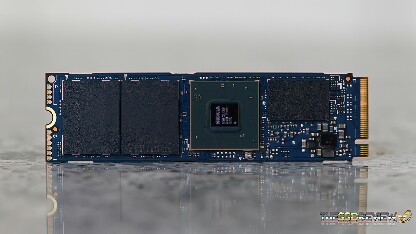
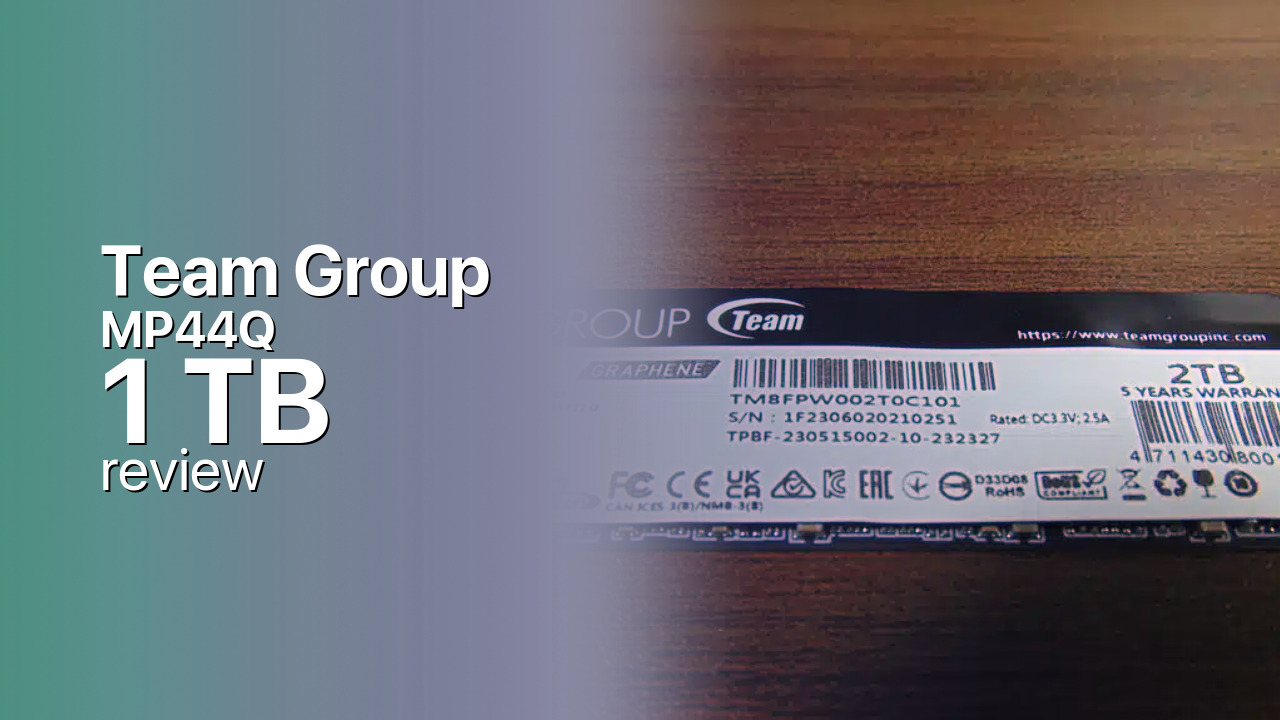
The Team Group MP44Q 1TB is TeamGroup's value answer to PCIe 4.0 storage: a DRAM-less M.2 2280 drive built on the Maxio MAP1602 controller with Host Memory Buffer, carrying YMTC's 232-layer 3D QLC NAND behind a graphene heat-dissipation label. TeamGroup rates it at 7,000 MB/s sequential reads and 5,900 MB/s writes over PCIe 4.0 x4 — numbers that belonged to flagship TLC drives only a few years ago and now headline a QLC budget line. The range spans 1 TB, 2 TB, 4 TB and 8 TB, and the speed ratings hold across every capacity.
The lineup's logic is simple: identical speed, endurance that scales with capacity. The 1 TB model is rated at 512 TBW (TeamGroup's product page rounds this to 500 TBW), the 2 TB doubles the budget to 1,024 TBW, and the 4 TB carries 2,048 TBW — all under one 5-year limited warranty. TechPowerUp lists the same hardware under the HP FX700, and the platform family extends to the Acer FA200 and Patriot Viper VP4300 Lite. The direct rivals are Crucial's P3 Plus and P310, which play the same QLC value game on Micron flash, and the WD Black SN770, which spends its budget on TLC NAND at lower rated speeds.
The audience is the buyer who wants PCIe 4.0 headline speed for a boot drive or a starter game library at the lowest cost per gigabyte. Tom's Hardware's review of the 2 TB family member landed on a three-star budget-winner verdict, praising power efficiency — a genuine advantage in laptops and consoles — while flagging the predictable QLC weakness in sustained writes. The graphene label keeps total height under 4 mm, so the drive meets Sony's PS5 size rules without an added heatsink, and there is no DRAM on the PCB by design.
Storage Comparisons:
MP44Q Performance & Benchmarks
TeamGroup rates the 1 TB MP44Q at 7,000 MB/s sequential reads and 5,900 MB/s writes, figures shared by every capacity in the range. No random IOPS rating is published, so anything beyond the sequential numbers comes down to platform behavior. In practice, 7,000 MB/s reads load operating systems and games with no perceptible penalty against costlier TLC drives, and Tom's Hardware's testing of the 2 TB family member found the MP44Q outscoring TLC rivals such as the Kingston NV3, TeamGroup's own MP44 and the WD Black SN770 in 3DMark and PCMark storage benchmarks — a genuinely surprising result for a QLC drive.
Team Group MP44Q 1 TB vs M.2 4.0 x 4 peers
Switch between sequential throughput and random IOPS to see how this drive stacks up against other M.2 4.0 x 4 SSDs in our database. The highlighted bar is the drive on this page — click any other bar to open that drive.
- Patriot Viper PV593 1 TB: 14,500 MB/s read, 14,000 MB/s write
- Patriot Viper PV593 2 TB: 14,500 MB/s read, 14,000 MB/s write
- Patriot Viper PV593 4 TB: 14,500 MB/s read, 14,000 MB/s write
- Patriot Viper PV573 2 TB: 14,000 MB/s read, 12,000 MB/s write
- Team Group MP44Q 1 TB (this drive): 7,000 MB/s read, 5,900 MB/s write
The fine print is the SLC cache. The MP44Q uses a large dynamic pseudo-SLC cache — roughly a quarter of the 2 TB model's capacity, per Tom's Hardware's measurements — which absorbs huge burst writes before throughput drops hard once the cache exhausts. Tom's Hardware measured the 2 TB model writing at 5.75 GB/s for 86 seconds, then falling to around 103 MB/s while cached data folded back into QLC. For boot drives, game installs and daily desktop work that wall never appears; for 100 GB-plus video projects or constant backup runs, a TLC drive is the safer tool. Power efficiency is the quiet strength — YMTC's QLC drew specific praise for low power draw, and the drive peaked at 56 degrees Celsius in write testing, comfortably clear of throttling.
Team Group MP44Q vs Competitors
See how the MP44Q stacks up against other M.2 4.0 x 4 drives in our database:
Compare with rival drives:
Endurance, TBW & Warranty
Team Group covers the MP44Q 1TB with a 5-year limited warranty rated at 512 TBW of writes — the product page rounds the same figure to 500 TBW — and whichever limit arrives first ends the coverage. At a modest 20 GB written per day, that budget stretches past seven decades, so the warranty term is the realistic ceiling rather than flash wear. The 2 TB and 4 TB models scale to 1,024 TBW and 2,048 TBW on identical terms. The rated MTBF of 1.6 million hours is a population statistic across the fleet, not a promise for any individual drive, but it sits near the top of the consumer tier. Claims run through TeamGroup's regional service network with standard proof-of-purchase.
Team Group MP44Q 1 TB Specifications
| Category | Value |
|---|---|
| Capacity [?] | 1 TB |
| Interface [?] | M.2 4.0 x 4 |
| Controller [?] | Maxio MAP1602 |
| Memory type [?] | 232-layer 3D QLC |
| DRAM [?] | No |
| Read speed (MB/s) [?] | 7000 |
| Write speed (MB/s) [?] | 5900 |
| Read IOPS [?] | n/a |
| Write IOPS [?] | n/a |
| Endurance (TBW) [?] | 512 |
| MTBF (million hours) [?] | 1600000 |
| Warranty (years) [?] | 5 |
Verdict: Is the MP44Q Worth It in 2026?
The Team Group MP44Q 1TB is the right buy when headline Gen4 speed matters more than NAND pedigree: a boot drive or starter game library that loads at 7,000 MB/s for QLC money, backed by five years of coverage. Skip it for sustained heavy writing, because post-cache QLC throughput is a known weak point — the Crucial P310 or WD Black SN770 handle constant large transfers far better. The Crucial P3 Plus 1TB is the closest spec-for-spec QLC rival, at lower rated speed. As a budget pick that beat TLC competition in Tom's Hardware's productivity testing, the MP44Q 1TB has earned a permanent and easy-to-recommend spot in the value tier.
+ Pros
- Rated 7,000 MB/s reads and 5,900 MB/s writes
- 5-year warranty with 512 TBW endurance
- Low power draw confirmed in Tom's Hardware testing
- Beat TLC rivals in 3DMark and PCMark storage tests
- 3.7 mm single-sided PCB fits PS5 and thin laptops
- Cons
- Writes fall to roughly 100 MB/s after SLC cache exhausts
- No DRAM on the PCB — Host Memory Buffer only
- Random IOPS figures not published
- Graphene label instead of a full-size heatsink
Buy this or similar SSD Storage:



Video Review
TEAMGROUP MP44Q Review 2026 - Don't Waste your Money...