TeamGroup T-Force G50 1TB Review — The Lineup's Sweet Spot (2026)
Quick answer
The TeamGroup T-Force G50 1TB is the version of this drive worth buying: it carries the family's fastest write rating, double the endurance of the 512GB, and a graphene heat spreader in the box, all in a DRAM-less TLC build that reviewers keep scoring as a value pick.
Read: 5000 MB/s Write: 4800 MB/s Endurance: 650 TBW Warranty: 5 years Interface: M.2 4.0 x 4
The TeamGroup T-Force G50 1TB is the sweet spot of the G50 range, pairing 5,000 MB/s reads with the family's fastest write rating and 650 TBW of endurance.
Controller & Memory
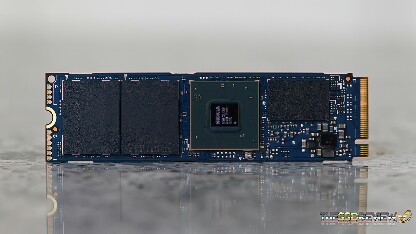
Inside, the TeamGroup T-Force G50 1TB runs the same platform as the rest of the family: an InnoGrit IG5220 (RainierQX) controller in a DRAM-less configuration that leans on Host Memory Buffer, paired with YMTC 128-layer 3D TLC NAND — a combination The FPS Review verified by reading the flash part numbers on the board. The single-sided M.2 2280 PCB carries TeamGroup's patented ultra-thin graphene heat spreader, weighs 7 g installed, and slots into laptops, small-form-factor builds and the PS5 without clearance issues.
Capacity is where the 1TB earns its keep. The 512GB model writes at only 2,500 MB/s, the 2TB and 4TB at 4,500 MB/s, while the 1TB holds the family's top write rating of 4,800 MB/s with 650 TBW of endurance — a cleaner balance than any of its siblings. The DRAM-cached G50 Pro tops out at 2 TB, leaving this uncached range's centre of gravity at 1 TB. Reviewers consistently read the G50 as a value play rather than a speed play: TechPowerUp's 2TB review praised outstanding pricing for good-enough performance, PCWorld called it fast enough for the masses, and The FPS Review scored value a perfect ten while flagging thermals as the weak point.
Buyers are mainstream gamers and upgraders who want real Gen4 numbers for a boot drive plus a growing game library, or a scratch disk that mostly reads. Its natural rivals are the WD Blue SN580 and Kingston NV3 in the same DRAM-less TLC bracket, with Crucial's QLC-based P3 Plus undercutting on price and endurance alike.
Storage Comparisons:
T-Force G50 Performance & Benchmarks
TeamGroup rates the G50 1TB at 5,000 MB/s sequential reads and 4,800 MB/s sequential writes over PCIe 4.0 x4, with 650 TBW of endurance behind it. Random IOPS ratings are not officially published for this drive, but family-level testing fills the picture: TechPowerUp's 2TB review measured reads near 4.5 GB/s and writes around 4.1 GB/s, still above 2.5 GB/s at realistic queue depths, and The FPS Review found game load times competitive with pricier Gen4 hardware. At 1 TB, the pseudo-SLC write cache is large enough that typical burst workloads stay at or near rated speeds.
Team Group T-Force G50 1 TB vs M.2 4.0 x 4 peers
Switch between sequential throughput and random IOPS to see how this drive stacks up against other M.2 4.0 x 4 SSDs in our database. The highlighted bar is the drive on this page — click any other bar to open that drive.
- Patriot Viper PV593 1 TB: 14,500 MB/s read, 14,000 MB/s write
- Patriot Viper PV593 2 TB: 14,500 MB/s read, 14,000 MB/s write
- Patriot Viper PV593 4 TB: 14,500 MB/s read, 14,000 MB/s write
- Patriot Viper PV573 2 TB: 14,000 MB/s read, 12,000 MB/s write
- Team Group T-Force G50 1 TB (this drive): 5,000 MB/s read, 4,800 MB/s write
Real-world behavior splits by workload. Boot times, game loading and level streaming are read-dominated and effectively indistinguishable from 7,000 MB/s drives in the same system. Large sustained transfers are the weak spot: once the cache fills, throughput settles to native TLC rates, and The FPS Review noted the controller runs toasty in sustained writes, recommending a motherboard heatsink for heavy sessions. The DRAM-less design shows in heavy multitasking — hundreds of parallel small writes — rather than in gaming, where queue depths stay low. For boot-and-games duty, this drive delivers almost exactly what its ratings promise.
Team Group T-Force G50 vs Competitors
See how the T-Force G50 stacks up against other M.2 4.0 x 4 drives in our database:
Compare with rival drives:
Endurance, TBW & Warranty
TeamGroup covers the G50 1TB with a 5-year limited warranty rated to 650 TBW of host writes, whichever comes first. The rating scales cleanly across the range at 0.65 TBW per gigabyte: 325 TBW at 512GB, 650 TBW here, and 1,300 TBW at 2 TB. At a moderate 20 GB of writes per day, the 650 TBW budget stretches to roughly 89 years, so the five-year calendar term is the practical limit for any normal desktop workload. The spec sheet lists MTBF at 3,000,000 hours — a population-level reliability statistic, not a lifespan promise for an individual drive. Support runs through TeamGroup's service channels with proof of purchase, backed by a repair-and-exchange network the company maintains through its global distributors.
Team Group T-Force G50 1 TB Specifications
| Category | Value |
|---|---|
| Capacity [?] | 1 TB |
| Interface [?] | M.2 4.0 x 4 |
| Controller [?] | InnoGrit IG5220 |
| Memory type [?] | YMTC 128-layer 3D TLC |
| DRAM [?] | No |
| Read speed (MB/s) [?] | 5000 |
| Write speed (MB/s) [?] | 4800 |
| Read IOPS [?] | 520000 |
| Write IOPS [?] | 480000 |
| Endurance (TBW) [?] | 650 |
| MTBF (million hours) [?] | 3000000 |
| Warranty (years) [?] | 5 |
Verdict: Is the T-Force G50 Worth It in 2026?
The TeamGroup T-Force G50 1TB is the version of this drive worth buying: it carries the family's fastest write rating, double the endurance of the 512GB, and a graphene heat spreader in the box, all in a DRAM-less TLC build that reviewers keep scoring as a value pick. Skip it for sustained write-heavy or multitasking workloads — the lack of DRAM shows there, and the DRAM-cached G50 Pro handles those better. The WD Blue SN580 1TB is the direct rival with faster rated writes; the Kingston NV3 undercuts it. For boot-plus-games Gen4 duty on a budget, we would pick this 1TB over any other capacity in the range. Its rated numbers are honest, its endurance scales cleanly across the range, and its independent review trail is unusually complete for a value drive.
+ Pros
- 5,000/4,800 MB/s rated reads and writes
- 650 TBW endurance with 5-year warranty
- Fastest write rating in the G50 range
- Graphene heat spreader included in the box
- Single-sided PCB fits laptops and PS5
- Real TLC NAND in a value-tier drive
- Cons
- No DRAM cache — Host Memory Buffer only
- Reads trail 7,000 MB/s Gen4 drives
- Sustained writes settle after the SLC cache
- Controller runs warm under sustained load
- No official random IOPS rating published
Buy this or similar SSD Storage:



Video Review
TEAMGROUP T-FORCE G50 1TB - Up For Some Speed Benchmarks!