Western Digital Blue SN580 1TB Review — Budget Gen4, Refined and Efficient (2026)
Quick answer
The Western Digital Blue SN580 1TB is the purchase to make from its line: full 4,150/4,100 MB/s ratings, the family-peak 600K random-read figure, 600 TBW of endurance and five years of coverage at a budget-tier positioning.
Read: 4150 MB/s Write: 4100 MB/s Endurance: 600 TBW Warranty: 5 years Interface: M.2 4.0 x 4
The sweet spot of WD's budget Gen4 line, the Western Digital Blue SN580 1TB holds the family's full 4,150 MB/s rating with 600 TBW behind it.
Controller & Memory
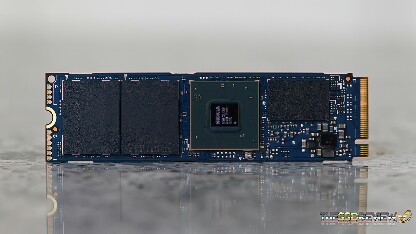
The Western Digital Blue SN580 1TB is the configuration of WD's budget PCIe 4.0 line where nothing is held back. The formula is proven rather than new: a SanDisk in-house four-channel DRAM-less controller shared across the SN350-to-SN770 budget family and clocked below the SN770's, a single 8 Tbit package of Kioxia BiCS5 112-layer TLC on the 1 TB board, Host Memory Buffer for the mapping tables, and the nCache 4.0 hybrid SLC caching scheme inherited from the WD Black SN850. Ratings are the family headline: 4,150 MB/s sequential reads, 4,100 MB/s writes, 600K random-read and 750K random-write IOPS on a single-sided M.2 2280 board.
This capacity is the line's balance point. The 500 GB variant drops to 4,000/3,600 with 450K random reads and 300 TBW; the 2 TB keeps the speeds but raises endurance to only 900 TBW. At 1 TB the drive carries the full 600K random-read rating and 600 TBW of endurance — figures Tom's Hardware and StorageReview both confirm — under the 5-year limited warranty. TechPowerUp's teardown of the 1 TB found an SLC cache more than 25 times larger than the SN570's, and Tom's Hardware highlighted efficiency as the family's real gain over its predecessor, a trait laptop buyers feel in battery life.
The bracket is crowded: Kingston's NV2 undercuts on price with a QLC-or-TLC parts lottery, and the Crucial P3 Plus commits to QLC outright. The SN580 1TB's pitch is TLC certainty, brand validation and a 5-year warranty — an unexciting but capable budget NVMe SSD, in Tom's Hardware's own words, and better for it.
Storage Comparisons:
Blue SN580 Performance & Benchmarks
WD rates the 1TB SN580 at 4,150 MB/s sequential reads, 4,100 MB/s writes, 600K random-read and 750K random-write IOPS. Independent coverage of exactly this capacity is deep: Tom's Hardware's full review characterised it as an unexciting but capable budget NVMe SSD, StorageReview's Blackmagic testing measured real-world throughput around 3,200 MB/s — below the rating ceiling, as expected at this tier — and TechPowerUp's review documented the platform's huge SLC-cache increase over the SN570. In practice, 4,150 MB/s reads make Windows boots, application launches and game loading indistinguishable from 7,000 MB/s-class drives.
Western Digital Blue SN580 1 TB vs M.2 4.0 x 4 peers
Switch between sequential throughput and random IOPS to see how this drive stacks up against other M.2 4.0 x 4 SSDs in our database. The highlighted bar is the drive on this page — click any other bar to open that drive.
- Patriot Viper PV593 1 TB: 14,500 MB/s read, 14,000 MB/s write
- Patriot Viper PV593 2 TB: 14,500 MB/s read, 14,000 MB/s write
- Patriot Viper PV593 4 TB: 14,500 MB/s read, 14,000 MB/s write
- Patriot Viper PV573 2 TB: 14,000 MB/s read, 12,000 MB/s write
- Western Digital Blue SN580 1 TB (this drive): 4,150 MB/s read, 4,100 MB/s write
The DRAM-less convention applies to sustained writes: nCache 4.0 absorbs install-sized bursts at rated speed, and very large transfers eventually settle to native TLC rates once the cache fills — though the 1 TB cache is large enough that most consumer workloads never see the floor. The 750K random-write rating keeps the OS volume responsive under mixed small-file traffic, and DirectStorage titles benefit from the clean Gen4 read path. Efficiency is the differentiator Tom's Hardware emphasised: this drive draws less power than many rivals, which matters in laptops. Thermals need no management beyond a motherboard's standard slot placement — a low-power single-sided design with no heatsink required.
Western Digital Blue SN580 vs Competitors
See how the Blue SN580 stacks up against other M.2 4.0 x 4 drives in our database:
Compare with rival drives:
Endurance, TBW & Warranty
WD backs the SN580 1TB with a 5-year limited warranty rated to 600 TBW of writes, whichever arrives first — the same coverage pattern across the family, scaled from 300 TBW at the small capacity to 900 TBW at 2 TB. Six hundred terabytes allows roughly 32 GB of writes per day across the warranty term, and at the 10-20 GB per day typical of a boot-and-games drive, the budget outlives any realistic ownership period; the 5-year term is the practical limit. That coverage length is the standout in the budget tier, where 3-year warranties are common. Support runs through WD's standard channels, with the WD Dashboard utility handling firmware updates and drive-health monitoring.
Western Digital Blue SN580 1 TB Specifications
| Category | Value |
|---|---|
| Capacity [?] | 1 TB |
| Interface [?] | M.2 4.0 x 4 |
| Controller [?] | SanDisk (WD in-house) |
| Memory type [?] | BiCS 5 112-layer 3D TLC |
| DRAM [?] | No |
| Read speed (MB/s) [?] | 4150 |
| Write speed (MB/s) [?] | 4100 |
| Read IOPS [?] | 600000 |
| Write IOPS [?] | 750000 |
| Endurance (TBW) [?] | 600 |
| MTBF (million hours) [?] | n/a |
| Warranty (years) [?] | 5 |
Verdict: Is the Blue SN580 Worth It in 2026?
The Western Digital Blue SN580 1TB is the purchase to make from its line: full 4,150/4,100 MB/s ratings, the family-peak 600K random-read figure, 600 TBW of endurance and five years of coverage at a budget-tier positioning. Skip it if speed is the point — the SN5000 successor rates a full 1,000 MB/s faster for similar money at retail — or if raw price per terabyte leads the decision, where Kingston's NV2 and the QLC Crucial P3 Plus usually win on the sticker at the cost of certainty. As a TLC-certain, efficient, well-warrantied boot-and-games drive with documented per-capacity ratings behind it, this is the budget Gen4 default done properly and honestly.
+ Pros
- Full family ratings: 4,150/4,100 MB/s
- 600K random-read IOPS — the line's peak
- 600 TBW endurance with 5-year warranty
- TLC NAND, no QLC parts lottery
- Efficient DRAM-less design suits laptops
- Cons
- No DRAM cache on the PCB
- 4,150 MB/s trails mid-range Gen4 drives by half
- Successor SN5000 is faster for similar retail money
- Sustained writes settle after the SLC cache fills
Buy this or similar SSD Storage:



Video Review
The WD Blue SN580 may be the ideal cost conscious option for your next SSD #pcmr