Western Digital WD SN5100 1TB Review — The New Value Benchmark (2026)
Quick answer
The Western Digital WD SN5100 1TB suits the buyer who wants full Gen4 speed, real 600 TBW endurance and minimal power draw in the single slot a laptop or compact desktop actually has.
Read: 7100 MB/s Write: 6700 MB/s Endurance: 600 TBW Warranty: 5 years Interface: M.2 4.0 x 4
The Western Digital WD SN5100 1TB pushes 7,100 MB/s reads and 6,700 MB/s writes from DRAM-less QLC hardware, with 600 TBW endurance and a 5-year warranty.
Controller & Memory
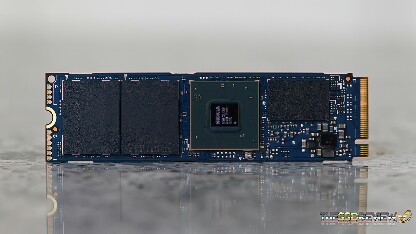
The Western Digital WD SN5100 1TB is the first capacity in the family to run at full rated speed, and it arrives with an unusual endorsement: TechPowerUp's review of the platform called it the fastest QLC SSD the site has ever tested, with behavior comparable to the Samsung 980 Pro and Kingston KC3000. The hardware is a single-sided M.2 2280 board on PCIe 4.0 x4 and NVMe 2.0 — SanDisk's Polaris 3 controller, 218-layer BiCS8 3D QLC NAND in CMOS-bonded-array form, up to 64 MB of Host Memory Buffer in place of DRAM, and SanDisk's nCache 4.0 hybrid pseudo-SLC write cache. After the Western Digital and SanDisk consolidation, the same drive sells under both brands.
At 1 TB the ratings are 7,100 MB/s sequential reads and 6,700 MB/s writes, with 1,000K random reads and 1,300K random writes, and 600 TBW of endurance under a 5-year warranty. The 500 GB variant steps down to 6,600/5,600 MB/s, the 2 TB matches this capacity while raising endurance to 900 TBW, and the 4 TB trades a little read speed for 1,200 TBW. StorageReview's testing of the 2 TB sibling measured 7,329/6,740 MB/s — above rating — and highlighted idle draw of just 4 milliwatts, the trait that has made this family a laptop-upgrade favorite.
The buyer here wants one drive for everything in a machine that sips power: a laptop's single slot, a compact desktop, a growing game library. The honest comparison is internal — WD's TLC-based SN7100, which Tom's Hardware found cheaper at review time and called the better drive, writes more gracefully under sustained load — while Crucial's P310 is the external QLC rival that wins random reads but loses sequential burst. For sequential throughput per watt at the 1 TB sweet spot, the numbers are hard to argue with.
Storage Comparisons:
WD SN5100 Performance & Benchmarks
Western Digital rates the 1 TB SN5100 at 7,100 MB/s sequential reads, 6,700 MB/s writes, 1,000K random reads and 1,300K random writes. Independent testing of the platform backs the claims: StorageReview measured 7,329 MB/s reads and 6,740 MB/s writes on the 2 TB sibling, TechPowerUp judged the family the fastest QLC design it has benchmarked, and Tom's Hardware's 2 TB review opened with the words best QLC SSD we have tested. For a drive built on four-bit flash, that is remarkable company.
Western Digital WD SN5100 1 TB vs M.2 4.0 x 4 peers
Switch between sequential throughput and random IOPS to see how this drive stacks up against other M.2 4.0 x 4 SSDs in our database. The highlighted bar is the drive on this page — click any other bar to open that drive.
- Patriot Viper PV593 1 TB: 14,500 MB/s read, 14,000 MB/s write
- Patriot Viper PV593 2 TB: 14,500 MB/s read, 14,000 MB/s write
- Patriot Viper PV593 4 TB: 14,500 MB/s read, 14,000 MB/s write
- Patriot Viper PV573 2 TB: 14,000 MB/s read, 12,000 MB/s write
- Western Digital WD SN5100 1 TB (this drive): 7,100 MB/s read, 6,700 MB/s write
Day to day, 7,100 MB/s reads mean boot screens, game loads and application launches feel identical to pricier TLC drives; sequential burst matters less than the random behavior these ratings support. The nCache 4.0 pseudo-SLC buffer absorbs burst writes, and Tom's Hardware's saturation test on the 2 TB model showed the cache holding roughly 6.45 GB/s for over a minute before throughput dropped — an unusually large and capable buffer for QLC. Sustained, cache-empty writing is the one real weakness, settling well below the burst figure. Power efficiency is the other headline: roughly 4 watts active and 4 milliwatts idle, figures that put the drive among the gentlest full-speed Gen4 options for battery-powered machines.
Western Digital WD SN5100 vs Competitors
See how the WD SN5100 stacks up against other M.2 4.0 x 4 drives in our database:
Compare with rival drives:
Endurance, TBW & Warranty
Western Digital backs the SN5100 1TB with a 5-year limited warranty rated to 600 TBW of writes, whichever arrives first — the family ladder runs 300 TBW at 500 GB, 600 TBW here, 900 TBW at 2 TB and 1,200 TBW at 4 TB. Six hundred terabytes covers about 80 GB of daily writes for twenty years, far beyond typical laptop or desktop workloads, so the calendar term is the practical limit. QLC cells hold four bits and wear faster than TLC, which is why budget QLC drives carry these ratings, but Tom's Hardware noted the TBW figure is a warranty boundary, not an expected failure point. Claims run through Western Digital's standard support channels with proof of purchase.
Western Digital WD SN5100 1 TB Specifications
| Category | Value |
|---|---|
| Capacity [?] | 1 TB |
| Interface [?] | M.2 4.0 x 4 |
| Controller [?] | SanDisk Polaris 3 |
| Memory type [?] | BiCS8 218-layer 3D QLC |
| DRAM [?] | No |
| Read speed (MB/s) [?] | 7100 |
| Write speed (MB/s) [?] | 6700 |
| Read IOPS [?] | 1000000 |
| Write IOPS [?] | 1300000 |
| Endurance (TBW) [?] | 600 |
| MTBF (million hours) [?] | n/a |
| Warranty (years) [?] | 5 |
Verdict: Is the WD SN5100 Worth It in 2026?
The Western Digital WD SN5100 1TB suits the buyer who wants full Gen4 speed, real 600 TBW endurance and minimal power draw in the single slot a laptop or compact desktop actually has. Game libraries, boot duty and general desktop loads are exactly its territory. Skip it for sustained-write duties — daily large video exports belong on the TLC-based WD Black SN7100, which Tom's Hardware found cheaper at review and called the better drive — and Crucial's P310 remains the rival for random-read-heavy desktop work. As the first full-speed capacity in the fastest QLC platform TechPowerUp has ever tested, this drive makes QLC a default rather than a compromise for mainstream builds.
+ Pros
- 7,100 MB/s reads and 6,700 MB/s writes rated
- 600 TBW endurance with 5-year warranty
- 4 mW idle, roughly 4 W active draw
- Fastest QLC platform in TechPowerUp testing
- 1,000K random reads, 1,300K random writes rated
- Single-sided board with TCG Pyrite security
- Cons
- QLC sustained writes fall well below burst speed
- No DRAM cache; HMB only
- Random reads trail Crucial's P310 in StorageReview testing
- Ships without a heatsink
- TLC-based SN7100 listed lower at review time
Buy this or similar SSD Storage:
Video Review
WD Blue SN5100 1TB NVMe SSD