Western Digital WD SN7100 1TB Review — Mainstream Gen4, Masterfully Efficient (2026)
Quick answer
The Western Digital WD SN7100 1TB is the sweet spot of its family: full 7,250/6,900 MB/s speed, 600 TBW of endurance, five years of warranty and the best power efficiency Tom's Hardware has measured in a consumer SSD, at the capacity most PCs actually need.
Read: 7250 MB/s Write: 6900 MB/s Endurance: 600 TBW Warranty: 5 years Interface: M.2 4.0 x 4
The Western Digital WD SN7100 1TB rates 7,250 MB/s reads and 6,900 MB/s writes on PCIe 4.0, with 600 TBW endurance and record-setting power efficiency.
Controller & Memory
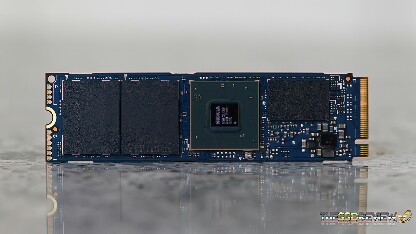
The Western Digital WD SN7100 1TB is the capacity most buyers should choose in the drive Tom's Hardware calls the new power-efficiency champion of consumer SSDs. The platform is a single-sided M.2 2280 board on PCIe 4.0 x4 and NVMe 1.4: SanDisk's in-house Polaris 3 controller, 218-layer BiCS8 3D TLC NAND built with CMOS-bonded-array technology, and no DRAM chip — mapping tables live in system memory through the Host Memory Buffer, while a pseudo-SLC cache absorbs burst writes. After the Western Digital and SanDisk brand consolidation, identical hardware appears under both names; the spec sheet remains the reliable guide.
At 1 TB the drive runs at full family speed: 7,250 MB/s sequential reads, 6,900 MB/s writes, 1,000K random reads and 1,400K random writes rated, with 600 TBW of endurance under a 5-year warranty. That mirrors the 2 TB model exactly and outruns the 500 GB variant's 6,800/5,800 MB/s ratings, while a 4 TB model added after launch trades a little speed for 2,400 TBW. PC Gamer's review of precisely this capacity scored it 92/100, measured 7,116 MB/s reads in CrystalDiskMark, recorded 101 MB/s of queued 4K reads — the best its reviewer had tested — and logged a maximum of 48 degrees Celsius under a motherboard heatsink.
The audience is broad: a boot drive for a gaming PC, a single-drive build, a laptop upgrade, or a PS5 storage expansion for which the rated speed clears Sony's 5,500 MB/s guidance (add a slim heatsink). Against rivals, WD's own SN850X flagship keeps its DRAM cache and double-sided board but is three years older; Samsung's 990 EVO Plus and Lexar's NM790 compete directly in the DRAM-less Gen4 bracket. PC Gamer's verdict — perfect for any gaming PC or console — summarizes the positioning cleanly.
Storage Comparisons:
WD SN7100 Performance & Benchmarks
Western Digital rates the 1 TB SN7100 at 7,250 MB/s sequential reads and 6,900 MB/s writes, with 1,000K random reads and 1,400K random writes — and unlike most spec sheets, these numbers survive independent testing. PC Gamer's CrystalDiskMark results on this exact capacity came in at 7,116 MB/s reads and 6,820 MB/s writes, essentially on the rating, while its 4K queued read figure of 101 MB/s topped every drive the reviewer had measured, including PCIe 5.0 hardware in that discipline. Tom's Hardware's platform testing reached the same conclusion from another direction: the SN7100 sits at the top of its power-efficiency charts, doing more work per watt than anything else in its consumer lineup.
Western Digital WD SN7100 1 TB vs M.2 4.0 x 4 peers
Switch between sequential throughput and random IOPS to see how this drive stacks up against other M.2 4.0 x 4 SSDs in our database. The highlighted bar is the drive on this page — click any other bar to open that drive.
- Patriot Viper PV593 1 TB: 14,500 MB/s read, 14,000 MB/s write
- Patriot Viper PV593 2 TB: 14,500 MB/s read, 14,000 MB/s write
- Patriot Viper PV593 4 TB: 14,500 MB/s read, 14,000 MB/s write
- Patriot Viper PV573 2 TB: 14,000 MB/s read, 12,000 MB/s write
- Western Digital WD SN7100 1 TB (this drive): 7,250 MB/s read, 6,900 MB/s write
In use, that translates to instant-feeling loads: operating systems, games and applications open with no perceptible difference from drives rated a thousand megabytes faster, because random behavior — this platform's strength — dominates those tasks. Writes hold 6,900 MB/s for bursts through the pseudo-SLC cache; very large sustained transfers eventually settle to native TLC rates once the cache fills, which matters mainly for repeated multi-hundred-gigabyte video workflows. Thermals are a genuine strong point: 48 degrees Celsius under a motherboard heatsink in PC Gamer's testing means the drive runs comfortably bare in most desktops and laptops.
Western Digital WD SN7100 vs Competitors
See how the WD SN7100 stacks up against other M.2 4.0 x 4 drives in our database:
Compare with rival drives:
Endurance, TBW & Warranty
Western Digital covers the SN7100 1TB for five years or 600 TBW of written data, whichever arrives first — endurance scaled at 600 TBW per terabyte across the family, from 300 TBW at 500 GB to 1,200 TBW at 2 TB and 2,400 TBW on the 4 TB model. Six hundred terabytes equates to roughly 80 GB of writes daily for twenty years, several times the workload of a typical gaming PC, so the 5-year calendar term is the realistic boundary. Tom's Hardware judged the coverage competitive for the class, and the TLC NAND underneath wears far slower than the QLC flash in cheaper drives. Claims are handled through Western Digital's standard support process with proof of purchase.
Western Digital WD SN7100 1 TB Specifications
| Category | Value |
|---|---|
| Capacity [?] | 1 TB |
| Interface [?] | M.2 4.0 x 4 |
| Controller [?] | SanDisk Polaris 3 |
| Memory type [?] | BiCS8 218-layer 3D TLC |
| DRAM [?] | No |
| Read speed (MB/s) [?] | 7250 |
| Write speed (MB/s) [?] | 6900 |
| Read IOPS [?] | 1000000 |
| Write IOPS [?] | 1400000 |
| Endurance (TBW) [?] | 600 |
| MTBF (million hours) [?] | n/a |
| Warranty (years) [?] | 5 |
Verdict: Is the WD SN7100 Worth It in 2026?
The Western Digital WD SN7100 1TB is the sweet spot of its family: full 7,250/6,900 MB/s speed, 600 TBW of endurance, five years of warranty and the best power efficiency Tom's Hardware has measured in a consumer SSD, at the capacity most PCs actually need. Skip it if an SN850X already sits in the system — PC Gamer's verdict was that existing flagship owners gain little — or if sustained multi-terabyte writes dominate the workload, where DRAM-cached drives still cope better. Samsung's 990 EVO Plus and Lexar's NM790 are the direct alternatives, and the WD Black SN850X remains the enthusiast step-up. For everyone building a fresh PC in 2026, this drive is the mainstream Gen4 default.
+ Pros
- 7,250 MB/s reads and 6,900 MB/s writes rated
- 600 TBW endurance with 5-year warranty
- Best power efficiency Tom's Hardware has measured
- PC Gamer 92/100: 101 MB/s queued 4K reads
- Runs at 48 degrees C under a motherboard heatsink
- Single-sided M.2 2280 fits thin laptops
- Cons
- No DRAM cache on the PCB
- Ships without a heatsink
- 4K random writes trail the SN850X
- Game loads trail DRAM-cached drives in PC Gamer testing
- Sustained writes drop to TLC rates past the pSLC cache
Buy this or similar SSD Storage:



Video Review
Best and Easy PC Upgrade - WD_Black SN7100 NVMe SSD #pc #storage #ssd #gaming