What the Klevv CRAS C930 1TB offers mainstream builders (2026)
Quick answer
For buyers wanting flagship-generation numbers without flagship pricing, the CRAS C930 1TB threads the needle: true DRAM cache, 7,400 MB/s-class reads, above-average endurance and a heatsink in the box.
Read: 7400 MB/s Write: 6400 MB/s Endurance: 750 TBW Warranty: 5 years Interface: M.2 4.0 x 4
The Klevv CRAS C930 1TB brings genuine DRAM caching and near-ceiling PCIe 4.0 speed to the midrange, backed by 750 TBW and a five-year warranty.
Controller & Memory
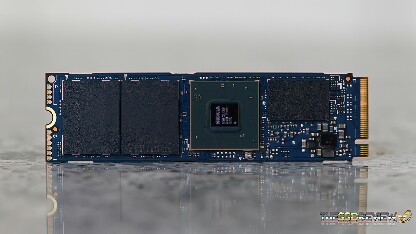
Launched in late 2022 yet still current in KLEVV's lineup, the CRAS C930 pairs InnoGrit's IG5236 - a 12nm eight-channel controller codenamed Rainier - with SK hynix's 176-layer V7 TLC flash under Essencore branding and, unlike its budget siblings, a dedicated DRAM cache. This 1TB model carries a 1GB Nanya LPDDR4-4266 chip holding the mapping tables, which steadies latency during heavy multitasking and mixed workloads. Everything runs over PCIe 4.0 x4 with NVMe 1.4, protected by hardware LDPC correction and end-to-end CRC checks.
Capacity positioning shapes the ratings here: writes are quoted at 6,400 MB/s against the 2TB model's 6,800 MB/s, while both capacities share the same up-to-7,400 MB/s read ceiling and symmetric million-IOPS random targets. Endurance stands at 750 TBW - above the usual 600 TBW convention at this size - under a five-year limited warranty. The retail package includes an optional flat-fin aluminium heatsink you attach yourself; bare, the drive measures 3.2mm thin, while the fitted stack reaches 8.7mm - clearing the PlayStation 5's bay cover comfortably.
Reviewer consensus lands on competent rather than class-leading. Tom's Hardware appreciated the uncommon pairing of hynix V7 flash with tuned firmware yet found overall results ordinary, while GamesRadar+ averaged 7,327/6,795 MB/s across CrystalDiskMark runs and recommended the drive as a budget PS5 upgrade. Rivals include the Acer Predator GM7000 on the same controller family, alongside the Addlink A93 and Silicon Power XS70.
Storage Comparisons:
CRAS C930 Performance & Benchmarks
Rated figures reach 7,400 MB/s sequential reads and 6,400 MB/s sequential writes over PCIe 4.0 x4, alongside symmetric 1,000,000 random-read and random-write IOPS. Real testing supports the numbers credibly: GamesRadar+'s three-run CrystalDiskMark average landed within one percent of both ratings, while their PS5-reported figure settled at 6,408 MB/s - normal console formatting overhead and still far above Sony's recommendation. Tom's Hardware characterized performance as competent without leading its class, noting some latency quirks from pairing hynix flash with this InnoGrit controller.
Klevv CRAS C930 1 TB vs M.2 4.0 x 4 peers
Switch between sequential throughput and random IOPS to see how this drive stacks up against other M.2 4.0 x 4 SSDs in our database. The highlighted bar is the drive on this page — click any other bar to open that drive.
- Patriot Viper PV593 1 TB: 14,500 MB/s read, 14,000 MB/s write
- Patriot Viper PV593 2 TB: 14,500 MB/s read, 14,000 MB/s write
- Patriot Viper PV593 4 TB: 14,500 MB/s read, 14,000 MB/s write
- Patriot Viper PV573 2 TB: 14,000 MB/s read, 12,000 MB/s write
- Klevv CRAS C930 1 TB (this drive): 7,400 MB/s read, 6,400 MB/s write
The onboard DRAM changes the sustained story relative to cheaper HMB drives: heavy multitasking, thousands of small files and long mixed workloads hold composure because mapping data never competes with system memory bandwidth. Extended pure writes still ride the pseudo-SLC cache until it fills, then ease toward native TLC speed during folding recovery - standard mechanics, handled well. For gaming, office productivity and content consumption the gap versus costlier flagships is effectively invisible; where DRAM earns its keep is sustained professional workloads and older systems short on spare RAM.
Klevv CRAS C930 vs Competitors
See how the CRAS C930 stacks up against other M.2 4.0 x 4 drives in our database:
Compare with rival drives:
Endurance, TBW & Warranty
KLEVV covers the C930 line with a five-year limited warranty and rates this 1TB version at 750 TBW of host writes - above the industry-standard 600 TBW at this capacity, equivalent to roughly 0.4 drive writes per day across the term. At everyday volumes of 20-50 GB written daily, exhaustion lies decades away, and coverage simply ends at whichever limit arrives first. The protection stack includes hardware LDPC error correction, end-to-end CRC parity, SRAM error handling, global wear leveling and thermal throttling safeguards, all visible through S.M.A.R.T. reporting. AES-256 hardware encryption is supported, though buyers should note this is not the same as TCG Opal self-encryption management. An Acronis True Image activation key ships in the box; KLEVV publishes no MTBF statistic for this platform.
Klevv CRAS C930 1 TB Specifications
| Category | Value |
|---|---|
| Capacity [?] | 1 TB |
| Interface [?] | M.2 4.0 x 4 |
| Controller [?] | InnoGrit IG5236 8 Channel |
| Memory type [?] | SK Hynix 176-L TLC |
| DRAM [?] | Yes |
| Read speed (MB/s) [?] | 7400 |
| Write speed (MB/s) [?] | 6400 |
| Read IOPS [?] | 1000000 |
| Write IOPS [?] | 1000000 |
| Endurance (TBW) [?] | 750 |
| MTBF (million hours) [?] | 2000000 |
| Warranty (years) [?] | 5 |
Verdict: Is the CRAS C930 Worth It in 2026?
For buyers wanting flagship-generation numbers without flagship pricing, the CRAS C930 1TB threads the needle: true DRAM cache, 7,400 MB/s-class reads, above-average endurance and a heatsink in the box. It suits desktop gaming rigs and general upgrades especially well, and the detachable cooler makes PlayStation 5 installation straightforward. Skip it if your laptop demands a single-sided stick - the PCB carries chips on both faces - or if maximal sustained-write throughput matters professionally, where newer TLC flagships hold rated speeds longer. Against the QLC-based Crucial P3 Plus it trades a lower price for durability and DRAM consistency; against the pricier Samsung 980 Pro it concedes little that games or daily use would ever reveal.
+ Pros
- True DRAM cache (1GB LPDDR4-4266)
- Rated 7,400/6,400 MB/s sequential speeds
- 750 TBW endurance beats the 600 TBW norm
- Five-year limited warranty
- Detachable flat-fin heatsink included
- Cons
- Write rating trails the 2TB model by 400 MB/s
- Double-sided PCB complicates thin laptop slots
- Performance lands mid-pack despite premium specs
- Availability fluctuates noticeably by region
Buy this or similar SSD Storage:



Video Review
KLEVV CRAS C930 Review - Brilliant Results & Price!