Team Group T-Force G70 Pro 1TB Review — DRAM-Backed Gen4 Speed (2026)
Quick answer
Buy the Team Group T-Force G70 Pro 1TB if you want a DRAM-equipped PCIe 4.0 drive with flagship-class 7,400 MB/s reads, a 5-year warranty and PS5-ready cooling options, and can accept a 5,500 MB/s write rating.
Read: 7400 MB/s Write: 5500 MB/s Endurance: 740 TBW Warranty: 5 years Interface: M.2 4.0 x 4
The Team Group T-Force G70 Pro 1TB brings 7,400 MB/s Gen4 reads, a genuine DRAM cache and 740 TBW of endurance — with a 5,500 MB/s write rating as the one compromise.
Controller & Memory
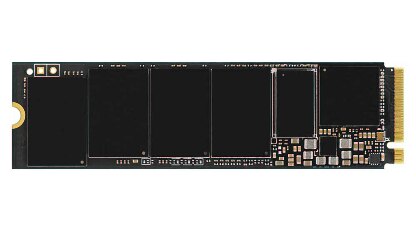
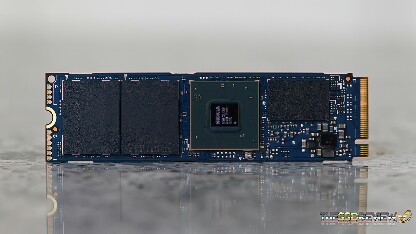
The Team Group T-Force G70 Pro 1TB is TEAMGROUP's implementation of the InnoGrit IG5236, the same eight-channel PCIe 4.0 controller that powers the Acer Predator GM7000 and the Lexar NM800 Pro. TeamGroup pairs it with 128-layer YMTC TLC NAND and — unusual for a drive at this tier — a full DRAM cache: 1 GB of Micron DDR4 on the 1 TB model. That DRAM-backed, double-sided M.2 2280 design is the drive's identity, and it launched in 2024 into the most crowded segment in storage, competing on latency and warranty support rather than raw peak numbers.
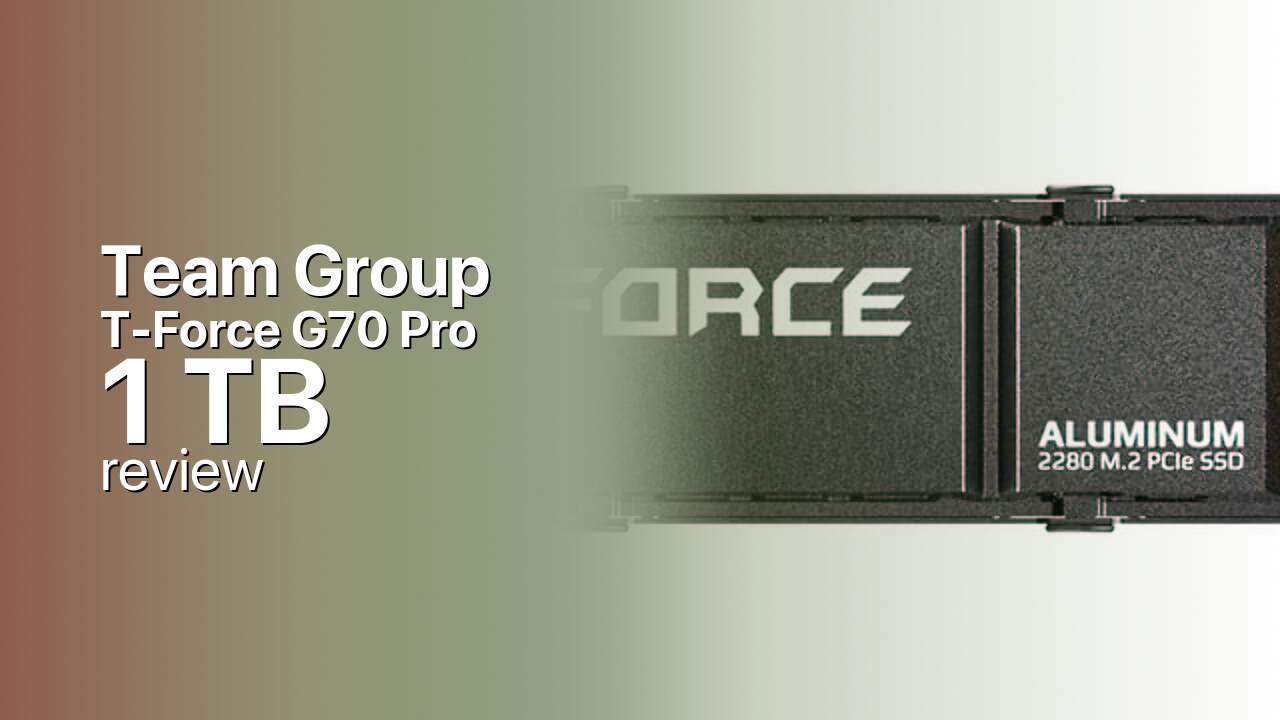
The range runs from 512 GB up to 8 TB, and the 1 TB variant is the first rung where the platform flexes: reads hit the full 7,400 MB/s rating, but writes are rated 5,500 MB/s — a step below the 6,800 MB/s of the 2 TB and the 6,600 MB/s of the 4 TB. Endurance scales the same way, from 740 TBW here to 1,480 TBW and 2,960 TBW on the bigger models. TeamGroup ships two factory cooling options, a patented ultra-thin graphene spreader (3.7 mm) and an aluminum heatsink (8.7 mm), both stated to meet Sony's PS5 heatsink regulations; the bare board also drops under a motherboard's own M.2 heatsink.
The audience is a builder who wants Gen4-flagship reads and real DRAM without flagship pricing, or a PS5 owner happy to fit a heatsink variant. The trade-offs are real: Tom's Hardware's 2 TB review praised excellent random read latency but flagged poor power efficiency, and TechPowerUp found the platform thermally throttles under heavy sustained load even with the aluminum cooler fitted. Against the Samsung 990 Pro or WD Black SN850X it gives up peak sustained performance; against DRAM-less value drives like the Kingston NV3 it bets on latency, DRAM and a 5-year warranty.
Storage Comparisons:
T-Force G70 Pro Performance & Benchmarks
TeamGroup rates the 1 TB G70 Pro at 7,400 MB/s sequential reads and 5,500 MB/s writes, with an SLC write cache layered on top of the DRAM. The company publishes no random IOPS figure for this drive, so the latency story comes from reviewers instead: Tom's Hardware measured excellent random read latency on the 2 TB model, with PC Mark results near the top of its comparison group for both bandwidth and latency — the profile that matters for game loading and application responsiveness rather than peak copy speeds.
Team Group T-Force G70 Pro 1 TB vs M.2 4.0 x 4 peers
Switch between sequential throughput and random IOPS to see how this drive stacks up against other M.2 4.0 x 4 SSDs in our database. The highlighted bar is the drive on this page — click any other bar to open that drive.
- Patriot Viper PV593 1 TB: 14,500 MB/s read, 14,000 MB/s write
- Patriot Viper PV593 2 TB: 14,500 MB/s read, 14,000 MB/s write
- Patriot Viper PV593 4 TB: 14,500 MB/s read, 14,000 MB/s write
- Patriot Viper PV573 2 TB: 14,000 MB/s read, 12,000 MB/s write
- Team Group T-Force G70 Pro 1 TB (this drive): 7,400 MB/s read, 5,500 MB/s write
In everyday work, 7,400 MB/s sits at the practical ceiling of PCIe 4.0, and the 5,500 MB/s write rating covers large game installs and batch file moves comfortably. The gap to the 2 TB model's 6,800 MB/s rating shows up mainly in very long sustained transfers, where a smaller NAND complement offers fewer parallel dies to write across. Like every SLC-cached drive, throughput settles once the write cache fills, and TechPowerUp's testing of the 2 TB sibling found the G70 Pro will thermally throttle under heavy sustained load even with its aluminum heatsink — an argument for a ventilated motherboard heatsink if sustained writes are routine. For boot times, game loads and daily desktop use in an aired case, none of it registers.
Team Group T-Force G70 Pro vs Competitors
See how the T-Force G70 Pro stacks up against other M.2 4.0 x 4 drives in our database:
Compare with rival drives:
Endurance, TBW & Warranty
TeamGroup backs the G70 Pro 1TB with a 5-year limited warranty rated to 740 TBW, whichever arrives first — the same terms as every capacity in the range, from 370 TBW on the 512 GB up to 2,960 TBW on the 4 TB. Seven hundred forty terabytes works out to roughly 400 GB of writes per day across the full warranty term, so at a typical 20-50 GB daily workload the NAND budget is effectively inexhaustible and the five-year clock is the real limit. TechPowerUp's database lists the model at 0.4 drive writes per day, matching the official figures. MTBF is rated at 3 million hours — a population statistic across many drives, not a promise about any single unit. Claims run through TeamGroup's standard RMA channels with proof of purchase.
Team Group T-Force G70 Pro 1 TB Specifications
| Category | Value |
|---|---|
| Capacity [?] | 1 TB |
| Interface [?] | M.2 4.0 x 4 |
| Controller [?] | Innogrit IG5236 8 Channel |
| Memory type [?] | YMTC 128-L TLC |
| DRAM [?] | Yes |
| Read speed (MB/s) [?] | 7400 |
| Write speed (MB/s) [?] | 5500 |
| Read IOPS [?] | n/a |
| Write IOPS [?] | n/a |
| Endurance (TBW) [?] | 740 |
| MTBF (million hours) [?] | 3000000 |
| Warranty (years) [?] | 5 |
Verdict: Is the T-Force G70 Pro Worth It in 2026?
Buy the Team Group T-Force G70 Pro 1TB if you want a DRAM-equipped PCIe 4.0 drive with flagship-class 7,400 MB/s reads, a 5-year warranty and PS5-ready cooling options, and can accept a 5,500 MB/s write rating. Skip it if sustained writing is your workload — the 2 TB model carries a higher write rating, and the Acer Predator GM7000 uses the same controller with a stronger cooling reputation. Thin laptops deserve a caveat too: the double-sided PCB and modest power efficiency led Tom's Hardware to call its 2 TB sibling a desktop powerhouse first. As the cheapest entry into this platform's full-speed read rating, the 1 TB is the sensible boot-and-games pick; heavy writers should step up a capacity.
+ Pros
- 7,400 MB/s sequential reads
- 1 GB Micron DDR4 DRAM cache
- 740 TBW endurance with 5-year warranty
- Graphene or aluminum heatsink options, PS5-ready
- Excellent random read latency in reviews
- Cons
- Write rating trails the 2TB model (5,500 vs 6,800 MB/s)
- Thermally throttles under heavy sustained load
- Double-sided PCB complicates thin-laptop fits
- No published random IOPS rating
- Poor power efficiency per Tom's Hardware
Buy this or similar SSD Storage:
Video Review
TEAMGROUP T-FORCE G70 PRO 1TB - Review